Preparando el informe

Cargando la información y las referencias disponibles

Consultando el registro arqueológico...

Recopilando registros antiguos

Saltar al contenido principal
Kurgans of the Southern Ural Sarmatians
Cultura destacada

Kurgans of the Southern Ural Sarmatians

Five kurgan burials (749–200 BCE) showing a steppe people at a genetic crossroads

749 CE - 200 BCE
Southern Urals, Russia
Desplázate para empezar
Capítulo I

La historia

Comprender la cultura Kurgans of the Southern Ural Sarmatians

Archaeological and genetic data from five Early Sarmatian burials in the Southern Urals (749–200 BCE) show a mix of steppe R paternal lineages and diverse maternal haplogroups (U, C1e, W3a, T). Limited samples mean conclusions are preliminary.

Time Period

749–200 BCE

Region

Southern Urals, Russia

Common Y-DNA

R (2 of 5)

Common mtDNA

U (2), C1e, W3a, T

Capítulo II

Cronología

Momentos clave de la historia de esta cultura

749 BCE

Earliest sampled burial

Earliest of the five sampled kurgan burials dated to 749 BCE in the Southern Urals (Avlasovo and related sites).

500 BCE

Early Sarmatian cultural florescence

Material culture and horse-centric burials reflect an emergent Early Sarmatian identity across the steppe.

200 BCE

Latest sampled burial

Latest of the sampled burials falls around 200 BCE, closing the sampled time window.

Capítulo III

Origins & Emergence

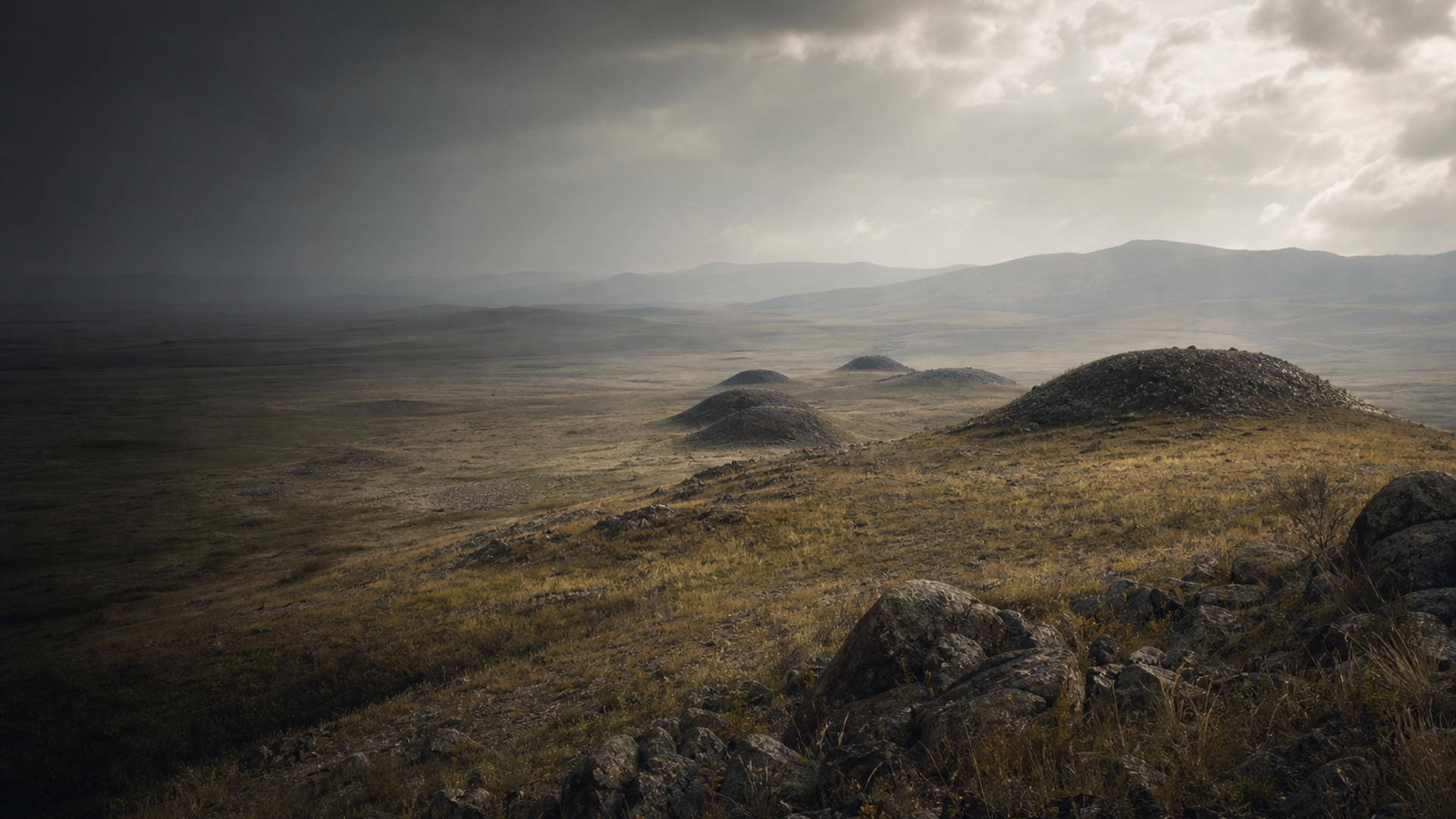
Along the rolling steppe fringes of the Southern Urals, low stone-ringed kurgans mark the graves of communities archaeologists identify with the Early Sarmatian horizon. Excavated mounds such as Avlasovo (Mound 3, burial 2), Sibai-1 (Mound 1, burial 1, skeleton 2), Novo-Muraptalovo-7, Perevolochan-2 and Ivanovka-1 contain typical Sarmatian burial practices: single interments, horse equipment, and occasional rich grave goods that narrate mobility, mounted warfare, and long-distance connections.

Archaeological data indicates these burials fall within a broad timeframe (749–200 BCE) when Sarmatian groups expanded west and south across the steppe from a core in the Pontic–Caspian regions. Material culture and funerary forms show continuity with earlier Scythian traditions but also innovations in equine gear and weaponry that mark a distinct Early Sarmatian identity. Limited evidence from the Southern Urals suggests local adaptation to a landscape of river valleys and open steppe where seasonal herding and horse-focused life shaped social organization.

Because only five well-preserved sampled burials inform the genetic picture, interpretations of population origins must remain cautious. These individuals offer a tantalizing glimpse into the biological makeup of Early Sarmatian communities, while archaeological context provides the cultural frame: mobile horse societies, kurgan funerary rites, and webs of exchange stretching across Eurasia.

  • Kurgan burials at Avlasovo, Sibai-1, Novo-Muraptalovo-7, Perevolochan-2, Ivanovka-1
  • Dates span 749–200 BCE, Early Sarmatian cultural horizon
  • Material culture shows Scythian roots with Sarmatian innovations
Capítulo IV

Daily Life & Society

Daily existence for Early Sarmatians in the Southern Urals unfolded as a cinematic interplay of horse, horizon, and tent. Archaeological assemblages—bits of bridles, horse harness hardware, weapons, and occasional imported goods—point to a mobile pastoral economy centered on seasonal herding and mounted warfare. Funerary arrangements suggest social differentiation: some kurgans contain richer grave goods and horse burials, indicating leaders or warrior elites, while simpler graves imply lower-status riders or households.

Skeletal remains from the sampled burials sometimes preserve indicators of strenuous mobility: robust limb bones, healed trauma, and dental wear patterns consistent with a diet of animal products and coarse cereals. Spatial clustering of mounds near river corridors suggests semi-permanent occupation foci used repeatedly by kin groups or seasonal camps.

Gender roles in burial practice show variability—women are sometimes interred with jewelry and ritual objects, men with weapons and horse gear—but archaeological data indicates fluidity and complexity rather than rigid codification. Trade and contact remain visible: exotic metalwork or nonlocal goods in some kurgans point to connections that extended beyond the Urals, tying these communities into broader steppe networks.

Archaeological evidence paints an evocative picture of a mobile society that balanced pastoral subsistence, martial display, and long-distance ties; genetic data provides a separate, complementary line of evidence on who these people were biologically.

  • Horse-centered pastoralism with seasonal mobility
  • Kurgan wealth varies—evidence of social ranking and long-distance exchange
Capítulo V

Genetic Profile

Five sampled individuals from Southern Ural Early Sarmatian kurgans provide a small but informative genetic snapshot. Two males carried Y-chromosome haplogroups assigned to lineage R, a common marker across steppe populations and often associated with broad West Eurasian steppe ancestry. Maternal lineages among the five are diverse: two U haplotypes (frequent in West Eurasia and steppe groups), and single occurrences of C1e, W3a, and T. The presence of C1e—an mtDNA lineage with eastern Eurasian associations—suggests episodes of east–west gene flow or local admixture with Siberian-derived maternal ancestry.

Taken together, the uniparental markers imply a predominance of steppe-associated paternal ancestry coupled with heterogeneous maternal inputs. This pattern aligns with broader ancient DNA studies of the Eurasian steppe that reveal mixtures of Pontic–Caspian steppe ancestry and eastern components during the first millennium BCE. However, because only five samples are available (fewer than 10), any population-level claims are provisional. Limited sample size makes it difficult to estimate frequencies, sex-biased migration, or the timing and sources of admixture precisely.

Future extraction and high-coverage genome-wide data from more kurgans in the Southern Urals and neighboring regions will be needed to test whether these five individuals reflect typical Early Sarmatian genetic structure or represent localized, perhaps mobility-driven, diversity.

  • Two Y-chromosome R lineages point to steppe paternal continuity
  • mtDNA mix (U, C1e, W3a, T) indicates west–east maternal admixture; conclusions provisional due to small sample size
Capítulo VI

Legacy & Modern Connections

The Sarmatians left a long shadow across the Eurasian steppe—archaeologically in kurgans and horse equipment, and genetically as strands woven into later populations. The Southern Ural samples hint at a genetic tapestry where core steppe ancestry (reflected in R paternal lineages and U maternal types) intermingled with eastern maternal inputs (C1e), a pattern that can contribute to the diverse genetic mosaic seen in modern populations of Russia and Central Asia.

Caution is essential: five samples cannot map the full demographic impact of Early Sarmatians. Yet combining the cinematic archaeology of kurgans with even limited ancient DNA helps us imagine movement, marriage networks, and cultural entanglement across the steppe. As more genomic data emerges, these individual graves may become touchstones for understanding how Sarmatian lifeways fed into the formation of later medieval and modern gene pools across Eurasia.

  • Genetic traces may contribute to modern regional diversity, but evidence is limited
  • Combining kurgan archaeology and aDNA frames mobility, admixture, and cultural legacy
Con IA

Asistente de IA

Haz preguntas sobre la cultura Kurgans of the Southern Ural Sarmatians

Asistente de IA por DNAGENICS

Desbloquear esta función
Pregunta sobre la cultura Kurgans of the Southern Ural Sarmatians. El asistente con IA puede explicar hallazgos genéticos, contexto histórico, pruebas arqueológicas y conexiones modernas, con sus límites de interpretación.
Ejemplo de análisis con IA

La cultura Kurgans of the Southern Ural Sarmatians representa un capítulo de la historia humana...

El análisis genético permite estudiar similitudes con poblaciones anteriores y posibles adaptaciones. Las muestras de ADN antiguo aportan información para investigar patrones migratorios y relaciones entre poblaciones, con límites que dependen del estudio y del contexto arqueológico.

Esta es una vista previa del análisis con IA. Accede al asistente completo para explorar información sobre:

  • Composición y similitud genética
  • Patrones migratorios y orígenes
  • Vida cotidiana y prácticas culturales
  • Contexto genético moderno

Explora más culturas antiguas

Descubre la historia de civilizaciones de distintas partes del mundo antiguo