Preparando el informe

Cargando la información y las referencias disponibles

Consultando el registro arqueológico...

Recopilando registros antiguos

Saltar al contenido principal
San Clemente Island Coastal Community
Cultura destacada

San Clemente Island Coastal Community

A maritime forager society (1000–1250 CE) glimpsed through shells, bones and DNA

1000 CE - 1250 CE
San Clemente Island, California, USA
Desplázate para empezar
Capítulo I

La historia

Comprender la cultura San Clemente Island Coastal Community

Archaeological deposits and eight genetic samples from San Clemente Island (California) reveal a small Late Holocene coastal community (1000–1250 CE). Material culture and DNA (Y: Q; mtDNA: R, C5b) suggest Native American ancestry with regional maritime adaptations; conclusions remain preliminary.

Time Period

1000–1250 CE

Region

San Clemente Island, California, USA

Common Y-DNA

Q (2 of 8)

Common mtDNA

R (5 of 8), C5b (3 of 8)

Capítulo II

Cronología

Momentos clave de la historia de esta cultura

1000 CE

Earliest dated island occupations (approx.)

Radiocarbon dates on midden and hearth contexts indicate established coastal occupations on San Clemente Island beginning around 1000 CE.

1250 CE

Late pre-contact occupation phase

Archaeological deposits show continued maritime adaptation through about 1250 CE; later changes reflect broader regional transformations.

Capítulo III

Origins & Emergence

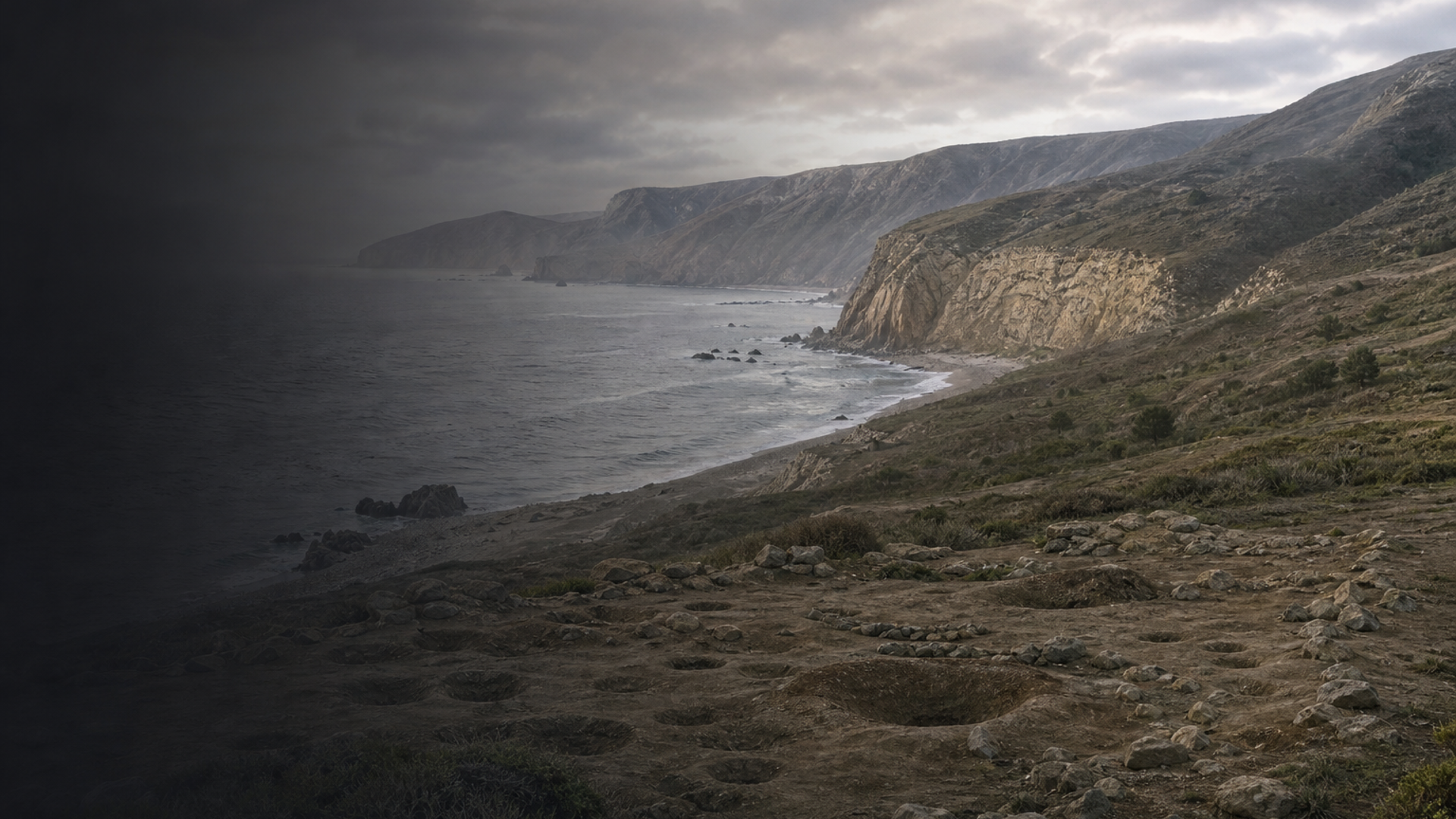
Against wind-lashed cliffs and the surf-roar of the Southern California Channel, communities established on San Clemente Island coalesced into a distinctive island lifeway by the early second millennium CE. Radiocarbon dates from shell-bearing midden deposits and hearths bracket human activity on the island between roughly 1000 and 1250 CE. Archaeological data indicates repeated seasonal use of coastal camps, concentrated midden lenses, and workshop areas where bone and stone tools were fashioned for fishing and seabird processing.

Culturally, these island occupations belong to the broader Native American San Clemente Island Culture and fit a regional pattern of maritime foragers across the Channel Islands and southern California coast. Limited evidence suggests connections — through trade in shell beads and shared tool types — with adjacent mainland groups, but the insular setting also produced locally specific artifact assemblages.

Because the available genetic dataset is small (8 samples), we treat models of population origin as tentative. The combined archaeological and genetic picture points to long-standing coastal lifeways maintained by people with deep regional ties to the Indigenous populations of southern California, adapted to an island environment of sea, wind and sky.

  • Radiocarbon-dated contexts on San Clemente Island: 1000–1250 CE
  • Middens, hearths, and tool workshops indicate sustained coastal adaptation
  • Evidence of exchange with mainland groups but also local island traditions
Capítulo IV

Daily Life & Society

Imagine dawn light silvering a rocky strand as people launch watercraft and cast lines into kelp-rich currents. Archaeological traces on San Clemente Island — dense shell middens, fish bone concentrations, worked bone fishhooks, and bead-production debris — evoke a society whose diet and craft relied heavily on the sea. Avian bones show intensive seabird procurement, and hearth features preserve evidence of routine food processing.

Material culture suggests specialized skills: fine bone and shell working for hooks and ornament, stone tool retouching, and structured refuse pits that reflect repeated, organized use of space. Social life likely balanced family-based household groups with broader seasonal gatherings; ethnographic parallels from nearby islands and coastal California support flexible mobility within a primarily maritime economy. Archaeological data indicates ritual and social signaling through bead use and personal ornament, though the symbolic meanings remain poorly documented in the archaeological record.

Preservation on the island is uneven, and many site contexts have been affected by later disturbances. Still, the tangible echoes of daily life are vivid: a shoreline threaded with human activity, where technological ingenuity met the demanding island environment.

  • Marine resources dominated diet: fish, shellfish, seabirds
  • Specialized craft: bone/shell fishhooks and shell bead production
Capítulo V

Genetic Profile

Genetic sampling from eight burials or skeletal contexts on San Clemente Island provides a preliminary window into ancestry and lineage diversity. Two samples carry Y-chromosome haplogroup Q, consistent with the dominant paternal lineage reported across many Indigenous populations of the Americas. On the maternal side, five mitochondrial genomes are classified as haplogroup R and three as C5b within this small sample set.

Important caveats: the label "R" in mtDNA is broad — it is a macro-haplogroup that encompasses multiple downstream branches (including haplogroups typical in the Americas). Further sequencing at higher resolution is needed to clarify whether these R assignments reflect Native American maternal lineages such as B or other derived clades. C5b is less commonly reported in modern surveys of North American mtDNA and may represent either an under-detected regional lineage or an ancestral link to broader north Pacific/Asian diversity; interpretation is uncertain.

With only eight samples, statistical power is limited and results should be treated as provisional. Nevertheless, the genetic signal accords with archaeological expectations of long-term Indigenous occupation of the Channel Islands and suggests both continuity with broader Native American paternal ancestry (Y: Q) and a complex maternal picture that invites more extensive sampling and targeted haplotype resolution.

  • Y-haplogroup Q in 2 of 8 samples aligns with Native American paternal ancestry
  • mtDNA shows R (5) and C5b (3); further sequencing needed due to low sample count
Capítulo VI

Legacy & Modern Connections

The island's archaeological remains and the emerging genetic data form a bridge between past communities and contemporary Indigenous peoples of southern California. Archaeological evidence of bead styles, fishing technology, and midden composition ties San Clemente occupations to wider cultural landscapes of the Channel Islands and mainland coast.

Genetically, the presence of haplogroup Q and diverse maternal lineages underscores enduring ancestral connections, but limited sample numbers mean care is required before asserting direct descent links to any single modern group. Collaboration with descendant communities and expanded sampling — guided by ethical protocols and consultation — are essential to refine the story and to situate San Clemente Island occupants within living cultural histories.

Ultimately, the legacy is both tangible and intangible: shell-scarred beaches and toolkits preserved underground, and the human stories they hint at, which continue to resonate for Indigenous peoples and researchers alike.

  • Archaeology and DNA highlight ties to broader Channel Islands and mainland traditions
  • Expanded, community-driven research is needed to clarify modern descendant links
Con IA

Asistente de IA

Haz preguntas sobre la cultura San Clemente Island Coastal Community

Asistente de IA por DNAGENICS

Desbloquear esta función
Pregunta sobre la cultura San Clemente Island Coastal Community. El asistente con IA puede explicar hallazgos genéticos, contexto histórico, pruebas arqueológicas y conexiones modernas, con sus límites de interpretación.
Ejemplo de análisis con IA

La cultura San Clemente Island Coastal Community representa un capítulo de la historia humana...

El análisis genético permite estudiar similitudes con poblaciones anteriores y posibles adaptaciones. Las muestras de ADN antiguo aportan información para investigar patrones migratorios y relaciones entre poblaciones, con límites que dependen del estudio y del contexto arqueológico.

Esta es una vista previa del análisis con IA. Accede al asistente completo para explorar información sobre:

  • Composición y similitud genética
  • Patrones migratorios y orígenes
  • Vida cotidiana y prácticas culturales
  • Contexto genético moderno

Explora más culturas antiguas

Descubre la historia de civilizaciones de distintas partes del mundo antiguo