Preparando el informe

Cargando la información y las referencias disponibles

Consultando el registro arqueológico...

Recopilando registros antiguos

Saltar al contenido principal
Tepe Anau Chalcolithic Horizon
Cultura destacada

Tepe Anau Chalcolithic Horizon

Sparse DNA from a Turkmen plain linking local life to wider Eurasian currents

4000 CE - 3000 BCE
Turkmenistan (Tepe Anau, Turkestan)
Desplázate para empezar
Capítulo I

La historia

Comprender la cultura Tepe Anau Chalcolithic Horizon

Chalcolithic occupations at Tepe Anau (Turkestan, Turkmenistan) c. 4000–3000 BCE yield three genome samples. Preliminary genetic signals (Y-R; mt H, U, W) hint at western Eurasian and possible steppe connections, but small sample size makes conclusions tentative.

Time Period

4000–3000 BCE

Region

Turkmenistan (Tepe Anau, Turkestan)

Common Y-DNA

R (2 of 3 sampled)

Common mtDNA

H, U, W (each 1 of 3)

Capítulo II

Cronología

Momentos clave de la historia de esta cultura

2500 BCE

Chalcolithic occupation at Tepe Anau

Settlement and material culture at Tepe Anau date to the mid-3rd millennium BCE, reflecting local farming communities with wider regional contacts.

Capítulo III

Origins & Emergence

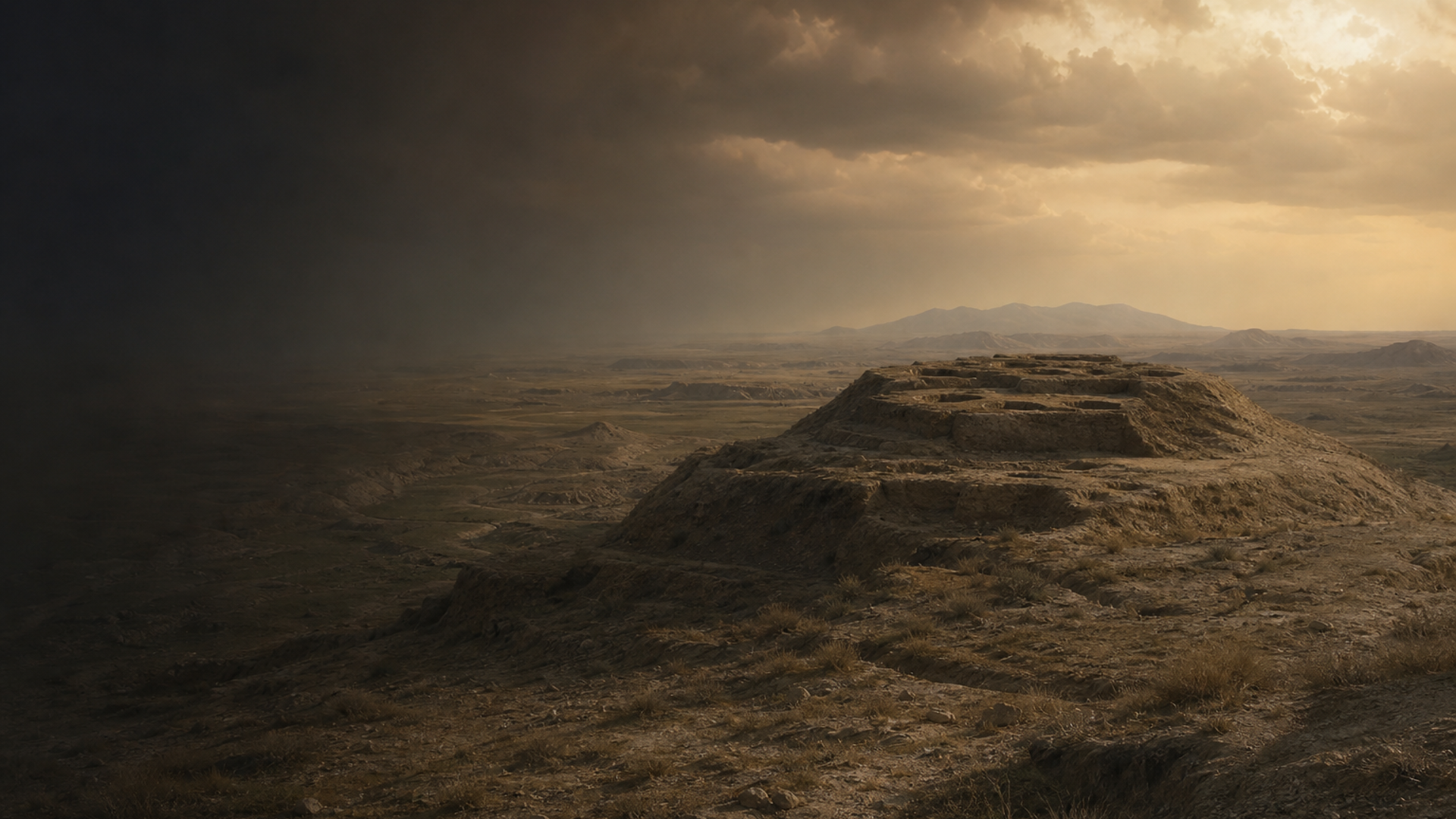
Tepe Anau sits on the flat, sun-bleached plains of Turkestan in modern Turkmenistan. Archaeological stratigraphy places a Chalcolithic occupation here between roughly 4000 and 3000 BCE — a time when local riverine communities were in dynamic contact with neighboring highlands and steppe margins. Excavations at Tepe Anau have identified settlement layers and material culture broadly consistent with regional Chalcolithic traditions; ceramic styles and architectural traces suggest a settled farming community with long-distance contacts.

The cinematic sweep of the horizon — wind across open steppe, seasonal herds, and low mounded settlements — frames a place of exchange. Limited evidence indicates Tepe Anau lay along networks that would later connect to Bronze Age polities in Central Asia. Archaeological data indicates interaction rather than isolation: raw materials and stylistic parallels hint at ties to both irrigated river valleys and more mobile pastoral economies.

However, the picture is fragmentary. Chronological control is improving but remains uneven, and direct links between material culture and population movements are inferred rather than proven. In this early phase, Tepe Anau appears as a local node in a broader mosaic of Chalcolithic life across Central Asia, part of the slow transformation that precedes the larger demographic shifts of the 3rd millennium BCE.

  • Occupation dated c. 4000–3000 BCE, Chalcolithic layers at Tepe Anau
  • Material culture indicates local farming with external contacts
  • Site likely part of wider Central Asian exchange networks
Capítulo IV

Daily Life & Society

Archaeological traces at Tepe Anau conjure intimate scenes: the rhythm of sowing and harvest, hearth-smoke in earthen houses, and the repair of pottery by lamplight. Domestic features recovered from Chalcolithic layers suggest households engaged in mixed subsistence — agriculture on irrigable plots combined with animal husbandry. Tools, grinding stones, and pottery sherds indicate daily crafts and food processing, while occasional exotic materials point to trade or exchange.

Social life was probably organized around kin groups and household units rather than large hierarchical polities. Burial evidence from the region is sporadic, and at Tepe Anau the funerary record is limited, making it difficult to reconstruct social ranking or ritual complexity with confidence. Where burials exist, they can illuminate diet, health, and mobility, but current samples remain few.

Everyday life at Tepe Anau must be read as the interplay of local practice and external influence: craft styles and raw materials traveled across landscapes, and people adapted to climatic variability, creating resilient lifeways. Archaeological data indicates a community at the threshold between long-standing local traditions and new social trajectories that shaped later Bronze Age societies.

  • Mixed farming and animal husbandry inferred from domestic remains
  • Limited funerary evidence constrains reconstruction of social hierarchy
Capítulo V

Genetic Profile

Three genome samples from Tepe Anau provide a slender but evocative genetic window into Chalcolithic Central Asia. Two of the three male individuals carry Y-chromosome lineage labeled broadly as R; mitochondrial lineages observed among the three individuals include H, U, and W. These haplogroups are widely distributed across western Eurasia and are commonly seen in ancient and modern populations of Europe and parts of western Asia.

The presence of Y-R in two individuals is suggestive, because R-lineages (in specific subclades) are frequently associated with populations expanding across the Eurasian steppe during the 4th–3rd millennia BCE. However, without higher-resolution subclade assignment it is not possible to link these R chromosomes decisively to a particular migration or cultural group. Similarly, mtDNA types H, U, and W point to western Eurasian maternal ancestry but cannot alone resolve mobility, admixture, or local continuity.

Crucially, these genetic signals must be read with caution. The sample count is only three — below the threshold commonly used to make robust population-level inferences — so conclusions are preliminary. Nevertheless, the combination of archaeological context and these genetic markers aligns with broader regional patterns in which local communities show varying degrees of western Eurasian and steppe-related ancestry during the late Neolithic–Chalcolithic transition. Additional samples, genome-wide analyses, and precise datings are required to move from suggestive patterns to firm narratives.

  • Two of three males carry Y-lineage R — potentially indicative of steppe-linked ancestry
  • mtDNA H, U, W signal western Eurasian maternal ties; small sample size makes conclusions tentative
Capítulo VI

Legacy & Modern Connections

Tepe Anau's legacy is not a single lineage but a palimpsest of human choices preserved in earth and bone. The limited DNA recovered connects this small sample to broader western Eurasian genetic landscapes, suggesting that the peoples of this Turkmen plain participated in long-distance networks that shaped Central Asia's genetic and cultural tapestry. For modern ancestry seekers, the data offers a cautious glimpse: some genetic threads at Tepe Anau are shared with later populations across Eurasia, but continuity is neither uniform nor guaranteed.

For scientific and public audiences alike, the chief lesson is humility. Sparse samples can illuminate possibilities — pathways of contact, admixture, and mobility — but they cannot alone rewrite population histories. Future excavations and a larger, well-dated genetic catalogue from Tepe Anau and neighboring sites will be essential to trace which elements of Chalcolithic identity persisted, changed, or vanished in the millennia that followed.

  • Preliminary genetic links to broader western Eurasian ancestries, not proof of direct continuity
  • More samples and finer genomic resolution needed to clarify connections to modern populations
Con IA

Asistente de IA

Haz preguntas sobre la cultura Tepe Anau Chalcolithic Horizon

Asistente de IA por DNAGENICS

Desbloquear esta función
Pregunta sobre la cultura Tepe Anau Chalcolithic Horizon. El asistente con IA puede explicar hallazgos genéticos, contexto histórico, pruebas arqueológicas y conexiones modernas, con sus límites de interpretación.
Ejemplo de análisis con IA

La cultura Tepe Anau Chalcolithic Horizon representa un capítulo de la historia humana...

El análisis genético permite estudiar similitudes con poblaciones anteriores y posibles adaptaciones. Las muestras de ADN antiguo aportan información para investigar patrones migratorios y relaciones entre poblaciones, con límites que dependen del estudio y del contexto arqueológico.

Esta es una vista previa del análisis con IA. Accede al asistente completo para explorar información sobre:

  • Composición y similitud genética
  • Patrones migratorios y orígenes
  • Vida cotidiana y prácticas culturales
  • Contexto genético moderno

Explora más culturas antiguas

Descubre la historia de civilizaciones de distintas partes del mundo antiguo