A preparar o relatório

A carregar as informações e as referências disponíveis

Consultando el registro arqueológico...

Recopilando registros antiguos

Saltar para o conteúdo principal
Ayousaigoukou Iron Age Echoes
Cultura de destaque

Ayousaigoukou Iron Age Echoes

Tiny sample from Xinjiang reveals a stirring, mixed ancestry at the heart of the Yili corridor.

754 CE - 204 BCE
Xinjiang, Yili Region (Xinyuan County)
Desplázate para começar
Capítulo I

A História

Comprender la cultura Ayousaigoukou Iron Age Echoes

Iron Age remains from Ayousaigoukou (Xinjiang, China; 754–204 BCE) show a mixture of west and east Eurasian lineages in a small sample (n=3). Archaeological data indicates local Iron Age lifeways and steppe connections; genetic signals are promising but preliminary.

Time Period

754–204 BCE

Region

Xinjiang, Yili Region (Xinyuan County)

Common Y-DNA

J (observed in 2/3 samples)

Common mtDNA

HV (2), C (1)

Capítulo II

Cronologia

Momentos-chave da história desta cultura

500 BCE

Iron Age occupation at Ayousaigoukou

Archaeological and genetic traces indicate local Iron Age activity around 500 BCE with signs of interaction across the Yili corridor.

Capítulo III

Origins & Emergence

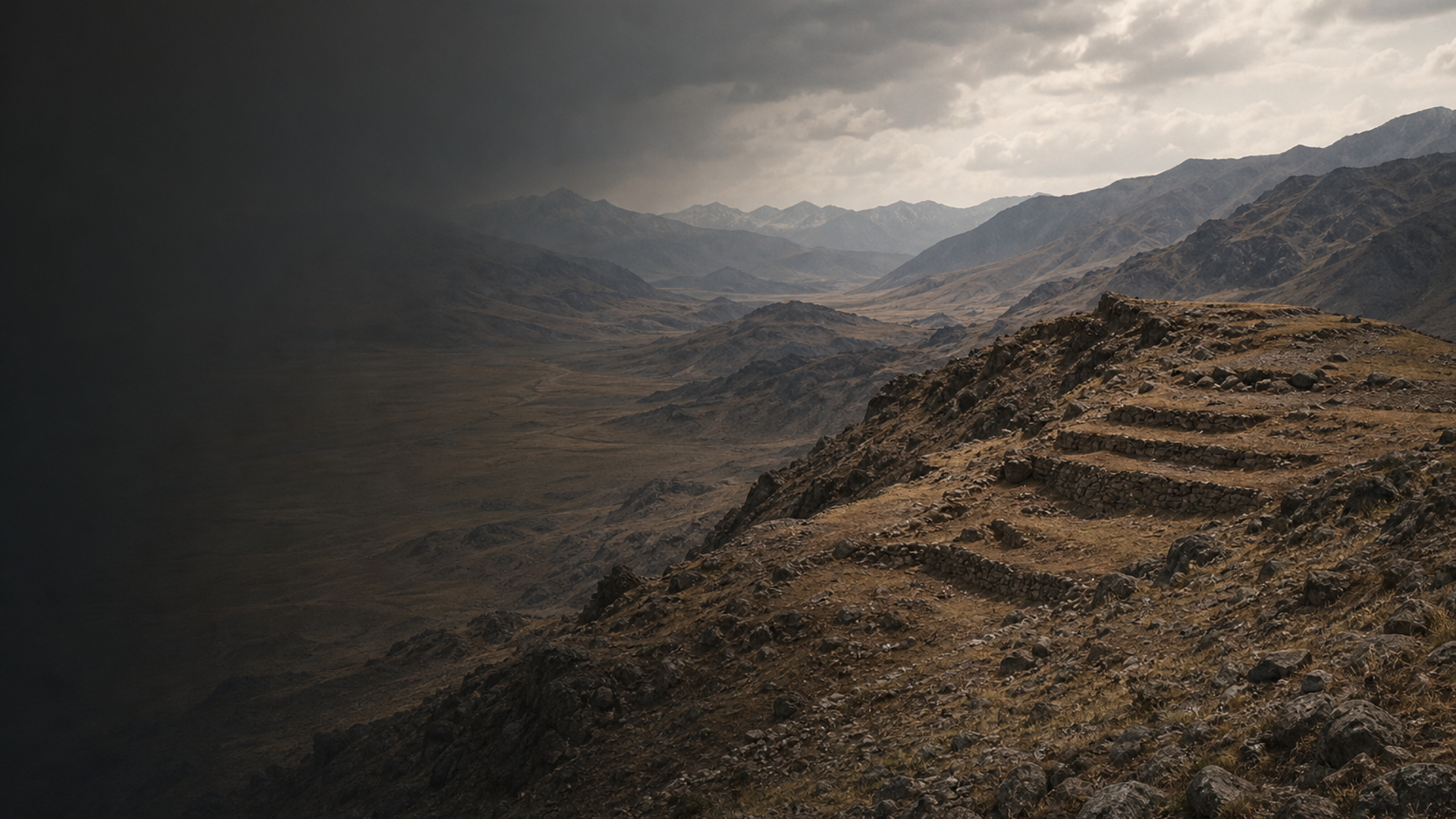
Set in the fertile Yili corridor, the site of Ayousaigoukou (Xinyuan County, Xinjiang) occupies a landscape where mountain rain-shadow meets broad steppe. Archaeological data indicates Iron Age occupation between 754 and 204 BCE, a period when mobile pastoral groups and settled farmers intersected along emerging long‑distance routes. Limited evidence suggests that communities here participated in networks that reached from the Inner Asian steppe toward Western Eurasia and the Chinese hinterland. Excavations at Ayousaigoukou have recovered funerary contexts and habitation traces consistent with regional Iron Age assemblages, though the full material record remains thin.

The emergence of this local Iron Age horizon likely reflects both indigenous cultural continuity and incoming influences carried by people, animals, and ideas across the mountains. Geographically the Yili basin is a natural conduit: rivers and valleys focus movement, while mountain passes channel contacts. Archaeological indicators — settlement patterns, burial variability, and regional comparisons — point to a dynamic, multi‑directional process rather than a single migratory event. As with many frontier zones, the material culture at Ayousaigoukou preserves a palimpsest of local lifeways and external connections.

  • Located in Yili corridor, Xinjiang (Xinyuan County)
  • Iron Age occupation dated to 754–204 BCE
  • Archaeology suggests local continuity plus external influences
Capítulo IV

Daily Life & Society

Archaeological traces paint a vivid, if partial, picture of daily life in the Iron Age Yili landscape. The ecology supports mixed economies: pastoralism on the open steppe, irrigated cropping in valley niches, and seasonal mobility that tied households to highland pastures. Material remains from nearby Iron Age sites in Xinjiang indicate craft production, animal husbandry, and the use of wheeled transport and pack animals—technologies that enable long-distance exchange.

Social life would have revolved around household assemblies, pastoral circuits, and ritual engagements with the landscape. Funerary deposits at Ayousaigoukou, though limited in published detail, hint at social differentiation and the importance of marking identity in death as well as life. Archaeological data indicates a community woven into wider trade and social networks: objects, metalwork styles, and burial practices show echoes of steppe and western influences filtered through local traditions.

Climate and topography shaped mobility and settlement size: river terraces sheltered agropastoral sites while mountain pastures supported seasonal herding. This interleaving of lifeways created resilient, adaptable societies able to navigate environmental and cultural crossroads.

  • Mixed agropastoral economy adapted to valley-steppe ecotone
  • Funerary evidence suggests social differentiation and long-distance ties
Capítulo V

Genetic Profile

Ancient DNA from Ayousaigoukou comprises three analyzed individuals dated between 754 and 204 BCE. Because the sample size is very small (n=3), any population-level inference must be treated as preliminary. Still, the genetic signatures are evocative: two of the three male-line Y-chromosome profiles belong to haplogroup J, a lineage today frequent in parts of West Asia and the Near East. On the maternal side, two mitochondrial genomes fall into haplogroup HV (a West Eurasian-associated lineage) and one into haplogroup C (a lineage widespread in northern and eastern Eurasia).

This combination — predominant J Y-chromosomes with HV and a single C maternal lineage — suggests a local population bearing both west and east Eurasian genetic elements. Such a pattern is consistent with the Yili corridor acting as a genetic and cultural contact zone where west Eurasian paternal inputs and mixed maternal ancestries coexisted. Archaeological data indicating trade and mobility dovetails with a genetic picture of admixture.

Caveats are essential: with fewer than ten samples, drift, kinship among buried individuals, or sampling bias can dramatically skew apparent frequencies. Broader sampling across sites and time slices is required to test whether the Ayousaigoukou trio reflects a wider regional pattern or a small family-level signal. Nevertheless, these first results illuminate the complex human tapestry of Iron Age Xinjiang and motivate further integrated archaeological and genetic study.

  • Y-DNA: J observed in 2 of 3 samples, indicating west Eurasian paternal input
  • mtDNA: HV (2) and C (1) point to mixed west–east maternal ancestries; small sample size limits conclusions
Capítulo VI

Legacy & Modern Connections

Ayousaigoukou serves as a microcosm of the larger story of Xinjiang: a landscape where peoples, languages, and genes intermingle across millennia. Modern populations of the region display complex genetic ancestries reflecting millennia of contacts along mountain corridors and steppe routes. The admixture signals seen in the Ayousaigoukou samples echo broader patterns observed elsewhere in Iron Age Central Asia, where west Eurasian and east Eurasian lineages meet and blend.

Importantly, the limited dataset means these impressions are tentative. Future excavations, more extensive radiocarbon dating, and larger ancient DNA series will be needed to trace continuity and change from the Iron Age into historical periods. For now, Ayousaigoukou offers a cinematic glimpse — human faces glimpsed in fragments of bone and DNA — of a frontier world that helped shape the genetic and cultural map of Central Asia.

  • Illustrates long-term west–east genetic mixing in Xinjiang
  • Highlights need for expanded sampling to connect Iron Age patterns to modern diversity
Com IA

Assistente de IA

Haz preguntas sobre la cultura Ayousaigoukou Iron Age Echoes

Assistente de IA por DNAGENICS

Desbloquear esta função
Pregunta sobre la cultura Ayousaigoukou Iron Age Echoes. El asistente con IA puede explicar hallazgos genéticos, contexto histórico, pruebas arqueológicas y conexiones modernas, con sus límites de interpretación.

Exemplo de análise com IA

La cultura Ayousaigoukou Iron Age Echoes representa un capítulo de la historia humana...

A análise genética permite estudar semelhanças com populações anteriores e possíveis adaptações. As amostras de DNA antigo fornecem informações para investigar padrões migratórios e relações entre populações, com limites que dependem do estudo e do contexto arqueológico.

Esta é uma antevisão da análise com IA. Aceder ao assistente completo para explorar informações sobre:

  • Composição e similaridade genética
  • Padrões migratórios e origens
  • Vida cotidiana e práticas culturais
  • Contexto genético moderno

Explore mais culturas antigas

Descubra a história de civilizações de diferentes partes do mundo antigo