A preparar o relatório

A carregar as informações e as referências disponíveis

Consultando el registro arqueológico...

Recopilando registros antiguos

Saltar para o conteúdo principal
Boglands and Longhouses
Cultura de destaque

Boglands and Longhouses

Early Neolithic Denmark seen through archaeology and ancient DNA

4247 CE - 3041 BCE
South Scandinavia (Denmark)
Desplázate para começar
Capítulo I

A História

Comprender la cultura Boglands and Longhouses

Archaeological sites across Jutland and Zealand (4247–3041 BCE) reveal farming communities, boats and wetland deposits. Ancient DNA from 29 individuals links local hunter‑gatherer ancestry and incoming farmers, illuminating population dynamics in early Denmark.

Time Period

4247–3041 BCE

Region

South Scandinavia (Denmark)

Common Y-DNA

I (majority), A1, Q, R (minor)

Common mtDNA

H, J, U, K (noted frequencies)

Capítulo II

Cronologia

Momentos-chave da história desta cultura

2500 BCE

Neolithic continuity and regional shifts

By 2500 BCE, many Neolithic traditions persisted in Denmark even as new contacts and technological changes foreshadowed later Bronze Age transformations.

Capítulo III

Origins & Emergence

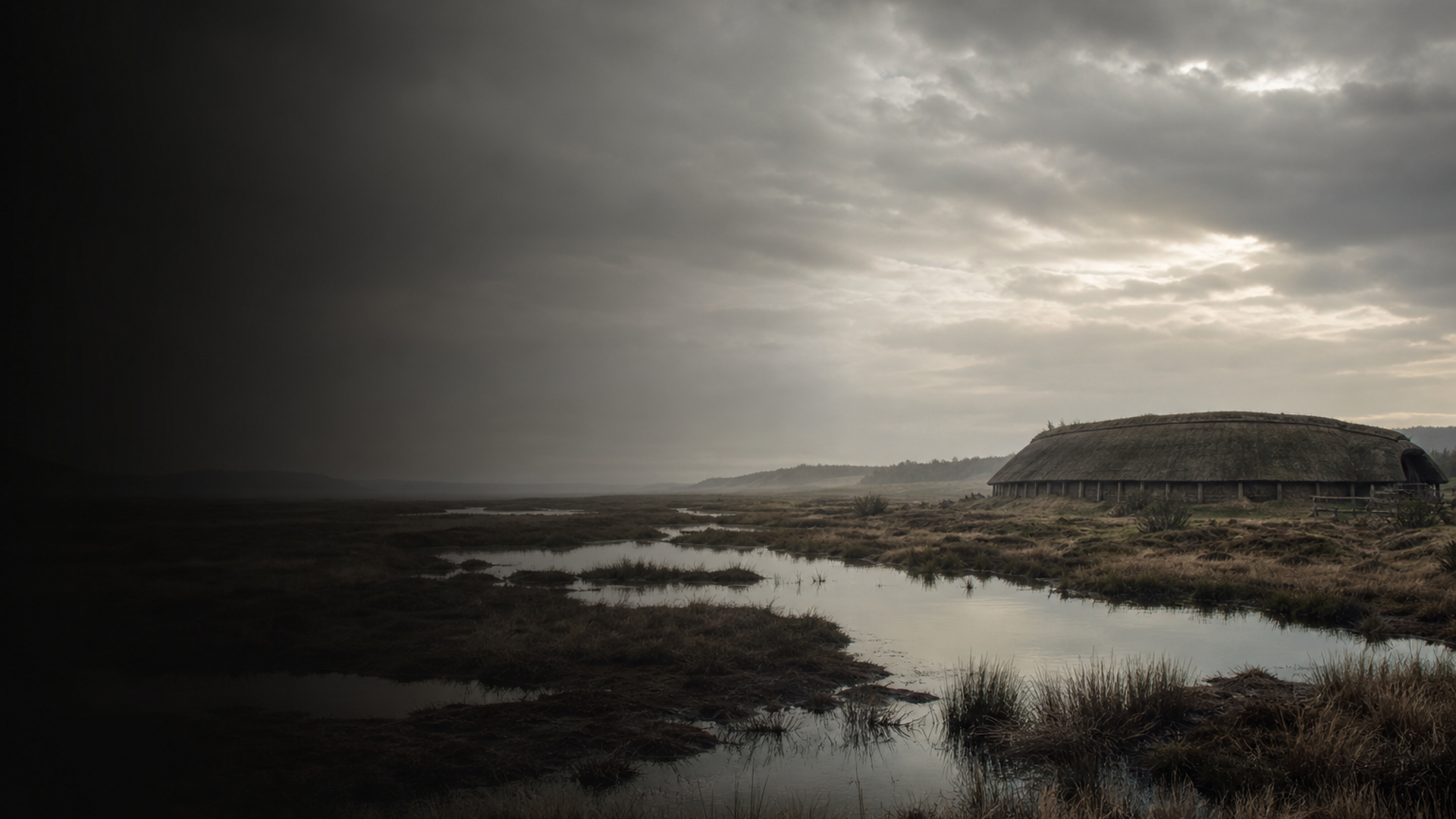
The Early Neolithic of southern Scandinavia unfolds like a landscape painting: reeds and bogs rim coastal waterways while new fields and timber houses appear inland. Archaeological data indicates that farming communities were established in Denmark by the fourth millennium BCE. The sample set for Denmark_SouthScandinavia_EN spans 4247–3041 BCE and comes from key locales on Jutland and Zealand — Rude and Bygholm Nørremark (Jutland), and Døjringe, Grøfte, Pandebjerg, Storelyng (including Øgarde boat III and Østrup Homo II), Viksø Mose, Rødhals and Jørlundegard (Zealand).

Material culture from this period often includes pottery styles and longhouse architecture consistent with regional variants of the Danish Early Neolithic (often placed within the broader Funnel Beaker tradition). Archaeological evidence indicates a mosaic of lifeways: inland arable plots, coastal fishing and maritime mobility. Wetland deposits and bog offerings — visible in places such as Viksø Mose — attest to ritual engagements with watery landscapes.

Genetically, the region stands at an intersection: immigrant farming groups carrying Anatolian‑derived Neolithic ancestry arrived in northern Europe and interacted with established Mesolithic communities. The archaeological record points to both continuity and change, but regional variation is marked and some inferences remain provisional: sample density varies by site and certain social dynamics are only partially visible in the material record.

  • Farming communities established in Denmark by the 4th millennium BCE
  • Sites include Rude, Bygholm Nørremark, Viksø Mose and Storelyng
  • Regional mosaic: coastal fishing, inland cultivation, bog rituals
Capítulo IV

Daily Life & Society

Life in Early Neolithic Denmark combined the rhythms of cultivated fields, herds, and the sea. Archaeological remains — pottery, polished stone tools, animal bones, and structural traces — indicate households managing cereals and domesticated animals alongside hunting and fishing. Longhouses and farmsteads provided the skeleton for village life; timber framing, hearths and storage pits organized daily tasks.

Coastal and wetland environments were integral: boats and watercraft enabled transport and resource exploitation, and several sample localities are associated with boat finds or wetland contexts (for example, the Øgarde boat III at Storelyng and peat contexts at Viksø Mose). Wetlands also functioned as curated places of deposition where tools, weapons or organic offerings were placed; archaeological interpretation treats such deposits as both practical and symbolic acts.

Burial practices show variety — inhumations, collective tombs and isolated burials — pointing to differentiated social identities. Artefacts and spatial organization hint at emerging kin groups and community networks. Archaeobotanical and zooarchaeological data from Denmark indicate cultivation of cereals and management of cattle, sheep and pigs, but the proportion of wild resources could remain locally significant. Overall, the archaeological picture is of resilient, adaptive communities negotiating new subsistence strategies in a northern maritime landscape.

  • Mixed farming economy with local hunting and fishing
  • Boats and wetland deposits play important economic and ritual roles
Capítulo V

Genetic Profile

Twenty‑nine ancient individuals under the Denmark_SouthScandinavia_EN label provide a window onto population dynamics in Early Neolithic Denmark. The genetic picture is one of admixture and local persistence: a majority of male lineages were assigned to haplogroup I (16 out of 29), a lineage often associated with pre‑farming European hunter‑gatherers. This prevalence suggests substantial male‑line continuity or assimilation of local forager males into Neolithic communities.

Maternal haplogroups are diverse: H (6), J (4), U (4) and K (4) feature among the samples, consistent with patterns seen in early farming groups across Europe where haplogroups H, J and K are common. Notable minor Y‑lineages in the dataset include one assignment each to A1, Q and R. The single A1 call is unexpected for Neolithic northern Europe and should be treated cautiously — such rare assignments may reflect authentic ancestry, post‑depositional factors, or technical uncertainty; follow‑up sequencing and broader comparative sampling are needed.

Autosomal ancestries in contemporaneous northern European Neolithic samples generally reflect a mixture of Anatolian‑derived farmer ancestry and local Western Hunter‑Gatherer ancestry. The Denmark_SouthScandinavia_EN samples are consistent with this blended heritage, though proportions can vary by site and individual. Because the dataset covers 29 individuals from multiple localities, it provides useful regional signal but cannot capture the full demographic complexity of Denmark; further sampling across time and space will refine these inferences.

  • Majority Y‑DNA I (16/29) suggests local male‑line continuity or assimilation
  • mtDNA composition (H, J, U, K) aligns with Neolithic farmer and mixed ancestries
Capítulo VI

Legacy & Modern Connections

The Early Neolithic left both visible monuments and genetic traces in northern Europe. Megalithic tombs, field boundaries and place‑names echo millennia of farming and ritual practice; wetlands and boat finds preserve dramatic moments of interaction between people and water. Genetically, the Neolithic transition contributed a substantial layer of ancestry to later populations in Denmark, particularly through maternally associated lineages (H, J, K) and cultural diffusion of agricultural lifeways.

However, later events — notably the Bronze Age influx of steppe‑derived ancestry — reshaped Y‑chromosome frequencies and autosomal profiles in northern Europe. Thus, while Neolithic lineages persist in part within modern Danes, the genetic landscape is palimpsest: layers of Mesolithic, Neolithic farmer, and later Bronze Age and Iron Age inputs. Archaeology and ancient DNA together show continuity in land use and ritual alongside demographic change. For descendants and residents today, these ancient communities help explain aspects of the deep past of the Danish cultural and biological landscape, but connections are complex and filtered through millennia of mobility and admixture.

  • Neolithic farming and ritual sites remain part of Denmark's archaeological heritage
  • Neolithic genetic contributions persist but were later reshaped by Bronze Age migrations
Com IA

Assistente de IA

Haz preguntas sobre la cultura Boglands and Longhouses

Assistente de IA por DNAGENICS

Desbloquear esta função
Pregunta sobre la cultura Boglands and Longhouses. El asistente con IA puede explicar hallazgos genéticos, contexto histórico, pruebas arqueológicas y conexiones modernas, con sus límites de interpretación.
Exemplo de análise com IA

La cultura Boglands and Longhouses representa un capítulo de la historia humana...

A análise genética permite estudar semelhanças com populações anteriores e possíveis adaptações. As amostras de DNA antigo fornecem informações para investigar padrões migratórios e relações entre populações, com limites que dependem do estudo e do contexto arqueológico.

Esta é uma antevisão da análise com IA. Aceder ao assistente completo para explorar informações sobre:

  • Composição e similaridade genética
  • Padrões migratórios e origens
  • Vida cotidiana e práticas culturais
  • Contexto genético moderno

Explore mais culturas antigas

Descubra a história de civilizações de diferentes partes do mundo antigo