A preparar o relatório

A carregar as informações e as referências disponíveis

Consultando el registro arqueológico...

Recopilando registros antiguos

Saltar para o conteúdo principal
Channel Islands Late Neolithic
Cultura de destaque

Channel Islands Late Neolithic

Island tombs, sea lanes, and the first genetic glimpses of Guernsey's past

3088 CE - 2301 BCE
Channel Islands, United Kingdom
Desplázate para começar
Capítulo I

A História

Comprender la cultura Channel Islands Late Neolithic

Archaeological remains from Le Déhus (Guernsey) and three ancient genomes (3088–2301 BCE) reveal a Late Neolithic island community shaped by maritime lifeways and admixture between incoming farmers and local lineages. Small sample size makes conclusions provisional.

Time Period

3088–2301 BCE

Region

Channel Islands, United Kingdom

Common Y-DNA

I2, I

Common mtDNA

K, K1, J

Capítulo II

Cronologia

Momentos-chave da história desta cultura

2500 BCE

Active use of Le Déhus tomb

Le Déhus chamber tomb in Vale, Guernsey, is in use for burial and ritual activity, reflecting island participation in Atlantic Neolithic practices.

Capítulo III

Origins & Emergence

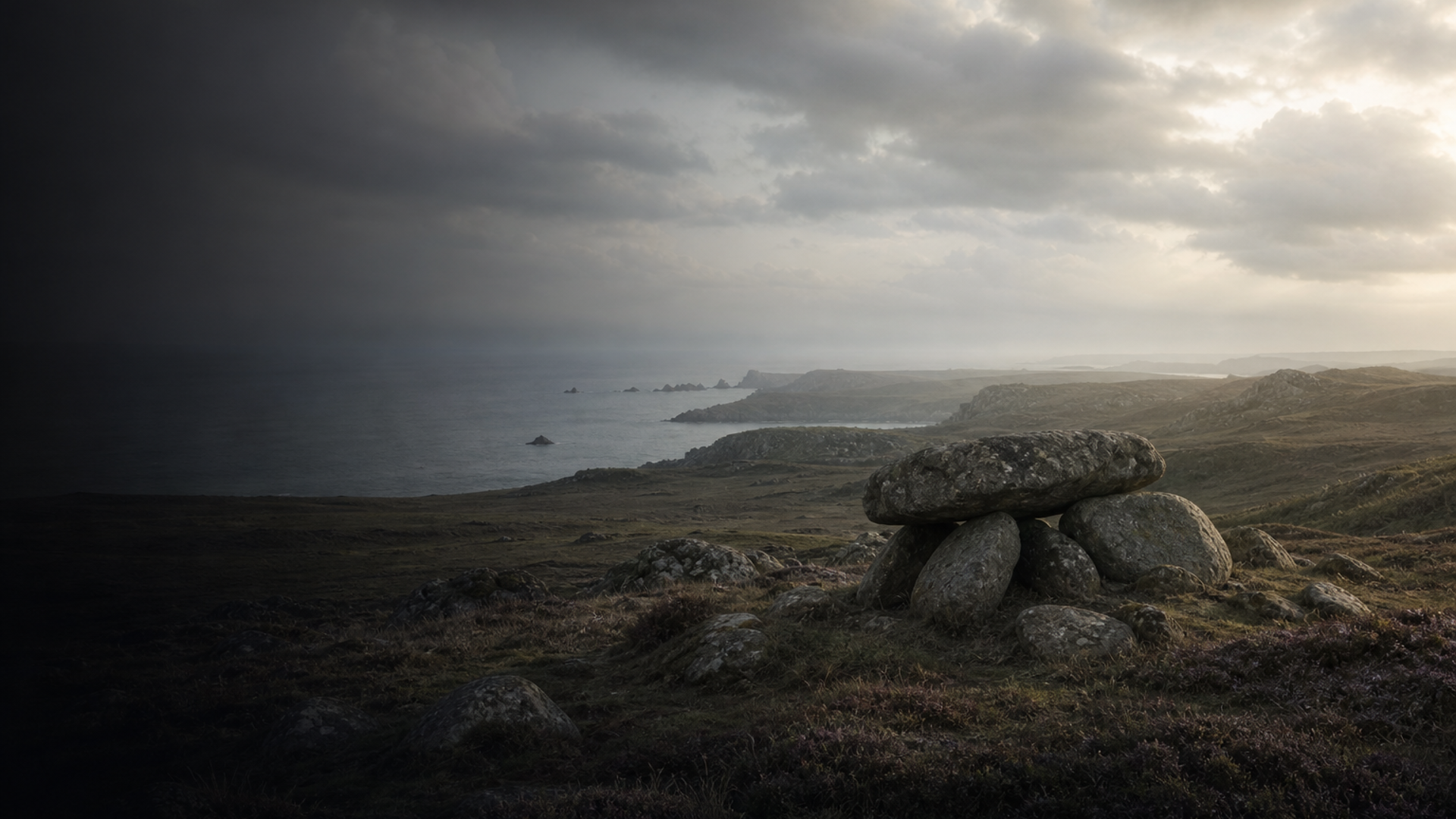
The Channel Islands in the Late Neolithic sit at a dramatic crossroads where sea and stone meet. Archaeological deposits dated between 3088 and 2301 BCE at sites such as Le Déhus (Vale, Guernsey) speak to a people living within a coastal mosaic of sheltered bays, rocky headlands and tide channels. Material culture and monument forms hint at sustained contact with the nearby coasts of Brittany and the southwestern British mainland, suggesting seafaring networks rather than isolation.

Archaeological data indicates the construction and reuse of chambered tombs and carved stones at Le Déhus, and household deposits that imply mixed farming adapted to maritime conditions. Radiocarbon dates place activity across several centuries of Late Neolithic life, but the archaeological record here is fragmentary and unevenly preserved on low-lying islands subject to erosion and sea-level change. Limited evidence suggests communities combined crop cultivation and pastoralism with intensive exploitation of marine resources.

The emergence of this island-specific signature likely reflects both the diffusion of Neolithic farming traditions along Atlantic coasts and local adaptations to island ecology. However, given sparse excavation coverage and small numbers of securely dated human remains, interpretations of cultural origins remain provisional and benefit from an integrated archaeological–genetic approach.

  • Le Déhus (Vale, Guernsey) is a key Late Neolithic tomb site
  • Evidence for maritime connections with Brittany and British mainland
  • Sea-level change and preservation bias make the record fragmentary
Capítulo IV

Daily Life & Society

Daily life for Late Neolithic islanders would have been shaped by tides, storms and rich coastal resources. Archaeological traces—discarded pottery, worked flint, animal bone and the architecture of tombs—paint a picture of small communities living in tightly knit households and engaging in seasonal rounds that mixed cereal cultivation, sheep and cattle herding, shellfish and fish gathering, and limited woodland use.

Le Déhus and similar chambered tombs functioned as focal points for ancestor veneration and social memory; their carved stones and assemblages suggest ritualized deposition of human remains and grave goods. The scale of monumental effort indicates cooperative labor and shared rituals that bound families or groups across generations. Craft activities, including stone working and pottery manufacture, reflect a material culture adapted for island life—robust containers, tools for processing marine and terrestrial foods, and items likely exchanged by boat.

Social organization likely combined kin-based households with inter-island exchange networks. However, the archaeological footprint is patchy: preservation biases and restricted excavation areas limit our view. Where organic materials do not survive, inferences depend on stone architecture and funerary deposits, so reconstructions of daily routines must be couched as informed hypotheses rather than certainties.

  • Mixed economy: crops, domesticated animals, and marine resources
  • Chambered tombs like Le Déhus served ritual and social roles
Capítulo V

Genetic Profile

Only three ancient genomes are available from the ChannelIslands_LN context (dated 3088–2301 BCE), so genetic conclusions are highly preliminary. Among these individuals, Y-chromosome results include haplogroups I2 (one sample) and I (one sample), lineages that are often associated in Europe with Mesolithic hunter-gatherer ancestry and with local male continuity in some regions. The mitochondrial results—K, K1 and J—are commonly observed among Neolithic farming groups in northwest Europe and reflect maternal lineages that spread with early agriculturalists from the Near East into Europe.

When archaeological inference is combined with these limited genetic data, a plausible picture emerges of local admixture: incoming Neolithic farmers carrying mtDNA lineages like K and J interacting and interbreeding with males carrying indigenous-associated I/I2 lineages, producing the mixed genomic signatures seen elsewhere in Atlantic Europe. This is consistent with wider patterns across the British Isles and Brittany where farmer and forager ancestries coexisted.

Caveats are essential: with only three samples, population-level inferences (sex-biased admixture, continuity, or migration magnitudes) cannot be robustly demonstrated. Future sampling across more graves, settlements and coastal deposits is required to test whether these three genomes are representative of wider island demographics or reflect particular lineages preserved by chance.

  • Small sample (n=3): conclusions are provisional
  • Y-lineages I/I2 suggest hunter-gatherer-linked paternal ancestry
Capítulo VI

Legacy & Modern Connections

The physical monuments and fragmentary genetic snapshots of the Channel Islands' Late Neolithic cast a long shadow across island landscapes and modern curiosity. Megalithic tombs like Le Déhus anchor a cultural memory of communal rites and seafaring ties that connect these isles to broader Atlantic Europe. Genetically, the presence of Neolithic maternal lineages alongside I/I2 paternal markers echoes a pattern of admixture seen across the British Isles, hinting that modern Channel Island populations may carry echoes of these deep ancestries.

Yet modern genetic landscapes have been reshaped by millennia of movement, trade, and later migrations, so any direct link between an individual ancient genome and a living local person must be presented cautiously. The strongest legacy is methodological: integrating archaeology, radiocarbon dating and ancient DNA provides a cinematic, evidence-based narrative of maritime adaptation and human resilience on the edge of the Atlantic—one that will sharpen as more samples and sites are studied.

  • Megaliths and maritime traditions link the islands to Atlantic Europe
  • Modern genetic continuity is possible but requires larger datasets
Com IA

Assistente de IA

Haz preguntas sobre la cultura Channel Islands Late Neolithic

Assistente de IA por DNAGENICS

Desbloquear esta função
Pregunta sobre la cultura Channel Islands Late Neolithic. El asistente con IA puede explicar hallazgos genéticos, contexto histórico, pruebas arqueológicas y conexiones modernas, con sus límites de interpretación.
Exemplo de análise com IA

La cultura Channel Islands Late Neolithic representa un capítulo de la historia humana...

A análise genética permite estudar semelhanças com populações anteriores e possíveis adaptações. As amostras de DNA antigo fornecem informações para investigar padrões migratórios e relações entre populações, com limites que dependem do estudo e do contexto arqueológico.

Esta é uma antevisão da análise com IA. Aceder ao assistente completo para explorar informações sobre:

  • Composição e similaridade genética
  • Padrões migratórios e origens
  • Vida cotidiana e práticas culturais
  • Contexto genético moderno

Explore mais culturas antigas

Descubra a história de civilizações de diferentes partes do mundo antigo