A preparar o relatório

A carregar as informações e as referências disponíveis

Consultando el registro arqueológico...

Recopilando registros antiguos

Saltar para o conteúdo principal
Peloponnese Neolithic Echoes
Cultura de destaque

Peloponnese Neolithic Echoes

Five ancient genomes from Alepotrypa and Franchthi illuminate early farming lifeways in southern Greece

5500 CE - 3600 BCE
Peloponnese, Greece
Desplázate para começar
Capítulo I

A História

Comprender la cultura Peloponnese Neolithic Echoes

Genomes from 5500–3600 BCE at Alepotrypa (Diros) and Franchthi Caves reveal maternal lineages dominated by mtDNA K, H and T1a. With only five samples, conclusions are preliminary; archaeological context ties these people to Neolithic farming and Ionian trade networks in the Peloponnese.

Time Period

5500–3600 BCE

Region

Peloponnese, Greece

Common Y-DNA

Undetermined (insufficient data)

Common mtDNA

K (2), T1a (1), H2 (1), H (1)

Capítulo II

Cronologia

Momentos-chave da história desta cultura

5500 BCE

Neolithic occupations at Franchthi and Alepotrypa

Cave and coastal sites show early farming, obsidian exchange, and burial practices marking Neolithic lifeways in the Peloponnese.

Capítulo III

Origins & Emergence

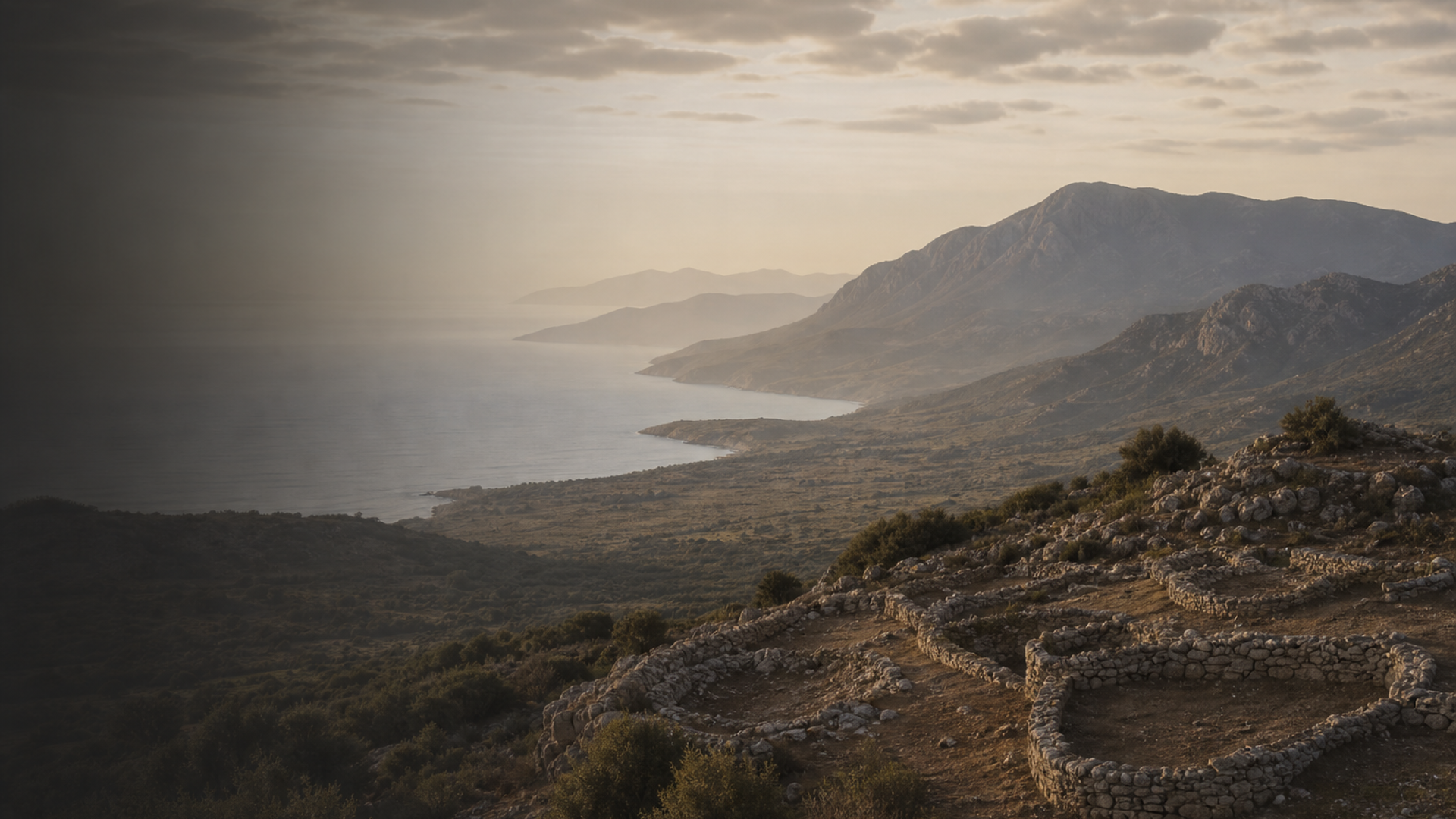
Under the vault of the Peloponnese sky, the Neolithic communities of the southern Greek mainland emerge in the archaeology as slow, deliberate gardeners of the landscape. Excavations at Franchthi Cave (Argolid) and Alepotrypa (Diros) reveal long sequences of occupation: Franchthi documents an unbroken thread from Mesolithic foragers into early farmers, while Alepotrypa contains stratified burials and domestic debris that speak to settled life. Radiocarbon dates associated with materials and contexts linked to the culture identifier span roughly 5500–3600 BCE, placing these people in the early to middle Neolithic of Greece.

Archaeological data indicates the adoption of domesticated cereals, pulses, sheep and goats, and material culture—simple painted pottery, stone tools, and personal ornaments—consistent with Neolithic lifeways across the Aegean. Franchthi is famous for its long-distance connections, including obsidian from Milos, which points to maritime exchange networks that predate extensive Bronze Age trade. Alepotrypa’s cave burials and collapsed chambers preserve evidence of complex ritualized depositional practices, suggesting a social world attentive to ancestry and place.

Genetically, broader ancient-DNA research in southeastern Europe ties early farmers to Anatolian sources. For the Peloponnese samples described here, the limited genetic record (five individuals) is coherent with that larger picture but remains preliminary. Limited evidence suggests these communities were part of the wave of early farming that transformed the Aegean coastlines, knitting local foraging traditions with incoming agricultural lifeways.

  • Sites: Franchthi Cave (Argolid) and Alepotrypa Cave (Diros)
  • Dates: c. 5500–3600 BCE (early to middle Neolithic)
  • Archaeology indicates early farming, obsidian exchange, and cave burial practices
Capítulo IV

Daily Life & Society

The day-to-day world of Neolithic Peloponnese inhabitants combined agriculture, coastal foraging, craft, and memory. Archaeobotanical remains from Franchthi and nearby sites show einkorn, emmer, and pulses, while faunal assemblages reflect managed herds of sheep, goats, and cattle alongside continued exploitation of fish and shellfish. People likely lived in small nucleated hamlets near arable plots, periodically using caves like Alepotrypa for mortuary practices and special activities.

Material culture paints a tactile portrait: hand-made and early wheel-made pottery, flaked and polished stone tools, bone awls, and personal beads. Franchthi’s long sequence also preserves evidence of specialized craft and long-distance contacts—most notably obsidian blades from Milos—implying exchange networks that connected coastal communities across the Aegean. Alepotrypa’s human remains and grave assemblages suggest care for the dead and possibly hierarchical or lineage-focused social structures, though direct evidence for ranked elites is sparse.

Archaeological data indicates households managed a mixed economy that blended cultivation with maritime resources. Social life was anchored in kinship, ritualized depositional acts in caves, and the slow accretion of local traditions woven with imported materials. These traces produce an intimate, cinematic view of Neolithic life—sunlit terraces of grain, the clink of obsidian, and the hush of cave chambers preserved beneath limestone.

  • Mixed economy: domesticated crops and animals plus fishing and shellfish gathering
  • Evidence of craft, personal ornamentation, and long-distance obsidian exchange
Capítulo V

Genetic Profile

Genetic data from these five individuals (sample count = 5) provides a narrow but meaningful window into maternal ancestry. The observed mitochondrial haplogroups are dominated by K (two individuals), with single occurrences of T1a, H2, and H. In broader ancient-DNA studies, mtDNA haplogroup K is frequently associated with early European farmers and is common in Anatolian and Aegean Neolithic contexts; its presence here is consistent with maternal ties to the Neolithic farming diaspora. Haplogroup H and its sublineages are widespread in later European populations and appear intermittently in Neolithic assemblages; H2 and T1a likewise occur in Neolithic and post-Neolithic contexts across Europe and the Near East.

Crucially, no consistent Y‑DNA pattern is reported for this small set, and autosomal data specific to these five individuals are limited or unpublished. Therefore, broader comparisons rely on regional ancient-DNA patterns: Neolithic Aegean genomes generally cluster with Anatolian Neolithic farmers, who contributed substantially to the ancestry of early European farming populations. Limited evidence suggests the Peloponnese Neolithic individuals fit within that larger genetic framework, reflecting maternal lineages common among early farmers.

Because the sample count is below ten, all genetic inferences must be treated as preliminary. Additional samples, especially male Y‑DNA and genome-wide data, are required to resolve questions of paternal lineages, kinship within cave burials, and finer-scale population dynamics such as local continuity versus later admixture.

  • mtDNA dominated by K (2), plus T1a, H2, H — consistent with early farmer maternal lineages
  • Y‑DNA undetermined; sample size (n=5) is too small for firm population conclusions
Capítulo VI

Legacy & Modern Connections

The echo of Neolithic Peloponnese lives on in landscapes shaped by millennia of cultivation and in the deep-time threads of ancestry that contribute to modern populations. Archaeologically, these communities established farming practices, maritime exchange routes, and ritual traditions that structured later Bronze Age and historic developments in southern Greece.

Genetically, maternal lineages such as mtDNA K and H observed here resonate with broader patterns seen across Europe, where early farmer ancestry was later modified by additional migrations. While some degree of genetic continuity from Neolithic inhabitants into modern Greeks is plausible, multiple subsequent population events (including Bronze Age movements) complicate direct lines of descent. Given the small number of ancient genomes from Franchthi and Alepotrypa, any statements about direct continuity to modern populations remain tentative.

These sites therefore offer a cinematic but careful reminder: the past is both proximate and layered. The stones of caves and the sequences of genomes together tell a story of movement, mixture, and enduring human presence on the shores of the Aegean.

  • Cultural legacy: early farming, maritime exchange, and cave mortuary traditions shaped later Peloponnese history
  • Genetic continuity is plausible but uncertain; later migrations complicated direct ancestry links
Com IA

Assistente de IA

Haz preguntas sobre la cultura Peloponnese Neolithic Echoes

Assistente de IA por DNAGENICS

Desbloquear esta função
Pregunta sobre la cultura Peloponnese Neolithic Echoes. El asistente con IA puede explicar hallazgos genéticos, contexto histórico, pruebas arqueológicas y conexiones modernas, con sus límites de interpretación.
Exemplo de análise com IA

La cultura Peloponnese Neolithic Echoes representa un capítulo de la historia humana...

A análise genética permite estudar semelhanças com populações anteriores e possíveis adaptações. As amostras de DNA antigo fornecem informações para investigar padrões migratórios e relações entre populações, com limites que dependem do estudo e do contexto arqueológico.

Esta é uma antevisão da análise com IA. Aceder ao assistente completo para explorar informações sobre:

  • Composição e similaridade genética
  • Padrões migratórios e origens
  • Vida cotidiana e práticas culturais
  • Contexto genético moderno

Explore mais culturas antigas

Descubra a história de civilizações de diferentes partes do mundo antigo