Menu
Store
Blog
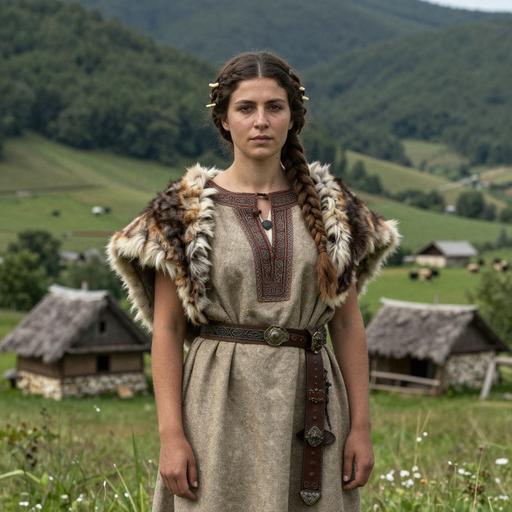
Portrait reconstruction of I13170
Ancient Individual

A woman buried in Montenegro in the Iron Age era

I13170
800 BCE - 400 BCE
Female
Montenegrin Iron Age
Montenegro
Scroll to begin
Chapter I

Identity

The biological and cultural markers that define this ancient individual

Sample ID

I13170

Date Range

800 BCE - 400 BCE

Biological Sex

Female

mtDNA Haplogroup

X1'2'3

Cultural Period

Montenegrin Iron Age

Chapter II

Place

Where this individual was discovered

Country Montenegro
Locality Velika Gruda
Coordinates 42.3667, 18.7333
Chapter III

Time

When this individual lived in the broader context of human history

I13170 800 BCE - 400 BCE
Chapter IV

Story

The narrative of this ancient life

The Montenegrin Iron Age of the Illyrian culture is a fascinating period marked by significant developments in social structure, economic practices, and artistic expression amidst the vibrant landscape of the western Balkans. This era, broadly spanning from around 1200 to 500 BCE, encapsulates the evolution and influence of the Illyrian tribes inhabiting the region known today as Montenegro.

Geographic and Environmental Context

Montenegro is characterized by its rugged mountains, deep river valleys, and a narrow coastal plain along the Adriatic Sea. During the Iron Age, these geographical features played a critical role in shaping the Illyrian way of life. The mountainous terrain provided natural fortification which led to the development of hillforts, known as gradina. This strategic advantage was crucial for the defense against neighboring tribes and external invaders.

Social and Political Structure

The social organization of Illyrian tribes during the Iron Age was predominantly clan-based. Society was structured into various tribes, which were occasionally unified under a single chieftain or petty king for military or economic purposes. These tribal societies were often competitive, though they also engaged in alliances and confederations when facing common threats. Power dynamics were heavily influenced by kinship and wealth, with leaders known as \princes" often emerging from the most influential families.

Economy and Trade

The Montenegrin Iron Age economy was primarily based on agriculture, animal husbandry, and metallurgy. The fertile lowlands and plateaus facilitated the cultivation of grains, olives, and grapes. Meanwhile, the breeding of livestock such as sheep, goats, and cattle was widespread, providing meat, wool, and dairy products.

Iron metallurgy became a central pillar of the economy, with the production of weapons, tools, and crafting materials becoming more sophisticated. The iron industry catalyzed trade, both within the Illyrian territories and with neighboring cultures such as the Greeks to the south. The exchange of goods like amber, ceramics, and crafted metal items with other Mediterranean cultures facilitated cultural diffusion and economic prosperity.

Art and Craftsmanship

Illyrian craftsmanship during the Iron Age is distinguished by intricate metalwork, especially in the production of jewelry and weaponry. Ornamentation often featured geometric patterns and symbolic motifs interpreted to have been imbued with spiritual or cultural meanings. Pottery from this era, although primarily utilitarian, occasionally demonstrated aesthetic qualities with painted and incised decorations.

Religion and Spiritual Beliefs

Spiritual life in Montenegrin Iron Age culture was polytheistic, and the society likely practiced ancestor worship alongside the veneration of deities related to natural elements and warfare. Archaeological findings such as burial goods and ceremonial objects suggest that funerary practices were of significant spiritual importance, possibly indicating beliefs in an afterlife or the transference of status in death.

Cultural Interactions and Influences

The Illyrian tribes were not isolated and their culture was subject to external influences through trade and conflict. Interaction with the Greeks, for instance, introduced new art styles and religious ideas, while also facilitating the amalgamation of various technological advancements into Illyrian society. This era of exchange arguably fostered a more complex and enriched cultural tapestry.

Legacy

The legacy of the Montenegrin Iron Age Illyrians is embedded in the enduring cultural identity and historical consciousness of the region. Many of the archaeological sites and artifacts from this period provide insight into the social structures, daily life, and belief systems of its people. As the prelude to later classical and medieval periods, the Iron Age set the stage for the subsequent historical developments in the Western Balkans, leaving a lasting imprint on Montenegrin heritage and identity."

Chapter V

Genetics

The genetic ancestry of this ancient individual

Ancient Genetic Admixture

This analysis compares the DNA profile of I13170 with ancient reference populations, showing the genetic composition in terms of prehistoric ancestral groups.

Western Steppe Pastoralists 52.4%
European Hunter-Gatherers 25.0%
Ancient Asians 11.6%
Neolithic Farmers 11.0%

Modern Genetic Admixture

This analysis compares the DNA profile with present-day reference populations, showing what percentage of genetic makeup resembles modern populations from different regions.

Europe 80.1%
Southern European 35.7%
Iberian 35.7%
Eastern European 35.6%
Northwestern European 8.8%
Northwestern European 4.9%
Finnish 3.9%
Asia 19.9%
Central Asian, Northern Indian & Pakistani 17.2%
Indian 12.9%
Pakistan 4.3%
Chinese & Southeast Asian 1.4%
Chinese 1.4%
Arab, Egyptian & Levantine 1.3%
Arabian 1.3%

Closest Modern Populations

These are the modern populations showing the closest statistical alignment to A woman buried in Montenegro in the Iron Age era, ranked by genetic distance. Lower distance values indicate closer statistical similarity.

1
Tatar Mishar
3.3874
2
Komi A
4.0992
3
Russian Leshukonsky
4.2620
4
Russian Pinega
4.9425
5
Russian Pinezhsky
5.1741
6
Tatar Kazan
5.2374
7
Russian Krasnoborsky
5.4071
8
Mordovian
5.5946
9
Vepsian
5.6707
10
Erzya
5.7692
Chapter VI

Context

Other ancient individuals connected to this sample

Sources

References

Scientific publications and genetic data

Scientific Publication

Population genomics of Bronze Age Eurasia

Authors Allentoft ME, Sikora M, Sjögren KG
Abstract

The Bronze Age of Eurasia (around 3000-1000 BC) was a period of major cultural changes. However, there is debate about whether these changes resulted from the circulation of ideas or from human migrations, potentially also facilitating the spread of languages and certain phenotypic traits. We investigated this by using new, improved methods to sequence low-coverage genomes from 101 ancient humans from across Eurasia. We show that the Bronze Age was a highly dynamic period involving large-scale population migrations and replacements, responsible for shaping major parts of present-day demographic structure in both Europe and Asia. Our findings are consistent with the hypothesized spread of Indo-European languages during the Early Bronze Age. We also demonstrate that light skin pigmentation in Europeans was already present at high frequency in the Bronze Age, but not lactose tolerance, indicating a more recent onset of positive selection on lactose tolerance than previously thought.

G25 Coordinates

The G25 coordinates for sample I13170 can be used for detailed admixture analysis in our G25 Studio tool.

I13170,0.10959072,0.0484317,0.07355982,0.05914836,0.01049092,0.01532038,0.00882562,0.01334266,-0.00131686,-0.0242581,0.00776648,-0.00853196,0.01779476,-0.00199672,-0.01748154,-0.01330716,-0.00803222,-0.0026859,-0.01615626,-0.01350288,0.00579828,0.00014314,-0.01294388,0.00226928,-0.00375985
Analyze in G25 Studio
Use code for 40% off Expires Feb 26