Menu
Store
Blog
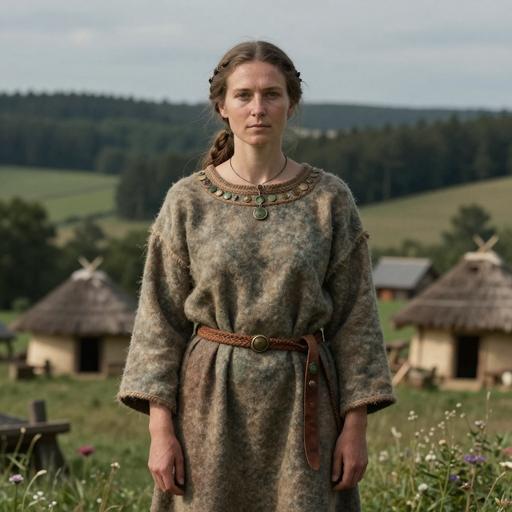
Portrait reconstruction of RISE586
Ancient Individual

A woman buried in Czechia in the Bronze Age era

RISE586
2800 BCE - 1800 BCE
Female
Únětice culture
Czechia
Scroll to begin
Chapter I

Identity

The biological and cultural markers that define this ancient individual

Sample ID

RISE586

Date Range

2800 BCE - 1800 BCE

Biological Sex

Female

mtDNA Haplogroup

K1b1a

Cultural Period

Únětice culture

Chapter II

Place

Where this individual was discovered

Country Czechia
Locality Moravská-Nová-Ves (South Moravian Region, Břeclav District)
Coordinates 48.8019, 17.0233
Chapter III

Time

When this individual lived in the broader context of human history

RISE586 2800 BCE - 1800 BCE
Chapter IV

Story

The narrative of this ancient life

The Únětice culture, named after the village of Únětice in the Czech Republic where the first evidence of this culture was discovered, is an early Bronze Age culture that spanned parts of Central Europe, approximately from 2300 BC to 1600 BC. It represents a significant period in prehistory characterized by metallurgical innovation, trade expansion, and social complexity. The Únětice culture is best understood within the broader context of the Bronze Age developments in Europe, wherein technological advancements and intercultural interactions led to profound societal transformations.

Geographic Spread

The Únětice culture primarily encompassed regions within modern-day Czech Republic, Germany, Poland, and Slovakia, with influences seen in parts of Austria and Hungary. This extensive geographic spread suggests a culture that, while regionally diverse, shared common technological, economic, and social characteristics.

Metallurgy and Technological Advances

One of the most defining aspects of the Únětice culture is its advanced metalworking skills. The Únětice people are credited with significant developments in bronze metallurgy, including the production of a diverse array of tools, weapons, and ornaments. They utilized copper, which was sourced both locally and through trade, and combined it with tin to produce bronze. The bronzesmiths of the Únětice culture crafted items such as flat axes, daggers, chisels, and jewelry, which were disseminated over a wide area through extensive trade networks.

Economy and Trade

Trade played a pivotal role in the Únětice society. The distribution of bronze artifacts and the presence of non-local materials in burial sites indicate an extensive trade network that likely included exchange with cultures across Europe. Amber, gold, and other valuable materials were traded goods, suggesting a complex economy that connected different regions and cultures.

The Únětice people were also agriculturalists, practicing mixed farming with the cultivation of cereals and the domestication of animals like cattle, sheep, and pigs. This agricultural base supported larger communities and allowed for increased specialization in crafts.

Social Structure and Society

The Únětice culture appears to have been hierarchical. Evidence from burial sites and settlement patterns suggests the existence of social stratification. elite class seems to have existed, potentially comprising warriors, leaders, and skilled craftsmen. This hierarchy is visible through variations in grave goods; elite burials often contained rich assemblages of weapons and ornaments, while others were more modest.

The presence of impressive burial mounds, such as the Leubingen burial mound in Germany, further highlights social differentiation. These mounds were complex structures that required considerable labor to construct, indicating a coordinated society with the means to organize and support such endeavors.

Burial Practices and Religion

Burial practices within the Únětice culture were characterized by inhumation, with bodies typically interred in flat graves or under burial mounds. Grave goods commonly included metal objects, pottery, and personal ornaments, reflecting beliefs in an afterlife where such items were useful.

Religious beliefs of the Únětice people remain speculative, but the care taken in burial practices suggests a belief system that honored ancestors and perhaps a pantheon of deities related to natural forces and human endeavors. The sun, cycles of nature, and fertility are often suggested motifs inferred from artifacts and burial orientations.

Art and Symbolism

The Únětice culture produced a range of artifacts that exhibit both artistry and utility. Items such as the famous \Sun Chariot" wheels and various ceremonial objects reflect a rich symbolic world, likely tied to religious and cultural beliefs. Ornamentation was made primarily from bronze, alongside materials like bone and ceramics, indicating an aesthetic appreciation and skilled craftsmanship.

Decline and Legacy

The Únětice culture eventually gave way to successor cultures around 1600 BC, influenced by new waves of migration and technological advancements. However, its legacy remained influential, particularly in its metallurgical traditions, which set the stage for continued developments throughout the Bronze Age in Europe. The trade routes and societal models established during the Únětice period laid an essential foundation for the later cultures that would emerge in the same regions.

In summary, the Únětice culture represents an early and significant chapter in the European Bronze Age, marking a period of technological innovation, expansive trade networks, and complex social structures. Its contributions to metallurgy and trade dynamics had long-lasting impacts on subsequent prehistoric European cultures."

Chapter V

Context

Other ancient individuals connected to this sample

Sources

References

Scientific publications and genetic data

Scientific Publication

Population genomics of Bronze Age Eurasia

Authors Allentoft ME, Sikora M, Sjögren KG
Abstract

The Bronze Age of Eurasia (around 3000-1000 BC) was a period of major cultural changes. However, there is debate about whether these changes resulted from the circulation of ideas or from human migrations, potentially also facilitating the spread of languages and certain phenotypic traits. We investigated this by using new, improved methods to sequence low-coverage genomes from 101 ancient humans from across Eurasia. We show that the Bronze Age was a highly dynamic period involving large-scale population migrations and replacements, responsible for shaping major parts of present-day demographic structure in both Europe and Asia. Our findings are consistent with the hypothesized spread of Indo-European languages during the Early Bronze Age. We also demonstrate that light skin pigmentation in Europeans was already present at high frequency in the Bronze Age, but not lactose tolerance, indicating a more recent onset of positive selection on lactose tolerance than previously thought.

Use code for 40% off Expires Feb 26