Menu
Store
Blog
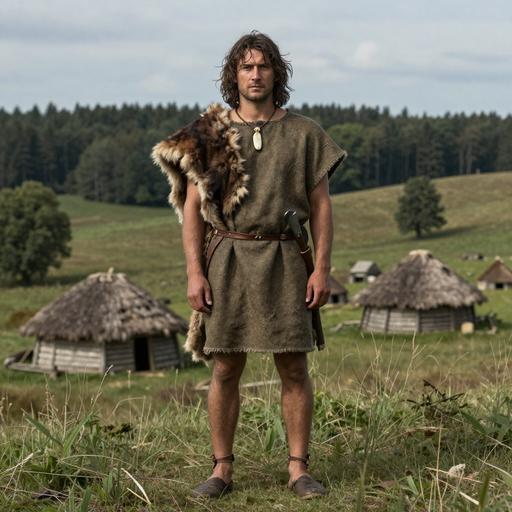
Portrait reconstruction of RISE61
Ancient Individual

A man buried in Denmark in the Middle Neolithic era

RISE61
2848 BCE - 2492 BCE
Male
Middle Neolithic B Denmark
Denmark
Scroll to begin
Chapter I

Identity

The biological and cultural markers that define this ancient individual

Sample ID

RISE61

Date Range

2848 BCE - 2492 BCE

Biological Sex

Male

mtDNA Haplogroup

J1c4

Y-DNA Haplogroup

R-PF6162

Cultural Period

Middle Neolithic B Denmark

Chapter II

Place

Where this individual was discovered

Country Denmark
Locality Kyndelöse
Coordinates 55.7030, 11.8550
Chapter III

Time

When this individual lived in the broader context of human history

RISE61 2848 BCE - 2492 BCE
Chapter IV

Story

The narrative of this ancient life

The Middle Neolithic B (circa 2800-2600 BCE) in Denmark marks a fascinating period in the region's prehistoric past, dominated by the Funnelbeaker culture, also known as the TRB (Trichterbecherkultur). This era is characterized by significant advances in agriculture, societal organization, and material culture.

Settlement and Society

During the Middle Neolithic B, Denmark's landscape was dotted with small, semi-permanent settlements. These communities often consisted of longhouses constructed from wood, with roofs thatched with reeds or straw. The Funnelbeaker people were primarily agrarian, relying on farming for sustenance, although hunting, fishing, and gathering continued to supplement their diet.

The society was likely organized into extended family units or clans. Evidence of social stratification is visible in the construction of megalithic structures and burials, suggesting the emergence of tribal leaders or elites. These leaders likely played significant roles in coordinating large communal efforts such as monument building and managing resources.

Agriculture and Economy

The Middle Neolithic B saw advancements in agriculture, with the cultivation of crops such as barley, wheat, and flax. Domesticated animals like cattle, sheep, goats, and pigs were integral to the economy, providing meat, milk, wool, and leather. The presence of communal storage pits and granaries suggests efforts in managing surplus production, which would have been crucial for sustaining communities through harsh seasons.

The development of polished stone tools, such as axes and adzes, improved efficiency in farming, forestry, and building. These tools were essential for land clearance and the construction of both homes and large ritual monuments.

Rituals and Megalithic Structures

Megalithic constructions are one of the most distinctive features of this period. The Funnelbeaker culture is renowned for their dolmens, passage graves, and stone settings. Dolmens, which are single-chamber megalithic tombs, and passage graves, consisting of burial chambers reached by a corridor, reflect sophisticated architectural designs and a deep spiritual or ritual significance.

These structures were often communal burial sites, suggesting a belief in an afterlife or the importance of ancestor worship. The scale and complexity of these monuments indicate coordinated communal efforts and suggest religious or spiritual leaders may have facilitated construction and ceremonial activities.

Material Culture

The Funnelbeaker culture is named after its distinctive pottery, characterized by funnel-shaped necks. This pottery often featured intricate decorations and was used for both everyday purposes and ritualistic contexts. Artifacts from this period include flint tools, bone implements, and pottery, which reveal much about the daily life and beliefs of the people.

Craftsmanship in the Middle Neolithic B also extended to textiles, as evidenced by impressions found in pottery and preserved materials in bogs. These textiles would have been made from wool or linen and dyed with plant-based colors.

Trade and Interaction

Trade played an important role during this period, as evidenced by the distribution of non-local materials such as amber, flint, and copper. The presence of these materials suggests a network of exchange that connected Denmark with other regions in northern and central Europe.

In conclusion, the Middle Neolithic B period in Denmark, epitomized by the Funnelbeaker culture, was characterized by significant developments in agriculture, social organization, and material culture. The era's megalithic monuments reflect complex societal structures and religious beliefs, while the material culture indicates a rich tradition of craftsmanship and trade. This dynamic period laid important foundations for the subsequent cultural and technological evolutions in Neolithic Scandinavia.

Chapter V

Genetics

The genetic ancestry of this ancient individual

Ancient Genetic Admixture

This analysis compares the DNA profile of RISE61 with ancient reference populations, showing the genetic composition in terms of prehistoric ancestral groups.

Western Steppe Pastoralists 42.1%
European Hunter-Gatherers 32.7%
Neolithic Farmers 25.2%

Modern Genetic Admixture

This analysis compares the DNA profile with present-day reference populations, showing what percentage of genetic makeup resembles modern populations from different regions.

Europe 98.3%
Northwestern European 79.2%
English 39.1%
Scandinavian 22.2%
Northwestern European 14.4%
Finnish 3.6%
Southern European 14.5%
Iberian 9.5%
Balkan 3.1%
Sardinian 1.5%
Eastern European 4.6%
Africa 0.6%
West African 0.6%
Senegambian & Guinean 0.6%
Oceania 0.6%
Melanesian 0.6%
Papuan 0.6%
Asia 0.5%
Northern West Asian 0.5%
Caucasian 0.5%

Closest Modern Populations

These are the modern populations showing the closest statistical alignment to A man buried in Denmark in the Middle Neolithic era, ranked by genetic distance. Lower distance values indicate closer statistical similarity.

1
Afrikaner
3.0831
2
Orcadian
3.4431
3
Dutch
3.4817
4
Scottish
3.5371
5
Shetlandic
3.5604
6
German Hamburg
3.5713
7
Norwegian
3.5716
8
Danish
3.7334
9
Irish
3.7462
10
Swedish
3.7758
Chapter VI

Context

Other ancient individuals connected to this sample

Sources

References

Scientific publications and genetic data

Scientific Publication

Population genomics of Bronze Age Eurasia

Authors Allentoft ME, Sikora M, Sjögren KG
Abstract

The Bronze Age of Eurasia (around 3000-1000 BC) was a period of major cultural changes. However, there is debate about whether these changes resulted from the circulation of ideas or from human migrations, potentially also facilitating the spread of languages and certain phenotypic traits. We investigated this by using new, improved methods to sequence low-coverage genomes from 101 ancient humans from across Eurasia. We show that the Bronze Age was a highly dynamic period involving large-scale population migrations and replacements, responsible for shaping major parts of present-day demographic structure in both Europe and Asia. Our findings are consistent with the hypothesized spread of Indo-European languages during the Early Bronze Age. We also demonstrate that light skin pigmentation in Europeans was already present at high frequency in the Bronze Age, but not lactose tolerance, indicating a more recent onset of positive selection on lactose tolerance than previously thought.

G25 Coordinates

The G25 coordinates for sample RISE61 can be used for detailed admixture analysis in our G25 Studio tool.

RISE61,0.1166157,0.11332322,0.05206424,0.0494799,0.02969404,0.0197506,0.00140392,0.00488844,0.00273862,-0.00945708,-0.00417904,0.00124762,-0.00645364,-0.00551248,0.0166606,-0.00117788,-0.01641414,0.00329714,-0.00117972,-0.0042652,0.00145132,0.00413906,-0.00122656,0.01309108,0.00158803
Analyze in G25 Studio
Use code for 40% off Expires Feb 26