Menu
Store
Blog
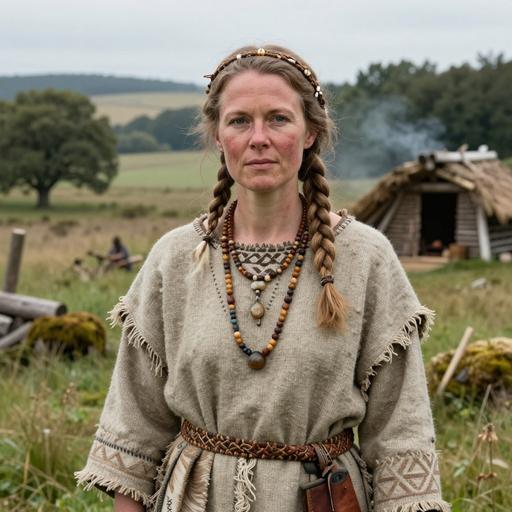
Portrait reconstruction of RISE71
Ancient Individual

A woman buried in Denmark in the Late Neolithic era

RISE71
2197 BCE - 1983 BCE
Female
Late Neolithic Denmark
Denmark
Scroll to begin
Chapter I

Identity

The biological and cultural markers that define this ancient individual

Sample ID

RISE71

Date Range

2197 BCE - 1983 BCE

Biological Sex

Female

mtDNA Haplogroup

H3b

Cultural Period

Late Neolithic Denmark

Chapter II

Place

Where this individual was discovered

Country Denmark
Locality Falshöj
Coordinates 56.6760, 10.0340
Chapter III

Time

When this individual lived in the broader context of human history

RISE71 2197 BCE - 1983 BCE
Chapter IV

Story

The narrative of this ancient life

The Late Neolithic era in Denmark, notably within the context of the Funnelbeaker culture (also known as the Trichterbecherkultur or TRB culture), represents a fascinating period of transition and development, roughly dated between 3000 and 2800 BCE. This era marks significant advancements in agriculture, technology, and social structures that laid the groundwork for more complex societies in Northern Europe.

Geographical Context: The Funnelbeaker culture is named after its distinctive pottery, featuring funnel-shaped beakers. It spanned a substantial part of Northern and Central Europe, with Denmark being one of the central regions. Denmark's landscape during this time was marked by densely forested areas interspersed with lakes and waterways, which heavily influenced the subsistence strategies and settlement patterns of the TRB communities.

Agriculture and Subsistence: The Late Neolithic period in Denmark witnessed substantial agricultural developments. The people of the Funnelbeaker culture practiced mixed farming, cultivating a variety of crops like wheat, barley, peas, and flax. They also domesticated animals, including cattle, sheep, goats, and pigs. Agriculture was complemented by hunting, fishing, and gathering, allowing communities to exploit the rich resources of their environment. This combination of farming and foraging facilitated more permanent settlements.

Settlement and Architecture: Settlements during this era typically consisted of small, scattered farmsteads. The architecture was relatively basic, with homes made of wood and utilizing wattle-and-daub techniques. Some sites indicate larger community structures, potentially used for gatherings or communal activities. One of the most notable architectural features of the Funnelbeaker culture in Denmark is the megalithic tombs. These monumental structures, including long barrows, dolmens, and passage graves, were constructed using large stones and served as communal burial sites, underscoring a complex spiritual or religious life.

Social Structure: The social structure of the Funnelbeaker communities during the Late Neolithic was likely organized around extended familial lines or clans, though there is evidence of social stratification. The construction and use of megalithic tombs suggest the presence of social hierarchies, with certain individuals or groups having access to prestigious burial sites. The distribution of grave goods, such as pottery, tools, and ornaments, further indicates differing social status among individuals.

Technology and Craftsmanship: Technological advancements were pronounced during this era, with significant progress in tool production and pottery. Flint was a primary material for tools, mining, and knapping techniques becoming more sophisticated and efficient. The pottery of the Funnelbeaker culture is recognized for its distinct shapes and decorations, indicative of skilled craftsmanship and cultural expression. Additionally, evidence of textile production, as suggested by spindle whorls and loom weights, points to developing domestic industries.

Cultural and Religious Practices: Religious and cultural practices in Late Neolithic Denmark were deeply intertwined with the natural landscape and agricultural cycle. The megalithic structures not only served as burial sites but also likely held ceremonial significance. Artifacts and remains found within these sites suggest rituals that honored ancestors and connected communities to their land. The art and symbolism reflected in pottery and carvings from this period indicate a rich spiritual life and a complex cosmology.

Trade and Interaction: The Funnelbeaker culture was not isolated; evidence suggests active trade networks existed during the Late Neolithic. Flint, amber, and pottery were among the items exchanged, linking Denmark to broader European trade routes. These interactions facilitated cultural exchange, influencing technological and cultural developments and introducing new ideas and goods.

In conclusion, the Late Neolithic era in Denmark under the Funnelbeaker culture was a dynamic period marked by significant cultural, technological, and social evolutions. The communities were adept at harnessing their environment, reflected in their agricultural practices, architectural achievements, and material culture. These developments laid crucial foundations for the subsequent cultural and historical trajectories in Northern Europe.

Chapter V

Genetics

The genetic ancestry of this ancient individual

Ancient Genetic Admixture

This analysis compares the DNA profile of RISE71 with ancient reference populations, showing the genetic composition in terms of prehistoric ancestral groups.

European Hunter-Gatherers 40.5%
Western Steppe Pastoralists 36.9%
Neolithic Farmers 18.4%
Ancient Oceanians 2.1%
Ancient Africans 2.1%

Modern Genetic Admixture

This analysis compares the DNA profile with present-day reference populations, showing what percentage of genetic makeup resembles modern populations from different regions.

Europe 94.7%
Northwestern European 81.3%
English 36.0%
Northwestern European 20.9%
Scandinavian 20.2%
Finnish 4.2%
Southern European 11.3%
Balkan 11.3%
Eastern European 2.1%
Asia 3.8%
Central Asian, Northern Indian & Pakistani 3.8%
Pakistan 3.8%
Africa 1.3%
Congolese & Southern East African 1.3%
South East African 1.3%

Closest Modern Populations

These are the modern populations showing the closest statistical alignment to A woman buried in Denmark in the Late Neolithic era, ranked by genetic distance. Lower distance values indicate closer statistical similarity.

1
German Hamburg
2.6347
2
Norwegian
2.6541
3
Swedish
2.7157
4
Danish
2.7333
5
Dutch
2.7472
6
Orcadian
2.8458
7
Afrikaner
2.8524
8
Icelandic
2.8935
9
Shetlandic
2.9167
10
Scottish
2.9545
Chapter VI

Context

Other ancient individuals connected to this sample

Sources

References

Scientific publications and genetic data

Scientific Publication

Population genomics of Bronze Age Eurasia

Authors Allentoft ME, Sikora M, Sjögren KG
Abstract

The Bronze Age of Eurasia (around 3000-1000 BC) was a period of major cultural changes. However, there is debate about whether these changes resulted from the circulation of ideas or from human migrations, potentially also facilitating the spread of languages and certain phenotypic traits. We investigated this by using new, improved methods to sequence low-coverage genomes from 101 ancient humans from across Eurasia. We show that the Bronze Age was a highly dynamic period involving large-scale population migrations and replacements, responsible for shaping major parts of present-day demographic structure in both Europe and Asia. Our findings are consistent with the hypothesized spread of Indo-European languages during the Early Bronze Age. We also demonstrate that light skin pigmentation in Europeans was already present at high frequency in the Bronze Age, but not lactose tolerance, indicating a more recent onset of positive selection on lactose tolerance than previously thought.

G25 Coordinates

The G25 coordinates for sample RISE71 can be used for detailed admixture analysis in our G25 Studio tool.

RISE71,0.1221381,0.12093818,0.05315276,0.0560387,0.04046518,0.01824276,0.0038847,0.00612534,0.00542628,-0.00923126,-0.00801064,0.00608836,7.03E-05,-0.0075011,0.01428972,0.0002481,-0.01011882,0.00178358,-0.00156598,-0.00070372,0.00575624,0.00423178,0.0008868,0.0098481,-0.00091302
Analyze in G25 Studio
Use code for 40% off Expires Feb 26