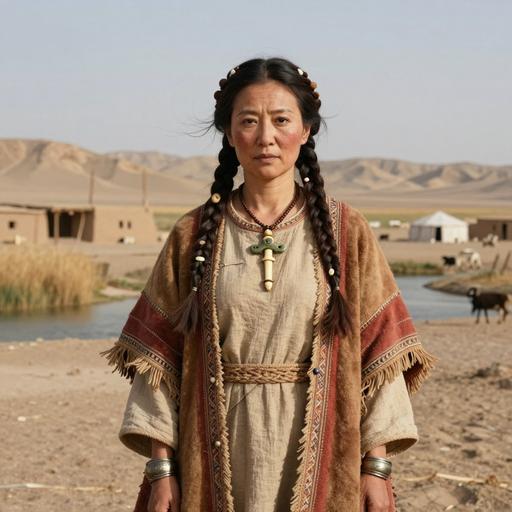
The Bronze Age Beifang Xiaohe culture of Xinjiang, China, represents a fascinating intersection of diverse cultural influences and ancient practices in a region that served as a significant crossroads of early civilizations. Situated in the Tarim Basin, this culture is particularly known from the Xiaohe Cemetery (also known as the Small River Cemetery), which has provided a wealth of archaeological finds that shed light on the life and customs of this enigmatic society.
Geographic and Environmental Context
The Tarim Basin is an expansive arid region characterized by desert landscapes and surrounded by imposing mountain ranges. During the Bronze Age, the climate was somewhat less harsh than today, allowing for settlements to flourish. The Xiaohe site, discovered in the Lop Nur region, is strategically located near ancient river routes, providing vital water resources in an otherwise inhospitable environment.
Chronology
The Beifang Xiaohe culture, primarily dated from around 2000 to 1450 BCE, existed during a period characterized by increasing interactions across Eurasia. This era witnessed the emergence and expansion of various cultures along trade routes that would later evolve into the Silk Road.
Cultural Influences and Origins
The Beifang Xiaohe culture exhibits a confluence of influences from both Indo-European and East Asian cultural spheres. This is evident in the anthropological findings, which show a mix of Europoid and Northeast Asian physical features among the mummified remains. These findings suggest that the inhabitants were likely part of early migratory waves that brought diverse cultural elements into the region.
Archaeological Discoveries
The Xiaohe Cemetery: Perhaps the most famous aspect of this culture, the Xiaohe Cemetery, houses a series of burial sites well-preserved by the dry desert sands. The cemetery is notable for its distinctive boat-shaped coffins and wooden phallus and vulva symbols, indicating specific religious or fertility beliefs.
Mummified Remains: The preservation conditions have yielded naturally-mummified bodies with remarkably intact textiles, hair, and garments. These mummies have become crucial in understanding the physical anthropology, dietary practices, and medical conditions of the period.
Artifacts: Excavations have uncovered a variety of artifacts, including woven fabrics, wooden implements, leather goods, and pottery. These items highlight the technological capabilities and daily life of the inhabitants, reflecting both local innovations and imported styles or materials.
Social and Economic Life
The inhabitants of Xiaohe were likely engaged in a form of semi-nomadic pastoralism, with evidence of sheep and cattle herding. The presence of textiles suggests weaving was a significant activity, possibly involving wool from their livestock. The community might have traded with adjacent regions, facilitating the exchange of goods, ideas, and genetic material.
Burial Practices and Beliefs
The prominence of fertility symbols in the burials implies a strong spiritual or religious component connected to life and regeneration. The orientation of the graves and the inclusion of grave goods suggest that the Xiaohe people practiced complex rituals and held beliefs in an afterlife, similar to other contemporary Bronze Age cultures.
Linguistic and Genetic Studies
Genetic analysis of DNA from the human remains has provided insights into the genetic diversity and migrations during this period. These studies reveal connections with populations across both the Eurasian Steppe and East Asia, complicating our understanding of early cultural and genetic exchanges.
Conclusion
The Beifang Xiaohe culture represents a vibrant, albeit enigmatic, component of the broader ancient Chinese civilization. Its location within the Tarim Basin underscores the region's historical role as a melting pot of Eurasian cultures. This culture's archaeological legacy, featuring unique burial customs and evidence of long-distance cultural interactions, continues to intrigue scholars, offering insights into the diverse tapestry of human history in ancient China.