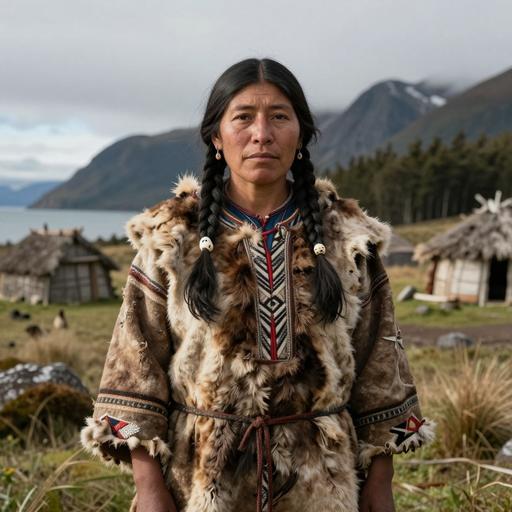
The North Tierra del Fuego region, located at the southernmost tip of South America, was inhabited by the Selknam people approximately 500 years ago, a time that predates significant European contact and influence. The Selknam, also known as the Ona, were a nomadic hunting and gathering society renowned for their endurance and adaptation to the harsh, windswept environments of Tierra del Fuego.
Environment and Geography
The Selknam inhabited the northern parts of Tierra del Fuego, which comprises dense forests, open grasslands, mountains, and a rugged coastline. This region experiences a cold and wet climate with strong winds, which shaped the lifestyle and survival strategies of the Selknam. The landscape was a mosaic of ecological zones, offering various resources for their sustenance.
Social Structure
The Selknam society was organized into bands, each typically comprising several families who were connected through kinship. These bands were relatively small, facilitating mobility and resource management in an environment where resources were often scarce. The Selknam maintained a strong sense of community and shared responsibilities, from hunting to the construction of temporary shelters.
Lifestyle and Subsistence
As a hunter-gatherer society, the Selknam's economy centered around hunting guanacos, a species of wild llama that traveled in herds across the pampas. Guanaco provided the Selknam with meat, hides for clothing and shelter, and bones for tools. Smaller mammals, birds, and marine life supplemented their diet. They used bows and arrows, traps, and other hunting implements crafted from available natural materials.
The Selknam also gathered edible plants, shellfish, and berries. Their deep knowledge of their land allowed them to exploit seasonal resources effectively. Their diet was diverse and adapted to seasonal availability.
Cultural Practices
The Selknam culture was rich in oral traditions and ceremonial practices. One of their most notable ceremonies was the Hain, an initiation rite for young men marking their passage into adulthood. This elaborate ceremony involved dramatic re-enactments of myths, dancing, body painting, and the wearing of masks and costumes to represent spirits.
The Selknam believed in a pantheon of spirits and deities linked to natural elements and phenomena. Their spiritual life was deeply connected to the land and their survival, and shamanistic figures played an essential role in mediating the human and spiritual realms.
Language and Communication
The Selknam language belonged to the Chonan language family, which included languages spoken by other indigenous groups in Patagonia. With no written tradition, their language was fundamental in transferring knowledge, history, and cultural practices across generations. Storytelling was an essential aspect of preserving their cultural identity.
Adaptations and Relations
The Selknam's survival depended on their adaptability and intimate knowledge of their environment. They constructed temporary shelters called chozas, made from tree branches, and animal hides, which provided respite from the elements.
Although largely isolated due to their remote location, the Selknam had some contact with neighboring indigenous groups, such as the Yaghan and Kawésqar, through trade or occasional intermarriage. These interactions were typically limited but contributed to a degree of cultural exchange in the region.
Conclusion
Five hundred years ago, the Selknam of North Tierra del Fuego were a vibrant society uniquely adapted to one of the world's most challenging environments. Their cultural practices, social organization, and survival strategies represent a sophisticated adaptation to the land they inhabited. Despite their disappearance largely due to colonization and external pressures in subsequent centuries, the legacy of the Selknam offers valuable insights into the resilience and diversity of indigenous cultures in pre-Columbian South America.