Menu
Store
Blog
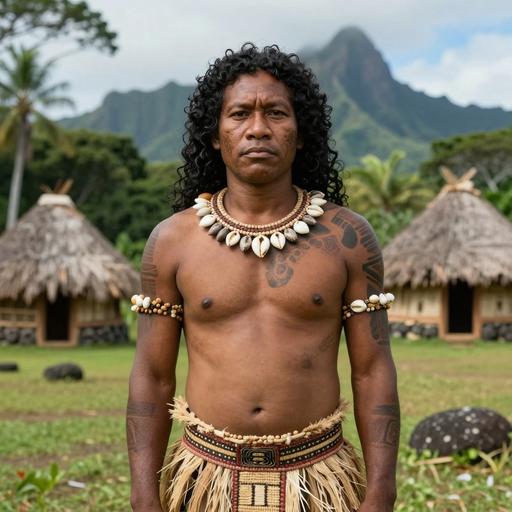
Portrait reconstruction of TAN002
Ancient Individual

A man buried in Vanuatu in the Early Prehistoric era

TAN002
680 BCE - 400 BCE
Male
Vanuatu 2,500 Years Ago
Vanuatu
Scroll to begin
Chapter I

Identity

The biological and cultural markers that define this ancient individual

Sample ID

TAN002

Date Range

680 BCE - 400 BCE

Biological Sex

Male

mtDNA Haplogroup

Q2a

Y-DNA Haplogroup

M-M5

Cultural Period

Vanuatu 2,500 Years Ago

Chapter II

Place

Where this individual was discovered

Country Vanuatu
Locality Tanna
Chapter III

Time

When this individual lived in the broader context of human history

TAN002 680 BCE - 400 BCE
Chapter IV

Story

The narrative of this ancient life

Around 2,500 years ago, the archipelago now known as Vanuatu was inhabited by Austronesian-speaking Lapita people. This period is characterized by significant cultural and technological developments that shaped the history and culture of the Pacific region.

Origins and Migration

The Lapita people, known for their remarkable voyaging and navigation skills, are believed to have originated from Southeast Asia. They were part of one of the largest human migrations in history, the Austronesian expansion, which commenced around 5,000 years ago. By 3,000 years ago, they had spread across vast areas of the Pacific, eventually reaching Vanuatu. The Lapita culture is considered the direct ancestor of many Pacific cultures, including those in Vanuatu.

Settlement Patterns

In Vanuatu, the Lapita people established coastal villages, taking advantage of the abundant marine resources. These early settlements were strategically located to access both the fertile inland areas and the ocean. The choice of coastal sites reflects their maritime culture and reliance on marine navigation and fishing.

Pottery and Material Culture

One of the defining features of the Lapita culture is their pottery, which is highly distinctive due to its intricate geometric designs. The pottery was typically made using locally sourced clay and decorated with dentate stamping techniques. These vessels served both practical and ceremonial purposes, playing a central role in the daily and spiritual life of the Lapita people. The pottery style also serves as a crucial archaeological tool for tracing Lapita migration routes.

Subsistence and Economy

The Lapita settlers of Vanuatu practiced a mixed economy that combined fishing, horticulture, and foraging. They introduced several plant and animal species, including taro, yam, breadfruit, banana, and pigs, which formed the backbone of their diet. Fishing was fundamental, with evidence suggesting the use of hooks, nets, and sophisticated fishing techniques to exploit both reef and deep-sea resources.

Social Structure and Organization

The social structure of the Lapita culture remains a subject of study, but archaeological evidence suggests a community-based life with an emphasis on kinship. Their society was likely organized in extended family groups or clans, with a strong social network supported by reciprocal exchanges of goods and services.

Navigation and Trade

Notably skilled in navigation, the Lapita people used outrigger canoes to traverse large ocean distances. They employed an advanced understanding of ocean currents, star navigation, and environmental cues to travel and trade between islands. This maritime prowess facilitated a network of exchange that disseminated goods, technology, and ideas across the Pacific, knitting together a broader Oceanic culture.

Spiritual and Ritual Life

While the specifics of Lapita spiritual life remain elusive, the complexity of their burial practices reveals a rich ceremonial tradition. Burial sites often contain elaborate grave goods, suggesting a belief in an afterlife or the importance of honoring ancestors. Some anthropologists speculate that the symbolic designs on their pottery had spiritual or religious significance, possibly linked to their mythology and cosmology.

Legacy and Descendants

The Lapita culture laid the foundation for the later cultures of Vanuatu. Over the centuries, these communities adapted and evolved, eventually forming the diverse and distinctive cultures observed in Vanuatu today. The linguistic, genetic, and cultural imprint of the Lapita people is deeply woven into the fabric of modern Pacific societies.

Conclusion

The era of 2,500 years ago in Vanuatu presents a picture of dynamic and adaptable Austronesian communities. Their innovations in navigation, agriculture, and art, combined with their ability to thrive in new environments, highlight the enduring legacy of the Lapita culture in the Pacific Islands' cultural heritage.

Chapter V

Context

Other ancient individuals connected to this sample

Sources

References

Scientific publications and genetic data

Scientific Publication

Language continuity despite population replacement in Remote Oceania

Authors Posth C, Nägele K, Colleran H
Abstract

Recent genomic analyses show that the earliest peoples reaching Remote Oceania-associated with Austronesian-speaking Lapita culture-were almost completely East Asian, without detectable Papuan ancestry. However, Papuan-related genetic ancestry is found across present-day Pacific populations, indicating that peoples from Near Oceania have played a significant, but largely unknown, ancestral role. Here, new genome-wide data from 19 ancient South Pacific individuals provide direct evidence of a so-far undescribed Papuan expansion into Remote Oceania starting ~2,500 yr BP, far earlier than previously estimated and supporting a model from historical linguistics. New genome-wide data from 27 contemporary ni-Vanuatu demonstrate a subsequent and almost complete replacement of Lapita-Austronesian by Near Oceanian ancestry. Despite this massive demographic change, incoming Papuan languages did not replace Austronesian languages. Population replacement with language continuity is extremely rare-if not unprecedented-in human history. Our analyses show that rather than one large-scale event, the process was incremental and complex, with repeated migrations and sex-biased admixture with peoples from the Bismarck Archipelago.

Use code for 40% off Expires Feb 27