Introduction
DNAGENICS note: This article is AI-generated for general educational background. It is not a summary of any particular study, and it is not medical or diagnostic advice.
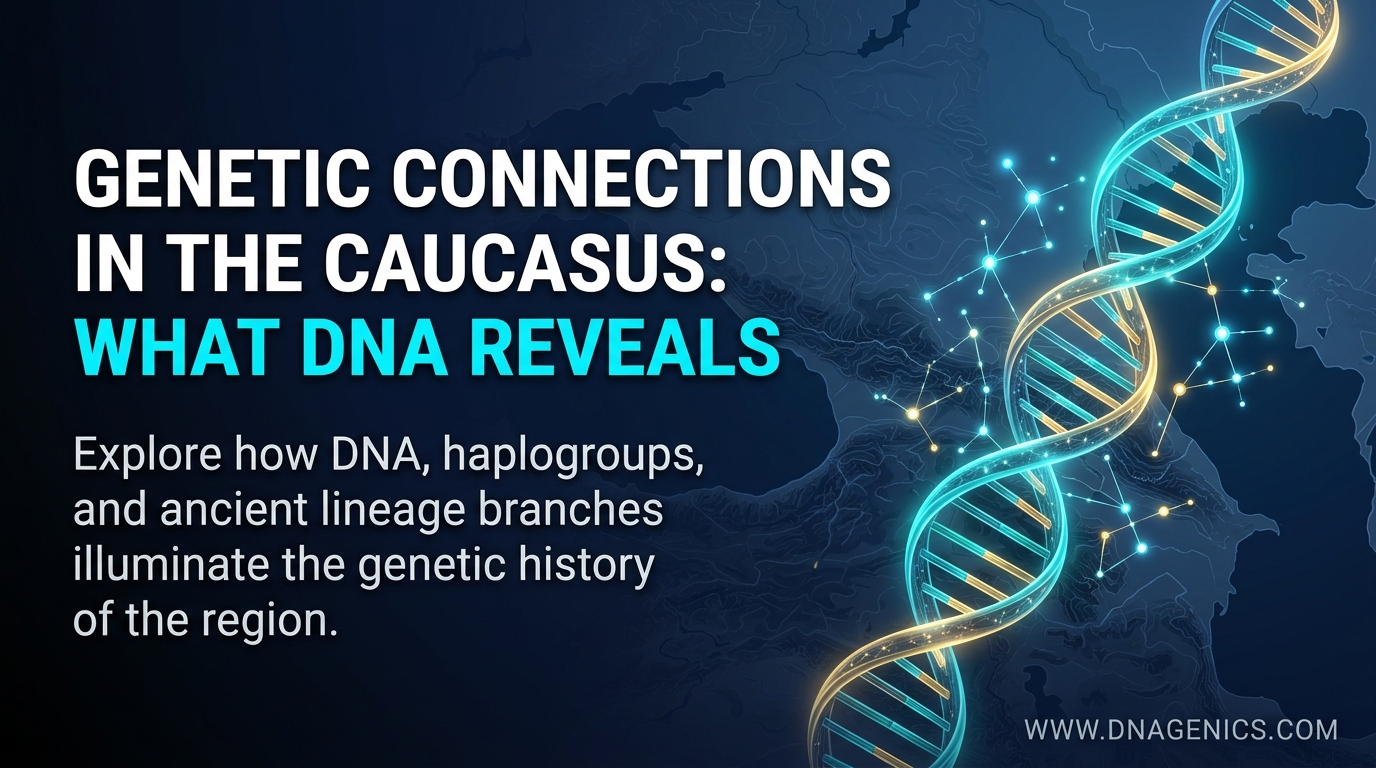
The Caucasus is one of the most genetically and culturally complex regions in the world. Sitting between the Black Sea and the Caspian Sea, it has long connected, filtered, and sometimes separated populations moving between Europe, West Asia, and the broader Eurasian steppe. Because of that position, the region offers a fascinating window into population genetics, ancient DNA, and the way human groups can retain both continuity and change over long periods of time.
When people ask what DNA can tell us about a region like the Caucasus, the answer is usually about genetic similarity rather than fixed identities. Modern and ancient DNA comparisons can show that different populations share branches of ancestry, partial overlaps in haplogroups, and patterns of relatedness shaped by migration, isolation, and repeated contact. These patterns do not prove who anyone “is” in a cultural or national sense, but they do help explain how human populations in a crossroads region became structured over time.
The Caucasus is especially useful for understanding how geography shapes genes. Mountain ranges can limit movement, valleys can encourage local continuity, and trade routes can create long-distance mixing. As a result, the region often shows a layered genetic landscape, with some lineages persisting for a very long time and others reflecting later historical interactions.
Key points
- DNA measures relatedness, not identity. Genetic similarity can suggest shared lineage branches or overlapping ancestry patterns, but it does not define ethnicity, nationality, or personal identity.
- Ancient DNA adds time depth. Comparing modern DNA with ancient DNA helps researchers see how population structure changed across prehistory and history.
- Haplogroups track lineages. Y-chromosome and mitochondrial haplogroups represent paternal and maternal branches, which can be informative but only capture part of ancestry.
- Population genetics is about frequencies. Scientists look at patterns across groups, not single individuals, to understand where shared genetic signals are strongest.
- Crossroads regions are layered. The Caucasus has often served as a contact zone where local continuity and incoming movements both influenced genetic variation.
What this means for genetic similarity
In population genetics, the idea of genetic similarity means that some groups share more alleles, lineage branches, or ancestry components with each other than with distant populations. In the Caucasus, that often reflects a long history of regional continuity combined with connections to neighboring areas. A person’s DNA may show affinity to reference populations from this broader region because those populations share parts of deep ancestral background, not because DNA can label someone as belonging to a single ancient group.
This is why reference groups matter. In ancestry analysis, scientists compare DNA to panels of modern and ancient reference populations. Those references provide a framework for detecting similarities, but they are not perfect stand-ins for the full past. If a person’s DNA clusters near a Caucasus-related reference profile, that suggests shared genetic structure or shared lineage branches with populations used in the comparison. It does not mean that their personal family history can be reduced to one place, one people, or one historical label.
The same caution applies to haplogroups. A haplogroup can be a useful clue about a paternal or maternal branch, but it is only one line in a very large family tree. Two people can share a haplogroup and still have very different overall ancestry, while two populations can be genetically similar without sharing the same dominant haplogroups. Population-level patterns matter more than any single marker.
Historical and archaeological context
The Caucasus has been occupied by human groups for a very long time, and archaeology shows repeated waves of cultural development, exchange, and adaptation. Over thousands of years, communities in the region interacted with neighbors across the steppe, Anatolia, the Iranian plateau, and the Near East. That made the area a natural meeting place for ideas, technologies, and people. In genetic terms, such contact zones often preserve a mosaic of ancestry signals rather than a single uniform profile.
The region’s mountainous terrain also matters. Mountains can create pockets of relative isolation, which can preserve local genetic patterns over long periods. At the same time, passes and river corridors can connect communities, allowing movement of people and genes. This balance between isolation and contact helps explain why the Caucasus is often described as having both deep continuity and strong regional diversity.
Ancient DNA from the broader area has helped show that populations in this part of Eurasia were not static. Instead, they were shaped by shifting subsistence strategies, local expansions, exchanges with neighboring regions, and later historical movements. That background is important because it reminds us that modern populations are not simple snapshots of a single ancient moment. They are the result of many layers of population history.
The science behind it
To study the genomic history of a region, researchers usually combine several kinds of genetic evidence. They may look at autosomal DNA, which captures ancestry from many branches of the family tree, and they may also examine Y-chromosome and mitochondrial DNA, which follow single paternal and maternal lines. Together, these data help identify shared ancestry patterns, population structure, and possible connections between ancient and modern groups.
Ancient DNA is especially powerful because it provides direct snapshots from the past. Instead of inferring old populations only from modern variation, scientists can compare ancient genomes with present-day people and with other ancient samples. This makes it possible to see which genetic patterns persisted, which changed, and which appeared through later mixtures of populations. In a region like the Caucasus, where history involved both continuity and movement, that time depth is crucial.
In Simple Terms: DNA in the Caucasus often looks like a patchwork built over a long time. Some genetic patterns stayed local, some spread through migration, and some mixed with neighboring regions, so ancestry results usually reflect shared similarity rather than a single origin story.
Another important idea is that genetic data are statistical. They reveal clusters, affinities, and proportions, not exact biographies. If a DNA profile shows similarity to a Caucasus reference group, that means the profile shares more features with that group than with other reference sets in the comparison. It does not prove a direct line of descent from any named ancient individual, and it does not turn a genetic signal into a complete personal history.
Why it matters
Understanding the genomic history of the Caucasus helps people appreciate how human diversity is formed. It shows that ancestry is often regional, layered, and shared across many communities rather than tied to simple categories. For readers exploring their own DNA, this can be especially helpful because it explains why ancestry reports may point to broad affinities, shared lineage branches, or overlapping population histories instead of a single precise label.
It also matters because the Caucasus is a reminder that population genetics is about connections over time. Ancient DNA and haplogroups can illuminate movement, continuity, and interaction, but they work best when interpreted carefully. The most accurate takeaway is usually not “you are this group,” but rather “your DNA shares genetic similarity with reference populations from this region, and that similarity reflects a long and complex history of human movement and contact.”