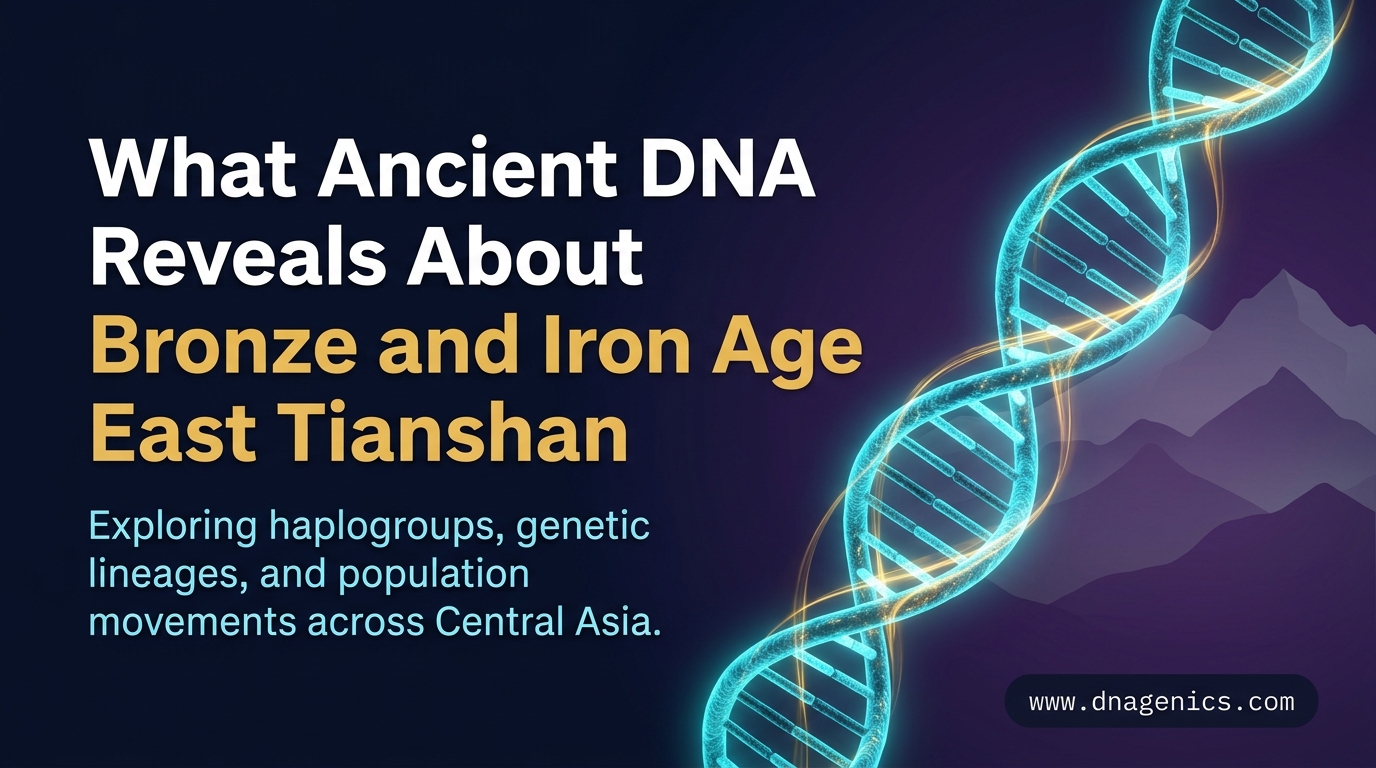
What Ancient DNA Reveals About Bronze and Iron Age East Tianshan
Ancient DNA has transformed how researchers study the past. Instead of relying only on artifacts, burial customs, and written records, it is now possible to compare genetic material preserved in ancient remains with modern and ancient reference populations. This makes it possible to study broad patterns of genetic similarity, population movement, and shared lineage branches across long stretches of time.
The East Tianshan region sits at an important geographic crossroads in Inner Asia. During the Bronze and Iron Ages, populations in and around this area were part of wider networks that connected steppe communities, mountain corridors, and oasis regions.
Ancient DNA from places like this does not mean that any modern person or group “is” a particular ancient population. Instead, it helps show which reference groups share parts of a genetic profile, and how ancestry in a region may have changed over time.
Key points
- DNA is inherited in mixed pieces, so each person reflects many ancestral contributions rather than a single origin.
- Population genetics compares groups, not identities, using shared markers and patterns of variation.
- Haplogroups trace deeper maternal or paternal line branches, but they do not define a whole population by themselves.
- Ancient DNA can reveal how communities in a region were connected to neighboring populations through movement, marriage, trade, and long-term interaction.
- Reference groups matter, because every result depends on which ancient or modern populations are used for comparison.
What this means for genetic similarity
When people hear that ancient DNA has revealed distinctive ancestries in a region like East Tianshan, it is easy to imagine a simple story of one group replacing another. Population genetics is usually more complex.
Ancient communities often showed genetic similarity to more than one regional source, and their DNA could reflect a mix of local continuity and inputs from surrounding areas. In other words, the genome is not a label for a single identity, but a record of shared ancestry across many generations.
This is why reference groups are so important. A sample may show stronger affinity with one set of steppe populations, mountain populations, or oasis-associated groups than with others, but that does not prove direct descent from any named historical people. It means the sample shares more genetic branches and allele patterns with those references.
In ancestry analysis, that kind of result helps reconstruct broad population history, not personal ethnicity or nationality.
Shared lineage branches can also appear in uniparental markers such as Y-chromosome or mitochondrial haplogroups. These lineages are useful for tracking deep ancestry lines, but they represent only one small part of the overall genetic picture. A population can carry multiple haplogroups, and the same haplogroup can be found in many different regions.
So, when ancient DNA points to distinctive ancestries in East Tianshan, the real message is about patterns of relatedness and movement, not a single unbroken family line.
Historical and archaeological context
The Bronze and Iron Ages were periods of major cultural change across Inner Asia. Communities in and around the Tianshan range lived in a landscape shaped by mountains, grasslands, river valleys, and routes that linked distant regions.
Archaeologists have long known that these settings supported contact between mobile pastoral groups, settled farming communities, and exchange networks that moved goods, ideas, and people.
This region is often discussed in the broader context of Eurasian interaction. The steppe world to the north and west, the oases and basins to the south and east, and the mountain corridors in between all created opportunities for migration and mixing.
Material culture can suggest contact, but DNA provides another layer of evidence by showing how populations were biologically related, how ancestry shifted through time, and how local communities fit into wider regional networks.
It is important to remember that archaeology and genetics answer different questions. Pottery styles, burial traditions, and architecture can spread without large-scale population movement, and population movement can happen without leaving obvious changes in artifacts. Ancient DNA helps fill in those gaps by offering a population-level view of ancestry that complements the archaeological record.
The science behind it
Ancient DNA analysis begins with very small fragments of genetic material recovered from bones or teeth. Over time, DNA breaks down, so scientists work with short sequences and carefully screen for damage patterns that indicate authenticity.
Once the data are cleaned and compared, researchers can examine shared variants across the genome to estimate genetic similarity among ancient samples and between ancient and modern populations.
Population genetics then places those samples within broader comparative frameworks. Methods may look at clustering, ancestry components, shared drift, or lineage markers such as haplogroups. These tools do not identify a person’s ethnic group in a modern sense. Instead, they show which populations, past or present, share more ancestry signals with the sample under study.
That is especially useful in areas like East Tianshan, where many communities have interacted over long periods and where ancestry histories may be layered and regionally diverse.
In simple terms: Ancient DNA helps researchers see which populations share parts of a genetic history. It does not prove who someone “was,” but it can show which ancient or modern groups they are genetically closer to and how populations changed over time.
In practice, these results are strongest when interpreted alongside archaeology, geography, and history. A genetic profile may look distinctive because it combines ancestry from several sources that were common in a specific region and period. That distinctiveness can reflect long-term local development, repeated contact across borders, or both.
The key point is that ancient DNA describes statistical relationships between populations, not fixed labels for individuals.
Why it matters
Studying ancient DNA in regions like East Tianshan matters because it helps build a more nuanced picture of human history. Rather than imagining the past as a series of isolated peoples, we can see how communities interacted, mixed, and moved across complex landscapes.
That makes the history of Eurasia more connected, and often more interesting, than simple migration stories suggest.
It also matters for ancestry interpretation today. Many people are curious about their genetic origins, but DNA results are best understood as patterns of genetic similarity and shared lineage branches. Ancient DNA adds depth to that understanding by showing how reference populations are built, why haplogroups are only part of the story, and how population genetics can illuminate the past without reducing identity to biology.