Préparation du rapport

Chargement des informations et références disponibles

Connexion au corpus archéologique…

Collecte des archives antiques

Aller au contenu principal
Croatia: Late Bronze–Early Iron Age Echoes
Profil culturel

Croatia: Late Bronze–Early Iron Age Echoes

Material traces and ancestral mitochondria from Velim-Kosa and Jazinka Cave

1500 CE - 400 BCE
Croatia (coastal & interior sites)
Faites défiler pour commencer
Chapitre I

Le récit

Comprendre la culture Croatia: Late Bronze–Early Iron Age Echoes

Archaeological finds from 1500–400 BCE in Croatia (Velim-Kosa, Jazinka Cave) reveal Late Bronze to Early Iron Age lifeways. Three DNA samples (mtDNA HV, H) offer preliminary maternal links to broader European lineages; paternal picture remains unresolved.

Time Period

1500–400 BCE

Region

Croatia (coastal & interior sites)

Common Y-DNA

Not reported / insufficient data

Common mtDNA

HV (2), H (1)

Chapitre II

Chronologie

Moments clés de l'histoire de cette culture

1500 BCE

Earliest contexts for Croatia_LBA_EIA

Archaeological contexts at Velim-Kosa begin to reflect Late Bronze Age lifeways that will evolve into Early Iron Age patterns over the next millennium.

Chapitre III

Origins & Emergence

The archaeological horizon labeled Croatia_LBA_EIA spans roughly 1500–400 BCE, a time when Late Bronze Age lifeways gradually gave way to Early Iron Age innovations across the eastern Adriatic. Excavations at Velim-Kosa and the cave contexts of Jazinka Cave provide the primary contextual anchors for this dataset. Material culture from these sites—metalwork fragments, pottery fabrics and burial deposits—speaks to communities rooted in local traditions while participating in wider exchange networks across the Adriatic and into the Balkans.

Archaeological data indicate continuity in settlement and craft practices alongside incremental changes in burial rites and metal technology that characterize the transition to the Iron Age. Limited evidence suggests increasing regional differentiation after ca. 800–600 BCE, but the small number of securely associated contexts makes broad generalizations hazardous. The three genetic samples linked to these sites must therefore be read as preliminary glimpses rather than definitive population histories.

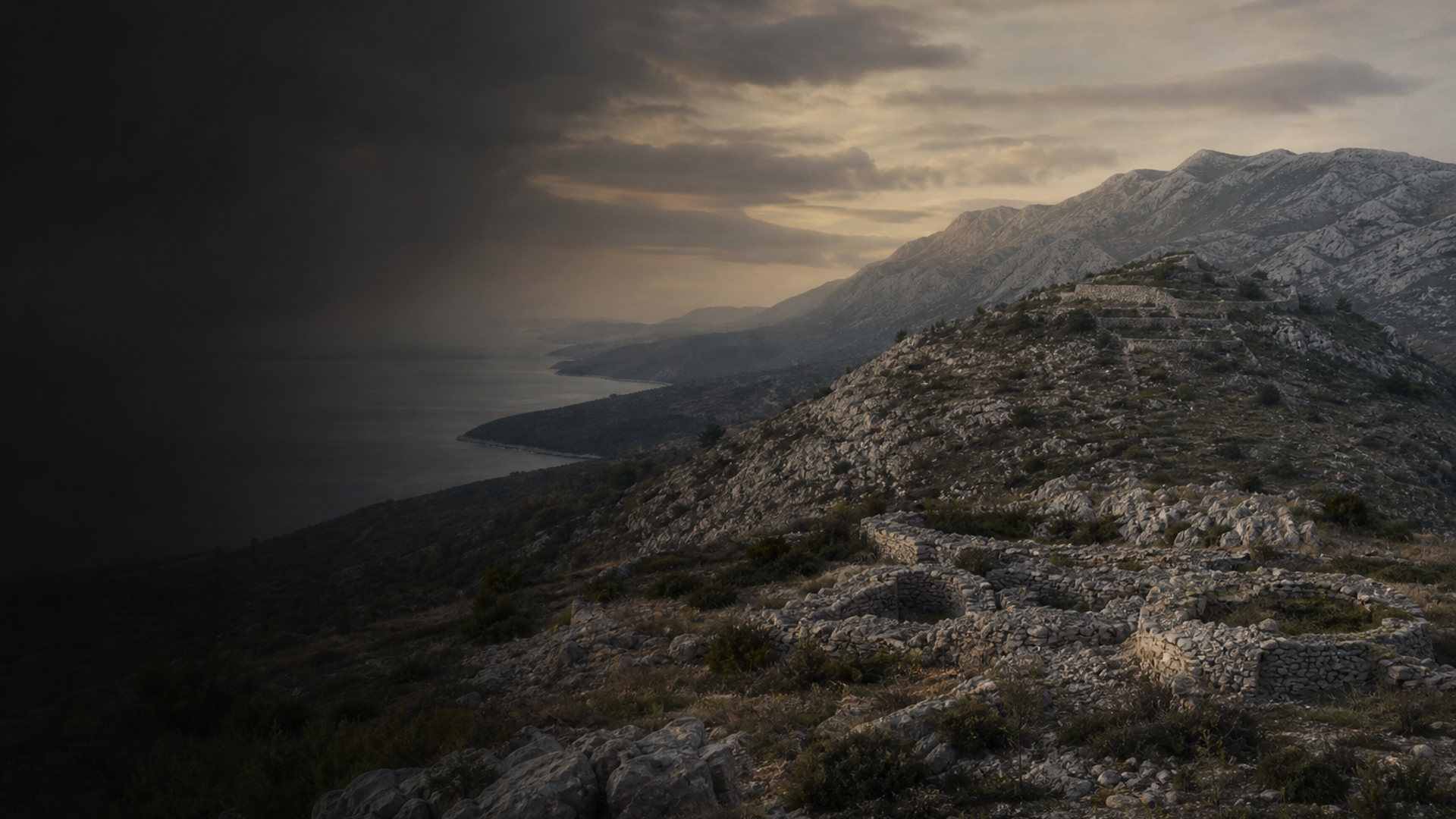
Taken together, the archaeological record evokes a landscape of villages and seasonal pastures, of artisans experimenting with new alloys and of coastal and inland routes carrying goods and ideas. The cinematic image is one of a world in motion: local traditions illuminated by the glow of distant contacts, yet shaped primarily by long-standing regional lifeways.

  • Sites: Velim-Kosa and Jazinka Cave anchor the dataset
  • Dates: 1500–400 BCE, spanning Late Bronze to Early Iron Age
  • Evidence shows local continuity with growing regional interactions
Chapitre IV

Daily Life & Society

Archaeological contexts from Late Bronze to Early Iron Age Croatia paint an image of everyday life organized around mixed farming, herding and localized craft production. Terraced fields and small hamlets likely dotted the coastal plain and inland valleys; people kept domestic herds and cultivated cereals and pulses, while local smiths and potters produced the tools and vessels of daily use. Finds from cave contexts such as Jazinka Cave suggest ritualized deposition and varied mortuary behaviors, which may reflect household-level status or lineage practices.

Social organization at this time appears to have been flexible: households and extended kin groups formed the core of production and memory, even as some settlements show signs of craft specialization or increased accumulation of prestige objects. Trade and exchange—alongshore maritime routes and overland connections into the central Balkans—brought exotic metals and styles that quickly became integrated into local repertoires. Archaeological evidence indicates both continuity with earlier Bronze Age lifeways and gradual shifts toward the more stratified societies often associated with the Early Iron Age, but the scale and timing of social change remain topics of active research given the limited dataset.

  • Economy: mixed farming, herding, and local craft production
  • Burials: cave deposits and variable funerary practices suggest social nuance
Chapitre V

Genetic Profile

Genetic data for the Croatia_LBA_EIA group are extremely limited: three samples tied to Velim-Kosa and Jazinka Cave. All three yielded mitochondrial DNA results—two HV haplotypes and one H—while no consistent Y-chromosome signature is currently reported for this set. Because the sample count is fewer than ten, conclusions must remain provisional.

mtDNA haplogroups H and HV are common across Europe during the Bronze and Iron Ages and persist today; their presence here indicates maternal line continuity with broader European maternal lineages rather than a unique local founder event. The absence of reliable Y-DNA data in these samples leaves paternal ancestry unresolved: questions about continuity versus incoming male-mediated gene flow during the Late Bronze–Early Iron Age transition cannot be answered from this dataset alone.

Archaeogenetic studies elsewhere in the Balkans have documented a mosaic of ancestry components—local Neolithic farmer ancestry, late Neolithic/Bronze Age steppe-derived signals, and later Iron Age heterogeneity. The Croatia_LBA_EIA mtDNA results are compatible with such regional complexity but cannot, by themselves, resolve demographic processes. Expanded sampling, especially of well-provenanced burials and successful nuclear DNA extraction, is essential to link the archaeological narrative to population dynamics robustly.

  • Sample size: 3—interpretations are preliminary
  • mtDNA: HV (2) and H (1); Y-DNA: insufficient data to conclude
Chapitre VI

Legacy & Modern Connections

The genetic and archaeological echoes of the Croatia_LBA_EIA period resonate into the present but require cautious translation. Haplogroups H and HV remain among the most frequent maternal lineages in modern Europe, including contemporary Croatian populations, suggesting enduring maternal continuities across millennia. Archaeological continuities—settlement patterns, craft traditions and regional exchange—also help explain cultural foundations that later communities built upon during the classical Iron Age and historical periods.

However, direct lines from these three samples to modern individuals are not established; small sample sizes and gaps in paternal data mean that claims of direct ancestry would be premature. Instead, these findings should be framed as pieces of a larger puzzle: they illuminate maternal threads within a tapestry of long-term regional interaction, and they underline the need for expanded sampling and integrated archaeological-genetic studies to more fully reveal how Bronze Age communities in Croatia contributed to the genetic and cultural landscape of the later Iron Age and beyond.

  • mtDNA continuity suggests maternal links to modern European lineages
  • Small sample size prevents direct claims of ancestry—more data needed
Propulsé par l'IA

Assistant IA

Posez des questions sur la culture Croatia: Late Bronze–Early Iron Age Echoes

Assistant IA par DNAGENICS

Débloquer cette fonction
Posez des questions sur la culture Croatia: Late Bronze–Early Iron Age Echoes. L'assistant IA peut expliquer les résultats génétiques, le contexte historique, les preuves archéologiques et les liens génétiques avec les populations actuelles, dans les limites de l'interprétation.
Exemple d'analyse IA

La culture Croatia: Late Bronze–Early Iron Age Echoes représente un chapitre fascinant de l'histoire humaine…

L'analyse génétique met en évidence des similarités avec des populations antérieures et des signes d'adaptations propres. Les échantillons d'ADN ancien éclairent les schémas migratoires et les liens entre populations, avec des limites qui dépendent de l'étude et du contexte archéologique.

Il s'agit d'un aperçu de l'analyse IA. Accédez à l'assistant complet pour explorer :

  • Composition et similarité génétique
  • Schémas migratoires et origines
  • Vie quotidienne et pratiques culturelles
  • Contexte génétique actuel

Explorez d'autres cultures antiques

Découvrez les récits de civilisations issues du monde antique