Préparation du rapport

Chargement des informations et références disponibles

Connexion au corpus archéologique…

Collecte des archives antiques

Aller au contenu principal
Middle Bronze Armenia: Highlands in Transition
Profil culturel

Middle Bronze Armenia: Highlands in Transition

Archaeology and DNA reveal a patchwork of local roots and incoming threads across 2127–1211 BCE

2127 CE - 1211 BCE
Armenian Highlands (Armenia)
Faites défiler pour commencer
Chapitre I

Le récit

Comprendre la culture Middle Bronze Armenia: Highlands in Transition

Archaeological sites in Armenia (Katnaghbiur, Karashamb, Tavshut and others) dated 2127–1211 BCE show a Middle Bronze Age population with mixed maternal lineages (T, K, U, HV) and limited Y-chromosome diversity. Genetic patterns hint at local continuity with episodic external influence; conclusions remain preliminary (N=9).

Time Period

2127–1211 BCE

Region

Armenian Highlands (Armenia)

Common Y-DNA

E (2 of 9), R (1 of 9)

Common mtDNA

T (4), K (2), U (2), HV (1)

Chapitre II

Chronologie

Moments clés de l'histoire de cette culture

2500 BCE

Regional Bronze Age consolidation

Early Bronze Age developments in the Armenian Highlands set the stage for Middle Bronze Age communities and craft networks that persist into 2127–1211 BCE.

Chapitre III

Origins & Emergence

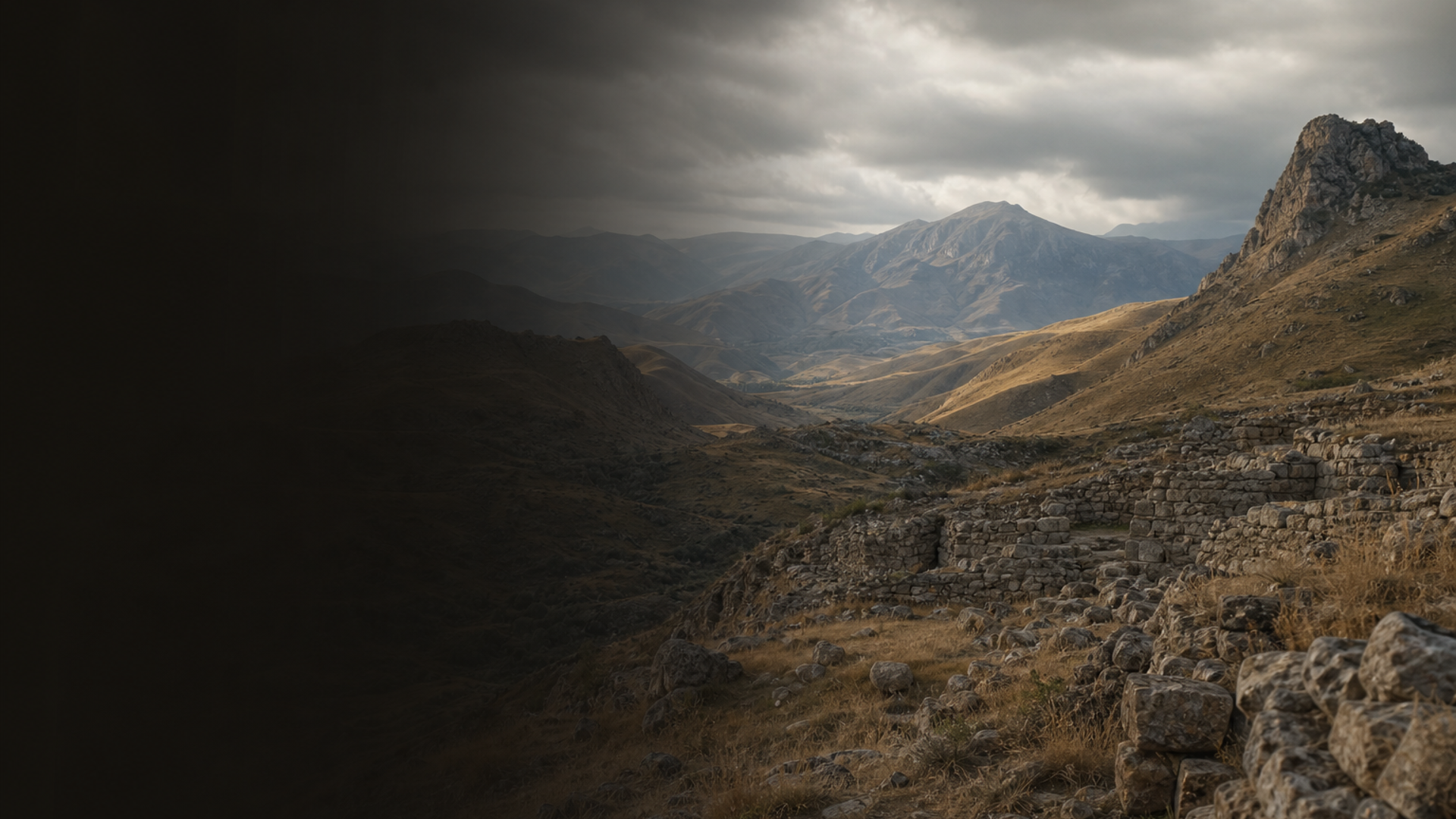
The Middle Bronze Age communities sampled across the Armenian Highlands (sites such as Katnaghbiur 1, Tavshut, Keti, Karashamb Cemetery, Dzori Gekh and Nerquin Getashen) emerge in the archaeological record between roughly 2127 and 1211 BCE. Archaeological data indicates continuity with earlier Bronze Age settlement patterns—hilltop dwellings, cemeteries, and an intensification of metallurgy and craft specialization—set against a rugged, cinematic landscape of terraces and river valleys.

Genetically, the small corpus of nine individuals exhibits a mosaic of maternal lineages (T, K, U, HV) commonly associated with West Eurasia and the Near East, suggesting deep regional maternal continuity and connections across the Caucasus corridor. The Y-DNA distribution is sparse and uneven (two E, one R), pointing to limited paternal resolution; haplogroup E in this region may reflect long-standing Near Eastern/Caucasus ties, while R could indicate episodic gene flow from steppe-associated sources. Given N=9, these signals are intriguing but preliminary.

Limited evidence suggests that population dynamics in this era were shaped by local persistence combined with mobility along trade and pastoral corridors. The archaeological places named above provide the spatial anchor for these genetic glimpses: each burial or assemblage is a fragment of a larger, still-fragile narrative about emergence and entanglement in the Armenian Middle Bronze Age.

  • Samples dated 2127–1211 BCE from six Armenian sites
  • Maternal lineages point to West Eurasian and Near Eastern connections
  • Paternal markers are few; patterns are suggestive but preliminary (N=9)
Chapitre IV

Daily Life & Society

Archaeological evidence from cemeteries and settlement loci in Armenia evokes a daily life shaped by agriculture, herding, and metallurgy. Ceramic repertoires and metal objects recovered in Middle Bronze contexts indicate specialized craft production and long-distance exchange networks that brought raw materials and stylistic influences into highland valleys and foothills.

Houses and communal structures—where preserved—suggest families organized around household units with seasonal transhumance likely practiced in upland pastures. Funerary contexts at sites such as Karashamb Cemetery and Dzori Gekh often include grave goods that gesture toward social differentiation: personal ornaments, ceramic vessels, and metal tools that mark identity, status, and connections beyond the immediate landscape.

The material world of these communities can be imagined in cinematic terms: smoke and hammer-spark, shepherds moving along stony terraces, and marketplaces humming with exchanged wares. Yet this picture is built from fragments. Archaeological data indicates clear craft and burial traditions, but the scale and social structures inferred from them remain partly conjectural without broader sampling and contextual study.

  • Economy: mixed farming, herding, specialized metallurgy
  • Burials show social differentiation and regional exchange ties
Chapitre V

Genetic Profile

The genetic dataset for Armenia_MBA comprises nine dated individuals (2127–1211 BCE) from six named sites. Maternal diversity is relatively high: four individuals carry mtDNA T, two carry K, two carry U, and one carries HV. These maternal haplogroups are broadly distributed across West Eurasia and the Near East and often appear in ancient samples from the Caucasus and Anatolia, consistent with a regional maternal substrate that persisted into the Middle Bronze Age.

Paternal resolution is limited: two individuals show haplogroup E and one shows R. Haplogroup E in the Caucasus and adjacent regions may reflect enduring connections with Near Eastern lineages, while R is commonly linked to wider West Eurasian and steppe-associated populations. With only three Y-chromosome calls, it is not possible to robustly infer paternal structure or migration rates; the presence of R hints at some degree of gene flow from northern or steppe-adjacent groups, but archaeological corroboration is essential.

Overall, the data point toward a mixed picture of local continuity on the maternal side with episodic paternal inputs—an archaeological landscape of enduring communities shaped by occasional long-range contacts. Because the sample count is low (<10), these conclusions should be treated as preliminary: additional sampling across sites and time-depth is required to test patterns of continuity, admixture, and social kinship.

  • mtDNA dominated by T (4), with K, U, HV also present
  • Y-DNA sparse (E and R); limited paternal inference—results preliminary
Chapitre VI

Legacy & Modern Connections

The Middle Bronze Age inhabitants of the Armenian Highlands contributed threads to the genetic and cultural tapestry of the Caucasus. The maternal lineages observed—T, K, U, HV—persist in varying frequencies across modern West Eurasian and Caucasian populations, suggesting elements of continuity in the female-mediated ancestry. The detected paternal markers, while few, are consistent with a long-term pattern in which the highlands acted both as a refuge of local lineages and as a crossroads for episodic incoming male-mediated gene flow.

Archaeogenetic snapshots like Armenia_MBA open a cinematic window into those ancient lives: landscapes of stone and flame, households steeped in craft, and people connected by routes of exchange. Yet caution is essential: with only nine samples, the story remains fragmentary. Further ancient DNA sampling and tightly contextualized excavation will refine how Middle Bronze communities in Armenia relate to later Iron Age societies and to the genetic map of the modern Caucasus.

  • Maternal haplogroups suggest long-term regional continuity
  • Highlands functioned as a crossroads—local persistence with episodic outside influence
Propulsé par l'IA

Assistant IA

Posez des questions sur la culture Middle Bronze Armenia: Highlands in Transition

Assistant IA par DNAGENICS

Débloquer cette fonction
Posez des questions sur la culture Middle Bronze Armenia: Highlands in Transition. L'assistant IA peut expliquer les résultats génétiques, le contexte historique, les preuves archéologiques et les liens génétiques avec les populations actuelles, dans les limites de l'interprétation.
Exemple d'analyse IA

La culture Middle Bronze Armenia: Highlands in Transition représente un chapitre fascinant de l'histoire humaine…

L'analyse génétique met en évidence des similarités avec des populations antérieures et des signes d'adaptations propres. Les échantillons d'ADN ancien éclairent les schémas migratoires et les liens entre populations, avec des limites qui dépendent de l'étude et du contexte archéologique.

Il s'agit d'un aperçu de l'analyse IA. Accédez à l'assistant complet pour explorer :

  • Composition et similarité génétique
  • Schémas migratoires et origines
  • Vie quotidienne et pratiques culturelles
  • Contexte génétique actuel

Explorez d'autres cultures antiques

Découvrez les récits de civilisations issues du monde antique