Préparation du rapport

Chargement des informations et références disponibles

Connexion au corpus archéologique…

Collecte des archives antiques

Aller au contenu principal
Mongun-Taiga Kurgans of Western Mongolia
Profil culturel

Mongun-Taiga Kurgans of Western Mongolia

Late Bronze Age burials in the Altai foothills hint at blended steppe ancestries

1441 CE - 1019 BCE
Western Mongolia (Uvs, Khovd, Bayan‑Ulgii)
Faites défiler pour commencer
Chapitre I

Le récit

Comprendre la culture Mongun-Taiga Kurgans of Western Mongolia

Three Late Bronze Age kurgan burials (1441–1019 BCE) from western Mongolia document a frontier of eastern and western Eurasian genetic signals. Archaeology and ancient DNA together suggest mobile pastoral lifeways and early admixture in the Mongun‑Taiga cultural horizon — conclusions remain preliminary (n=3).

Time Period

1441–1019 BCE

Region

Western Mongolia (Uvs, Khovd, Bayan‑Ulgii)

Common Y-DNA

R (2), N (1)

Common mtDNA

U (2), R (1)

Chapitre II

Chronologie

Moments clés de l'histoire de cette culture

1200 BCE

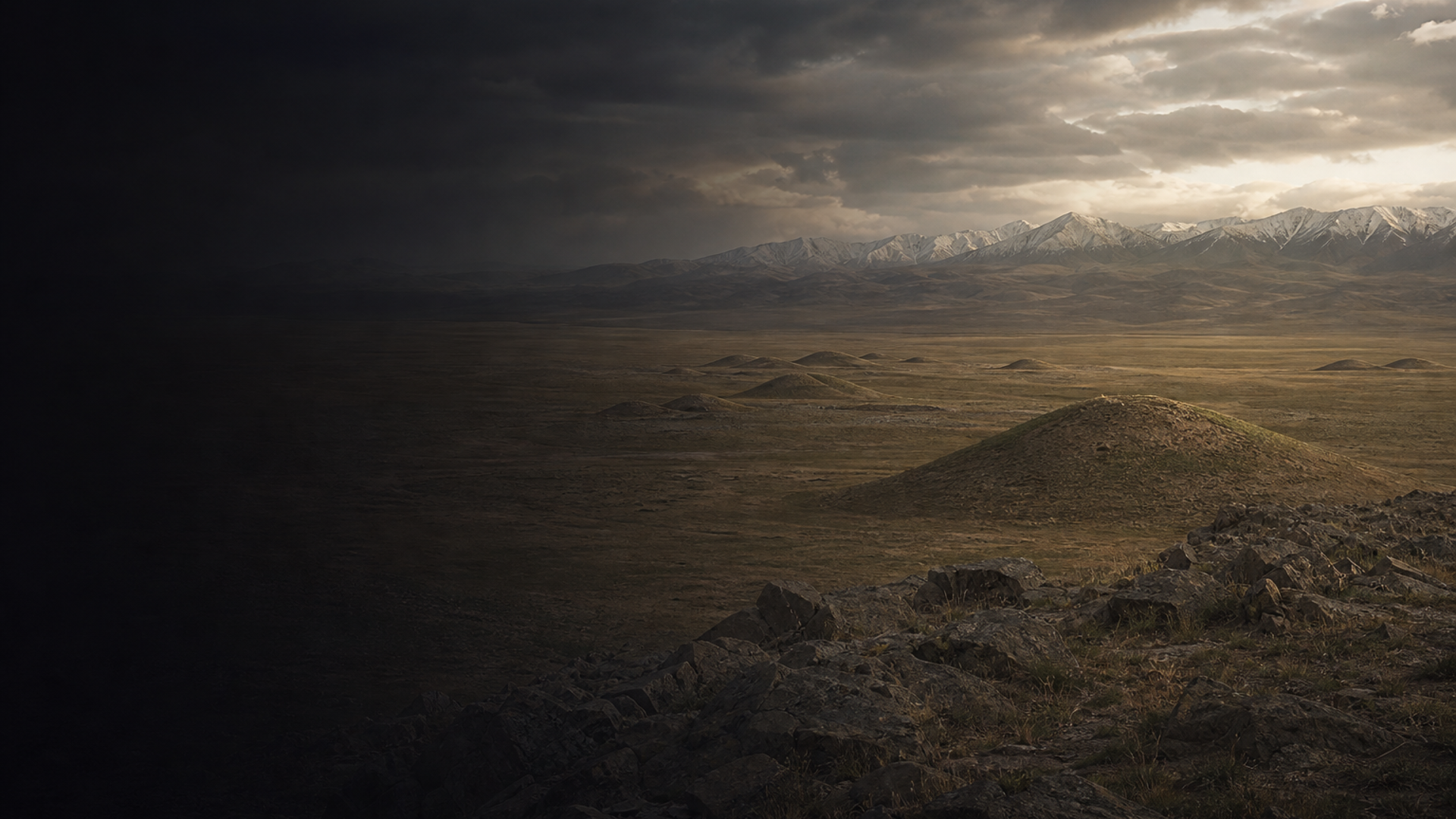
Landscape of kurgan burials

Multiple kurgan interments in western Mongolia date to the middle of the Late Bronze Age, reflecting mobile pastoral practices and emerging east–west contacts.

Chapitre III

Origins & Emergence

Set in the rain‑shadow of the Altai and the wide Uvs basin, the Mongun‑Taiga late Bronze Age horizon emerges in the archaeological record as a constellation of kurgan burials, ritual mounds, and ephemeral camps. The three sampled burials — Ulaangom cemetery kurgan 59 (Uvs aimag), Khudzrtyn gol II barrow 1 (Khovd), and Kulala Ula barrow 2 (Bayan‑Ulgii) — fall between 1441 and 1019 BCE, placing them squarely in a period of intensified mobility and interregional contact across the western Mongolian steppe.

Archaeological data indicate a funerary vocabulary of mound construction and articulated body placement that resonates with broader Altai‑Sayan mortuary traditions. Grave assemblages from contemporaneous sites (tools, metal fragments, worked bone — where preserved) suggest pastoralist economies with durable regional networks rather than isolated homesteads. Limited evidence suggests these groups occupied ecological thresholds — river valleys and mountain foothills — that favored seasonal movement between winter shelters and summer pastures.

Cinematic landscapes of wind‑scarred steppe and stony ridgelines frame this emergence: the archaeological picture is one of mobile communities negotiating ecological variety and long‑distance ties. However, with only three genetic samples, inferences about demographic origins and the full cultural scope of Mongun‑Taiga 3 remain preliminary and should be tested with broader excavation and dating.

  • Three kurgan burials from Uvs, Khovd and Bayan‑Ulgii dated 1441–1019 BCE
  • Funerary architecture aligns with Altai‑Sayan steppe traditions
  • Evidence points to mobile pastoral economies and interregional contact
Chapitre IV

Daily Life & Society

The material footprint of Mongun‑Taiga communities is sparse but evocative: small stone and earth mounds mark graves amid grassland and riverine corridors, while surface scatters and ephemeral hearths imply seasonal movement. Archaeological indicators from the wider region — livestock bone assemblages, portable metalwork fragments, and worked bone tools — support a pastoralist lifeway focused on sheep, goats, cattle and possibly horses, with households undertaking seasonal transhumance between lowland wintering zones and upland summer pastures.

Social structure can be glimpsed through funerary variability. Prominent kurgans with multiple grave features suggest differentiation in status or role, perhaps linked to livestock ownership, control of camp networks, or ritual leadership. Grave goods are generally modest, but their placement and treatment of the body highlight investment in commemoration and memory. Funerary landscapes functioned as territorial markers across a mosaic of kin groups and mobile households.

Craft and exchange likely tied families into long‑distance circuits: metal objects (often recycled), ornaments, and non‑local raw materials point to connections with adjacent steppe belts and upland zones. While the archaeological picture conveys a rhythm of herding life etched into the land, precise details about household size, craft specialization, and social hierarchy remain fragmentary and require more excavation and contextual analysis.

  • Seasonal pastoralism implied by burial contexts and regional zooarchaeology
  • Kurgans indicate social differentiation and ritualized commemoration
Chapitre V

Genetic Profile

Ancient DNA from the three Mongun‑Taiga burials yields a compact but intriguing genetic signal. Y‑chromosome lineages include two samples assigned to haplogroup R and one to N; mitochondrial lineages include two U and one R. These broad haplogroup assignments suggest an admixture landscape in which western Eurasian‑associated paternal or maternal markers (R and U) coexist with northeastern Eurasian‑linked paternal marker N.

Haplogroup R is geographically widespread across Eurasia and, in the broad sense recovered here, can reflect western steppe connections or long‑distance male lineages moving into the Altai region. Haplogroup N on the Y chromosome is often associated with northeastern Eurasian populations and points to eastern inputs into the gene pool. On the maternal side, mtDNA U is a recurring marker across many steppe contexts and in parts of western Eurasia; its presence here aligns with archaeological interpretations of cross‑steppe contact. The mtDNA R lineage — a broad macro‑haplogroup — similarly marks deep Eurasian continuity.

Crucially, sample size is very small (n=3). While these results are consistent with a mixed east–west genetic profile in western Mongolia during the Late Bronze Age, they are preliminary: low sample counts mean that population‑level claims are tentative. Further sampling and genome‑wide analyses are necessary to resolve admixture proportions, sex‑biased mobility, and links to contemporaneous groups in the Altai, Baikal and Inner Asian steppe.

  • Y: R (2) and N (1); mtDNA: U (2) and R (1)
  • Signals suggest east–west admixture but conclusions are preliminary (n=3)
Chapitre VI

Legacy & Modern Connections

The Mongun‑Taiga kurgan burials occupy a poignant place in the deep past of western Mongolia: they are archaeological anchors where material culture and genetics intersect. The presence of both western‑associated and eastern‑associated genetic markers in these Late Bronze Age individuals anticipates the long‑term pattern on the Eurasian steppe of layered ancestries — a mosaic that later populations would inherit and reshape.

For modern populations of the Altai and western Mongolia, these burials offer one thread in a complex tapestry of ancestry. Archaeogenetic continuity is plausible in some elements (maternal U lineages recur in later steppe contexts), but direct lines of descent cannot be asserted from three samples. Instead, these remains highlight how mobility, marriage networks, and cultural exchange in the Late Bronze Age contributed to the genetic and cultural palimpsest of the region. Future, larger‑scale sampling and genome‑wide studies will clarify connections to later Iron Age groups, medieval polities, and contemporary communities.

  • Preliminary genetic mix foreshadows the multilayered ancestry of later steppe populations
  • More samples are needed to link these burials directly to modern groups
Propulsé par l'IA

Assistant IA

Posez des questions sur la culture Mongun-Taiga Kurgans of Western Mongolia

Assistant IA par DNAGENICS

Débloquer cette fonction
Posez des questions sur la culture Mongun-Taiga Kurgans of Western Mongolia. L'assistant IA peut expliquer les résultats génétiques, le contexte historique, les preuves archéologiques et les liens génétiques avec les populations actuelles, dans les limites de l'interprétation.
Exemple d'analyse IA

La culture Mongun-Taiga Kurgans of Western Mongolia représente un chapitre fascinant de l'histoire humaine…

L'analyse génétique met en évidence des similarités avec des populations antérieures et des signes d'adaptations propres. Les échantillons d'ADN ancien éclairent les schémas migratoires et les liens entre populations, avec des limites qui dépendent de l'étude et du contexte archéologique.

Il s'agit d'un aperçu de l'analyse IA. Accédez à l'assistant complet pour explorer :

  • Composition et similarité génétique
  • Schémas migratoires et origines
  • Vie quotidienne et pratiques culturelles
  • Contexte génétique actuel

Explorez d'autres cultures antiques

Découvrez les récits de civilisations issues du monde antique