Préparation du rapport

Chargement des informations et références disponibles

Connexion au corpus archéologique…

Collecte des archives antiques

Aller au contenu principal
Ol'skaia: Magadan Bronze Age Shore
Profil culturel

Ol'skaia: Magadan Bronze Age Shore

Coastal lives on the Okhotsk — fragments of people, pots and maternal lineages

1300 CE - 900 BCE
Magadan Oblast, Russian Far East (Okhotsk Sea)
Faites défiler pour commencer
Chapitre I

Le récit

Comprendre la culture Ol'skaia: Magadan Bronze Age Shore

Archaeological remains at Ol'skaia (Magadan Oblast) record seasonal coastal communities from 1300–900 BCE. Three ancient genomes show primarily East Eurasian maternal lineages (G1b, D). Limited samples make genetic links to later populations provisional but suggest regional continuity in the Russian Far East.

Time Period

1300–900 BCE

Region

Magadan Oblast, Russian Far East (Okhotsk Sea)

Common Y-DNA

Not reported / no clear signal

Common mtDNA

G1b (2), D (1)

Chapitre II

Chronologie

Moments clés de l'histoire de cette culture

1300 BCE

Earliest Ol'skaia Horizons

Radiocarbon and archaeological context place the earliest occupational layers at Ol'skaia near 1300 BCE, marking coastal Bronze Age activity on the Okhotsk shore.

Chapitre III

Origins & Emergence

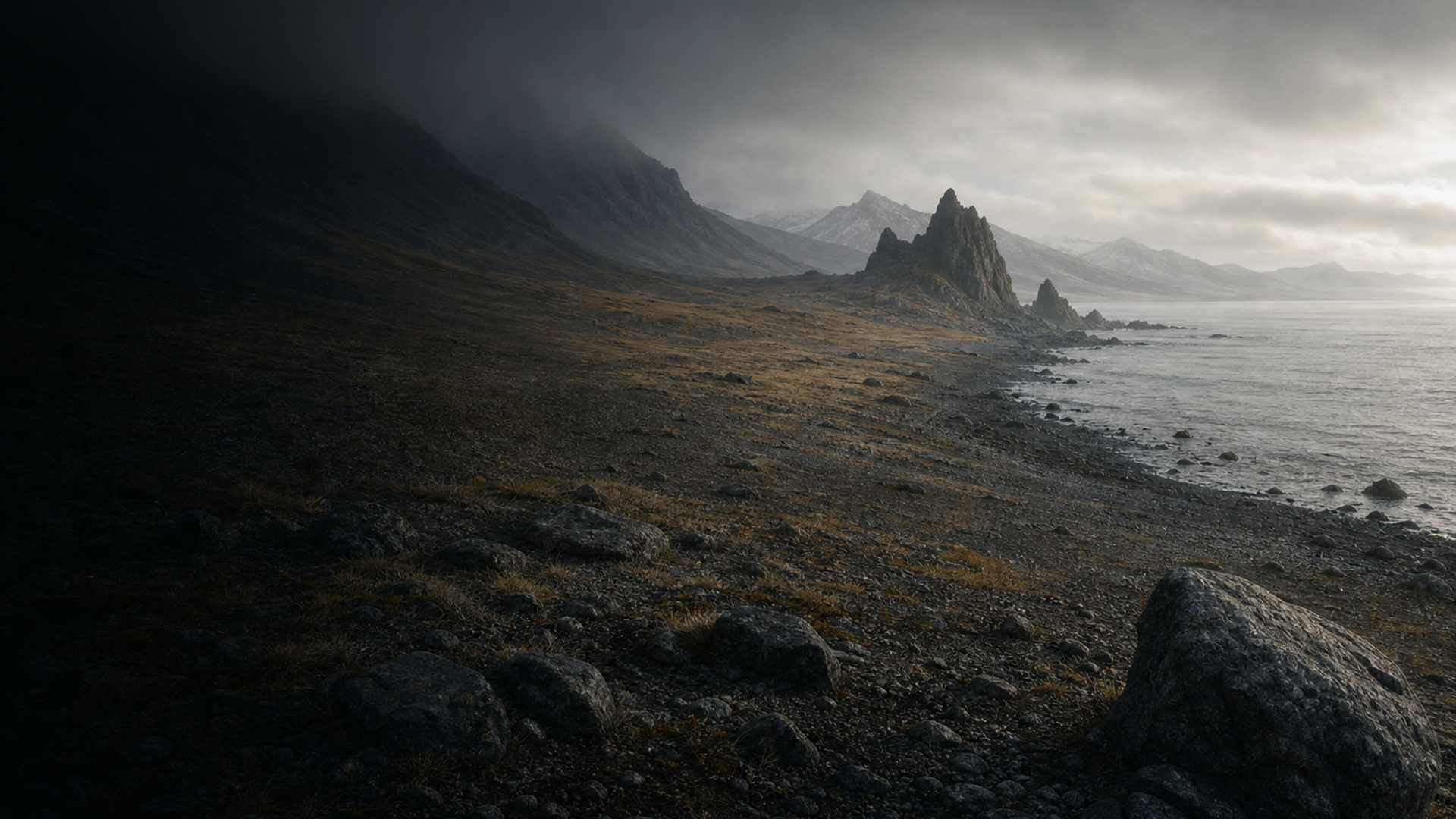
The Ol'skaia site sits on the wind‑scoured shore of the Okhotsk Sea in Magadan Oblast and belongs to the broader Magadan Bronze Age horizon dated roughly 1300–900 BCE. Archaeological data indicates coastal occupation, likely focused on marine resources and seasonal settlement. Material traces are fragmentary but evocative: hearths, small tool assemblages and the faint imprint of repeated human activity along the strand.

In cinematic terms, imagine low camps on a rocky shore where smoke threads over the sea: communities adapted to a demanding littoral environment. Limited excavations at Ol'skaia reveal patterns consistent with other Northeast Asian coastal sites, suggesting cultural connections across the Okhotsk littoral. However, the archaeological record is sparse and many interpretations remain tentative: evidence points to mobility and resource specialization rather than large sedentary villages.

Regional context places Ol'skaia within networks of exchange and movement across the Russian Far East during the Bronze Age. Archaeological parallels (ceramic styles and tool types) hint at dialogue with nearby coastal and riverine groups, but the precise origins and trajectories of these populations remain uncertain without more extensive sampling and stratigraphic control.

  • Located on the Okhotsk Sea coast (Ol'skaia, Magadan Oblast)
  • Dated to the Magadan Bronze Age, ca. 1300–900 BCE
  • Archaeological data indicates seasonal, marine‑focused occupation
Chapitre IV

Daily Life & Society

Daily life at Ol'skaia can be reconstructed only in broad strokes. Archaeological indicators point toward a coastal subsistence economy: fishing, shellfish collection, and marine mammal exploitation are plausible primary activities given the shoreline setting and analogies with nearby littoral sites. Portable technologies — flaked stone tools, bone artefacts and processing areas — would support hunting, butchery and hideworking in an environment where mobility mattered.

Social organization was likely based on small, flexible households or family groups, seasonally aggregated and dispersed according to marine resource cycles. Craft activities may have been carried out in informal work areas rather than specialized workshops. Material culture would have reflected maritime knowledge: gear for fishing and processing, storage for dried foods, and clothing suited to cold winds. Ritual or symbolic behavior is difficult to trace from current Ol'skaia data; funerary and formal ceremonial contexts are scarce or not yet identified.

Archaeological interpretations must remain cautious: small excavation areas and limited finds mean reconstructions are provisional. Future fieldwork could reveal more about settlement layout, craft specialization and seasonal movement patterns.

  • Coastal subsistence focused on marine resources
  • Likely small, mobile household groups with seasonal aggregation
Chapitre V

Genetic Profile

Three ancient mitochondrial genomes from Ol'skaia (sample count = 3) reveal two individuals with mtDNA haplogroup G1b and one with haplogroup D. Both G1b and D are well‑documented East Eurasian maternal lineages that appear across Northeast Asia, the Russian Far East and into parts of northern Siberia in both ancient and modern datasets. These maternal signatures are consistent with an East Eurasian affinity for the Ol'skaia communities.

No robust Y‑chromosome pattern is reported for these samples, so paternal lineages and male‑mediated connections remain unresolved. Importantly, with only three individuals the genetic picture is extremely preliminary: small sample counts (<10) can strongly bias interpretations of population structure, continuity and admixture. Nuclear genome data would be required to assess overall ancestry proportions, degree of hunter‑gatherer continuity, and possible contacts with inland Siberian or Beringian groups.

Archaeogenetic implications: the mtDNA evidence tentatively suggests maternal continuity with later and modern populations of the Russian Far East, but conclusions about demographic processes (migration, replacement, or local persistence) require larger and more geographically varied sampling. Ongoing collaboration between archaeologists and geneticists will be essential to move from evocative hints to robust population histories.

  • mtDNA: G1b (2 individuals) and D (1 individual) — East Eurasian maternal lineages
  • Sample size small (3); nuclear DNA and more samples needed for firm conclusions
Chapitre VI

Legacy & Modern Connections

The maternal lineages found at Ol'skaia resonate with genetic patterns still present in the Russian Far East, offering a cinematic thread from Bronze Age shore camps to modern coastal communities. Limited evidence suggests a degree of maternal continuity in the region, but the small number of ancient samples precludes sweeping claims about direct ancestry.

Culturally, the Ol'skaia assemblage fits within a long tradition of maritime adaptation along the Okhotsk Sea. Modern heritage in Magadan and neighboring regions — subsistence knowledge, place names, and continuity of coastal lifeways — may carry echoes of these Bronze Age occupants. For museums and education, Ol'skaia offers a striking narrative: fragile human presence on a cold coastline, preserved in bone, charcoal and mitochondrial DNA, inviting visitors to imagine lives shaped by wind, ice and sea.

Future ancient DNA sampling, broader regional excavation and integration with ethnographic and paleoenvironmental data will sharpen the picture and clarify how these Bronze Age communities contributed to the genetic and cultural landscape of Northeast Asia.

  • mtDNA hints at regional maternal continuity into the modern Russian Far East
  • Preliminary data invites further sampling and multidisciplinary study
Propulsé par l'IA

Assistant IA

Posez des questions sur la culture Ol'skaia: Magadan Bronze Age Shore

Assistant IA par DNAGENICS

Débloquer cette fonction
Posez des questions sur la culture Ol'skaia: Magadan Bronze Age Shore. L'assistant IA peut expliquer les résultats génétiques, le contexte historique, les preuves archéologiques et les liens génétiques avec les populations actuelles, dans les limites de l'interprétation.
Exemple d'analyse IA

La culture Ol'skaia: Magadan Bronze Age Shore représente un chapitre fascinant de l'histoire humaine…

L'analyse génétique met en évidence des similarités avec des populations antérieures et des signes d'adaptations propres. Les échantillons d'ADN ancien éclairent les schémas migratoires et les liens entre populations, avec des limites qui dépendent de l'étude et du contexte archéologique.

Il s'agit d'un aperçu de l'analyse IA. Accédez à l'assistant complet pour explorer :

  • Composition et similarité génétique
  • Schémas migratoires et origines
  • Vie quotidienne et pratiques culturelles
  • Contexte génétique actuel

Explorez d'autres cultures antiques

Découvrez les récits de civilisations issues du monde antique




