Préparation du rapport

Chargement des informations et références disponibles

Connexion au corpus archéologique…

Collecte des archives antiques

Aller au contenu principal
Petko Karavelovo: Chalcolithic Echoes
Profil culturel

Petko Karavelovo: Chalcolithic Echoes

Small Chalcolithic community (4700–4400 BCE) in northern Bulgaria with intriguing, preliminary genetic signals

4700 CE - 4400 BCE
Petko Karavelovo, Veliko Tarnovo, Bulgaria
Faites défiler pour commencer
Chapitre I

Le récit

Comprendre la culture Petko Karavelovo: Chalcolithic Echoes

Archaeological and ancient-DNA evidence from Petko Karavelovo (Veliko Tarnovo province) illuminates a small Chalcolithic community (4700–4400 BCE). Four genomes reveal rare Y-lineages and common European maternal types, suggesting local Neolithic roots with complex contacts—conclusions remain tentative.

Time Period

4700–4400 BCE

Region

Petko Karavelovo, Veliko Tarnovo, Bulgaria

Common Y-DNA

M (2), V88 (1), CTS (1)

Common mtDNA

H (2), HV+ (1), U (1)

Chapitre II

Chronologie

Moments clés de l'histoire de cette culture

4700 BCE

Occupation at Petko Karavelovo

Archaeological and aDNA evidence indicates community life at Petko Karavelovo begins around 4700 BCE within the Chalcolithic Bulgarian cultural horizon.

Chapitre III

Origins & Emergence

Beneath the open sky of northern Bulgaria, the Chalcolithic settlement at Petko Karavelovo (Polski Tyrambesh municipality, Veliko Tarnovo province) sits in the centuries between 4700 and 4400 BCE. Archaeological data indicates small, sedentary communities in this part of the central Balkans were continuing Neolithic lifeways while incorporating new technologies such as copper use and more elaborate pottery forms. The material horizon known locally as the Chalcolithic Bulgarian Culture (Petko Karavelovo) seems to represent a regionally distinct strand of these broader developments.

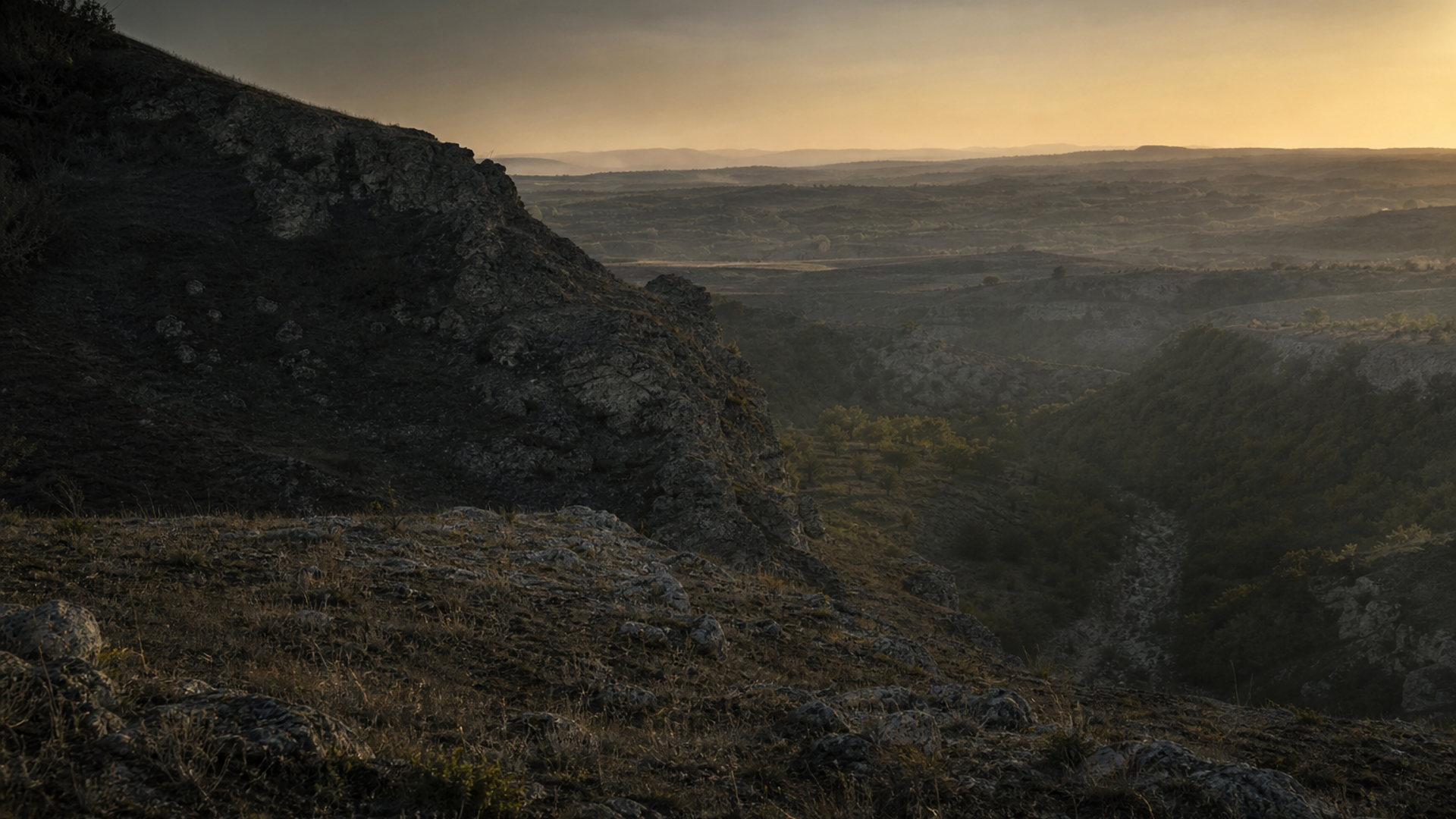
Limited evidence from the site itself—few burials and small habitation features—suggests modestly sized households embedded in riverine and arable landscapes. The cinematic image is of low mounds, domestic hearths, and fields where generations tended crops introduced earlier in the Neolithic. However, because large-scale excavations and published inventories from Petko Karavelovo are limited, many aspects of emergence—social organization, craft specializations, and external connections—remain uncertain and are best described as provisional.

  • Occupation centered 4700–4400 BCE in northern Bulgaria
  • Represents a regional expression of Chalcolithic Bulgarian Culture
  • Archaeological evidence is limited; broader regional context informs interpretation
Chapitre IV

Daily Life & Society

The everyday world of Petko Karavelovo can be imagined from fragmentary clues: households organized around hearths, pottery vessels for cooking and storage, and small-scale copper objects that signal early metallurgy. Archaeological parallels across the central Balkans indicate mixed farming economies—wheat, barley, pulses—combined with domesticated animals such as sheep, goats, and cattle. Settlement patterns were often dispersed hamlets rather than dense urban centers, producing a landscape of intimate, kin-based communities.

Social life likely revolved around household and local ritual practices rather than grand monumental architectures. Burials—when present—offer the most direct window into beliefs and social differentiation, but at Petko Karavelovo such mortuary contexts are sparse. This scarcity means reconstructions of hierarchy or long-distance exchange are necessarily cautious; instead, the site fits a quieter picture of Chalcolithic lifeways where local tradition met incremental innovation.

  • Mixed farming and herding economy inferred from regional analogies
  • Small households and limited mortuary evidence; social interpretations remain tentative
Chapitre V

Genetic Profile

Four ancient genomes recovered from Petko Karavelovo (sample count = 4) provide a slender but evocative genetic snapshot. On the paternal side, two individuals carry Y-haplogroup M, one carries V88, and one carries a CTS-designated lineage. These Y-lineages are notable: M and V88 are uncommon in later European populations and their presence here raises questions about deep, possibly long-standing west–east or north–south connections in the Chalcolithic era. CTS is a SNP-prefix used in contemporary Y-tree nomenclature; without further subclade resolution its broader affinities are unresolved.

Maternally, two individuals belong to mtDNA H, one to HV+ and one to U—haplogroups that are widely attested across Neolithic and later European populations. Archaeological and regional genomic studies indicate that Chalcolithic Balkans generally represent mixtures of earlier Anatolian farmer ancestry with variable hunter-gatherer input; the Petko Karavelovo maternal profiles are compatible with that pattern. Because the sample count is small (<10), these genetic patterns are preliminary: they hint at both continuity with European Neolithic maternal lineages and unexpected paternal diversity that will require more sampling and deeper sequencing to interpret robustly.

  • Paternal diversity: M (2), V88 (1), CTS (1) — unexpected in this region, interpretation tentative
  • Maternal profiles (H, HV+, U) align with broader Neolithic/Chalcolithic European patterns
Chapitre VI

Legacy & Modern Connections

The genetic echoes of Petko Karavelovo are subtle rather than dominant. MtDNA haplogroups such as H and U persist widely in modern European populations, implying a degree of maternal continuity across millennia, but population history in the Balkans is complex—successive migrations, cultural shifts, and demographic turnovers dilute simple lines of descent. The unusual Y-lineages observed at Petko Karavelovo (M and V88) suggest episodes of contact or survival of deep paternal lineages that are not well represented in later periods; whether these represent localized founder effects or broader networks remains unresolved.

For museum audiences and genetic ancestry platforms, Petko Karavelovo offers a reminder: ancient genomes can illuminate forgotten threads in human history, but small sample sizes demand humility. These remains invite targeted future sampling across the Veliko Tarnovo region to test whether the patterns seen in four individuals reflect a local community trait or chance preservation.

  • Maternal continuity plausible but population history is complex and layered
  • Paternal signals are intriguing; further sampling needed to assess long-term legacy
Propulsé par l'IA

Assistant IA

Posez des questions sur la culture Petko Karavelovo: Chalcolithic Echoes

Assistant IA par DNAGENICS

Débloquer cette fonction
Posez des questions sur la culture Petko Karavelovo: Chalcolithic Echoes. L'assistant IA peut expliquer les résultats génétiques, le contexte historique, les preuves archéologiques et les liens génétiques avec les populations actuelles, dans les limites de l'interprétation.
Exemple d'analyse IA

La culture Petko Karavelovo: Chalcolithic Echoes représente un chapitre fascinant de l'histoire humaine…

L'analyse génétique met en évidence des similarités avec des populations antérieures et des signes d'adaptations propres. Les échantillons d'ADN ancien éclairent les schémas migratoires et les liens entre populations, avec des limites qui dépendent de l'étude et du contexte archéologique.

Il s'agit d'un aperçu de l'analyse IA. Accédez à l'assistant complet pour explorer :

  • Composition et similarité génétique
  • Schémas migratoires et origines
  • Vie quotidienne et pratiques culturelles
  • Contexte génétique actuel

Explorez d'autres cultures antiques

Découvrez les récits de civilisations issues du monde antique




