Préparation du rapport

Chargement des informations et références disponibles

Connexion au corpus archéologique…

Collecte des archives antiques

Aller au contenu principal
Riverborn: Early Neolithic Amur Voices
Profil culturel

Riverborn: Early Neolithic Amur Voices

Fragments of riverine life and genes from the Amur Basin, 8175–6831 BCE

8175 CE - 6831 BCE
Amur River Basin, China
Faites défiler pour commencer
Chapitre I

Le récit

Comprendre la culture Riverborn: Early Neolithic Amur Voices

Ancient genomes from the Amur River Basin (8175–6831 BCE) illuminate early riverine foragers in northeast China. Limited samples (n=4) show Y haplogroup P and diverse mtDNA (D4m, R11, G, D), suggesting deep northern East Asian ancestry with tentative links to later Amur populations.

Time Period

8175–6831 BCE

Region

Amur River Basin, China

Common Y-DNA

P (1 sample)

Common mtDNA

D4m, R11, G, D (each observed)

Chapitre II

Chronologie

Moments clés de l'histoire de cette culture

8175 BCE

Earliest sampled individuals

Earliest dated genomes from the Amur River Basin (~8175 BCE) provide the first genetic glimpses of Early Neolithic riverine communities.

Chapitre III

Origins & Emergence

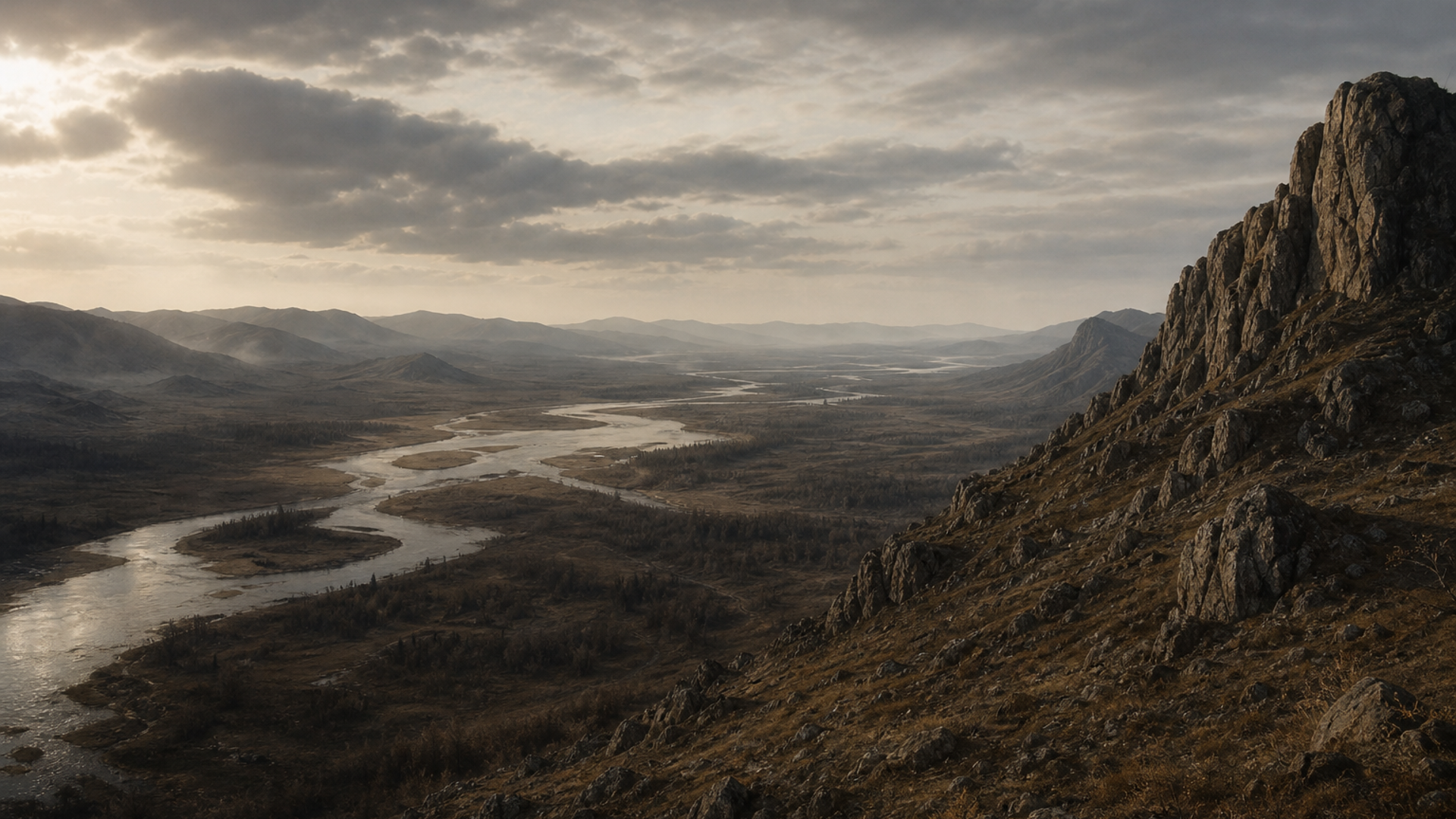
Along the wide, mist-wreathed channels of the Amur River, people reshaped life in the millennia after the last Ice Age. Radiocarbon-dated human remains placed between 8175 and 6831 BCE anchor this Early Neolithic horizon in the lower Amur Basin of northeastern China. Archaeological data indicates a transition from highly mobile post-glacial foraging to more river-oriented subsistence: pottery fragments, hearths, and concentrations of fish bone point to the long-term exploitation of salmon, sturgeon and other riverine resources.

Limited evidence suggests these communities lived in small seasonal aggregation sites rather than large permanent villages. Stone and bone tools recovered in the region are consistent with fishing, hide working, and woodworking. Comparisons with Near-Neolithic assemblages across the Sea of Japan and inland Siberia hint at cultural interactions across northern East Asia, but the material record remains sparse.

Genetic data from four sampled individuals provide a new dimension to this picture, offering snapshots of biological ancestry at precise times. With only four genomes, broad narratives must remain cautious; nonetheless, the combined archaeological and genetic view evokes a resilient riverine lifeway rooted in deep northern East Asian lineages and shaped by the ecological pulse of the Amur.

  • Dated individuals span 8175–6831 BCE in the Amur Basin
  • Archaeological signs of intensive riverine fishing and pottery
  • Evidence suggests seasonal aggregation rather than large sedentary villages
Chapitre IV

Daily Life & Society

Imagine waking to mist on braided channels, the day arranged around tides and fish runs. Zooarchaeological remains from Early Neolithic Amur contexts point to a diet rich in freshwater fish and migratory salmon, supplemented by wild plants, small game, and perhaps rudimentary horticulture in favorable patches. Pottery—often coarse and tempered with plant or mineral inclusions—appears alongside hearths and concentrated refuse, suggesting repeat occupation of favored riverine loci.

Tools of stone and bone reveal tasks: barbed points and retouched blades for fishing and processing, awls for working hides, and ground stone for plant processing. Ornamentation and pigment fragments, where preserved, imply social and symbolic behaviors—personal identity expressed through beads or ochre, though such finds are infrequent.

Settlement patterns inferred from archaeological surveys favor dispersed camps and seasonal aggregation near spawning rivers rather than extensive permanent architecture. This mobility would have structured social networks and marriage ties along river corridors, enabling gene flow and the spread of ideas. Yet archaeological visibility is uneven: preservation biases and limited excavation coverage mean many aspects of social complexity remain speculative.

  • Diet dominated by freshwater fish, with diverse wild foods
  • Portable toolkit for fishing, hide working, and plant processing
Chapitre V

Genetic Profile

The genetic snapshot from the Amur River Early Neolithic is tantalizing but preliminary: only four individuals have been reported from 8175–6831 BCE. Among them a single male carries Y-chromosome haplogroup P (one observation), while mitochondrial lineages recorded include D4m, R11, G, and D. These mtDNA haplogroups are all part of northern East Asian maternal diversity—D and sublineages of D4 are widespread in modern Northeast Asia, G is frequent in Siberia and adjacent regions, and R11 occurs at low frequency in East Asia.

Y-haplogroup P is a deep Eurasian lineage that, in broader phylogenies, sits ancestral to branches found far to the west and east; its presence here—recorded in a single individual—should be treated cautiously and may reflect an early northern Eurasian paternal lineage contributing to later regional diversity. The maternal profiles, taken together, are consistent with long-term continuity of northern East Asian mitochondrial ancestry in the Amur corridor.

Archaeogenetic patterns tentatively link these Early Neolithic Amur individuals to later populations of the region (including groups sampled in historic and modern times), suggesting continuity in at least parts of the maternal gene pool. However, with n=4, stochastic sampling can mislead: additional genomes, especially from multiple sites and times, are needed to resolve population structure, sex-biased processes, and interactions with neighboring Siberian and coastal groups.

  • Sample size is small (n=4); conclusions are preliminary
  • mtDNA (D4m, R11, G, D) aligns with northern East Asian maternal lineages
Chapitre VI

Legacy & Modern Connections

The riverborn peoples of the Early Neolithic Amur left a genetic and cultural imprint that echoes in the region today. Modern populations of the lower Amur and adjacent areas—whose genomes show a mixture of northern East Asian components—may retain elements of this deep ancestry, particularly in maternal lineages like D and G. Archaeologically transmitted lifeways—seasonal fishing, river-focused mobility, and pottery traditions—also resonate with ethnographic records of later Amur societies.

Yet continuity is not uniform: subsequent millennia brought migrations, language shifts, and technological changes (metal use, agriculture in some corridors) that layered additional ancestries atop the Early Neolithic substrate. Given the very small ancient sample set, it is prudent to frame connections as plausible continuities rather than proven lineages. Future ancient DNA from multiple Amur sites and time slices will refine how much of the Early Neolithic genetic signature persisted into historic and contemporary populations.

  • Maternal lineages suggest partial continuity with modern northern East Asian peoples
  • Cultural traditions like riverine fishing may reflect long-term regional lifeways
Propulsé par l'IA

Assistant IA

Posez des questions sur la culture Riverborn: Early Neolithic Amur Voices

Assistant IA par DNAGENICS

Débloquer cette fonction
Posez des questions sur la culture Riverborn: Early Neolithic Amur Voices. L'assistant IA peut expliquer les résultats génétiques, le contexte historique, les preuves archéologiques et les liens génétiques avec les populations actuelles, dans les limites de l'interprétation.
Exemple d'analyse IA

La culture Riverborn: Early Neolithic Amur Voices représente un chapitre fascinant de l'histoire humaine…

L'analyse génétique met en évidence des similarités avec des populations antérieures et des signes d'adaptations propres. Les échantillons d'ADN ancien éclairent les schémas migratoires et les liens entre populations, avec des limites qui dépendent de l'étude et du contexte archéologique.

Il s'agit d'un aperçu de l'analyse IA. Accédez à l'assistant complet pour explorer :

  • Composition et similarité génétique
  • Schémas migratoires et origines
  • Vie quotidienne et pratiques culturelles
  • Contexte génétique actuel

Explorez d'autres cultures antiques

Découvrez les récits de civilisations issues du monde antique