Préparation du rapport

Chargement des informations et références disponibles

Connexion au corpus archéologique…

Collecte des archives antiques

Aller au contenu principal
Vau‑Una Sambaqui (~600 BP)
Profil culturel

Vau‑Una Sambaqui (~600 BP)

A single ancient genome from a northeastern Brazilian shell mound illuminates coastal lives.

1318 CE - 1409600 CE
Northeast Brazil — Vau (Sta. M. Vitória)
Faites défiler pour commencer
Chapitre I

Le récit

Comprendre la culture Vau‑Una Sambaqui (~600 BP)

Late pre-contact Sambaqui at Vau‑Una (1318–1409 CE), Northeast Brazil. Shell‑mound archaeology from Vau - Sta. M. Vitória paired with one ancient genome showing Y‑haplogroup Q and mtDNA B. Limited sample—genetic links to wider coastal forager lineages are preliminary.

Time Period

1318–1409 CE (ca. 600 BP)

Region

Northeast Brazil — Vau (Sta. M. Vitória)

Common Y-DNA

Q (1 sample)

Common mtDNA

B (1 sample)

Chapitre II

Chronologie

Moments clés de l'histoire de cette culture

2500 BCE

Emergence of sambaqui builders

Archaeological evidence indicates shell‑mound formation along parts of the Brazilian coast by this period, marking long‑term coastal foraging and mound construction traditions.

Chapitre III

Origins & Emergence

Towering heaps of shell and bone—sambaquis—dot the Atlantic coast of Brazil and testify to generations who lived by the sea. The Vau‑Una mound at Vau - Sta. M. Vitória in Northeast Brazil belongs to this long‑lived coastal tradition often called the Sambaqui Culture. Archaeological data indicates that sambaqui building began millennia earlier in some regions; the Vau‑Una context for our sample dates to 1318–1409 CE, placing it among late pre‑contact coastal communities.

Environmental reconstructions suggest these sites grew where estuaries and rich intertidal zones provided abundant shellfish, fish, and birds. Shell mounds functioned as refuse deposits, habitation platforms, and sometimes cemeteries—markers of repeated, seasonal marine exploitation. Limited evidence from Vau‑Una supports a community organized around maritime resources, with material traces that include worked bone, shell ornaments, and human interments.

Because this entry rests on a single genome, conclusions about population origins remain tentative. Archaeological patterns suggest continuity in coastal foraging strategies and regional interaction across centuries; genetic data from Vau‑Una can be read as a first glimpse into the biological ancestry of one individual within these broader cultural landscapes. Further excavation and sampling are needed to track demographic continuity, migration, and social change across the sambaqui coastline.

  • Sambaqui tradition: coastal shell‑mound builders; long regional history
  • Site: Vau - Sta. M. Vitória (Northeast Brazil); sample dated 1318–1409 CE
  • Single genomic sample provides a cautious, preliminary window into origins
Chapitre IV

Daily Life & Society

The world of the sambaqui dweller was framed by tides and estuaries. Archaeological evidence from shell mounds indicates diets rich in mollusks, fish, and seabirds; midden stratigraphy preserves the daily detritus of food, tools, and ornaments. At Vau‑Una, as at many coastal sites, layered shells and interleaved hearths suggest repeated seasonal occupation and long‑term place attachment.

Material culture recovered from comparable sambaqui sites includes bone and shell tools, carved ornaments, and occasional lithic items—objects that speak to craft specialization and symbolic display. Funerary contexts in sambaquis range from simple interments to burials placed within the mound matrix, indicating that these places also anchored ancestral memory. Social organization likely combined kin groups with broader networks of exchange along the coast; archaeological data indicates interaction between neighboring mounds through shared artifact styles and raw materials.

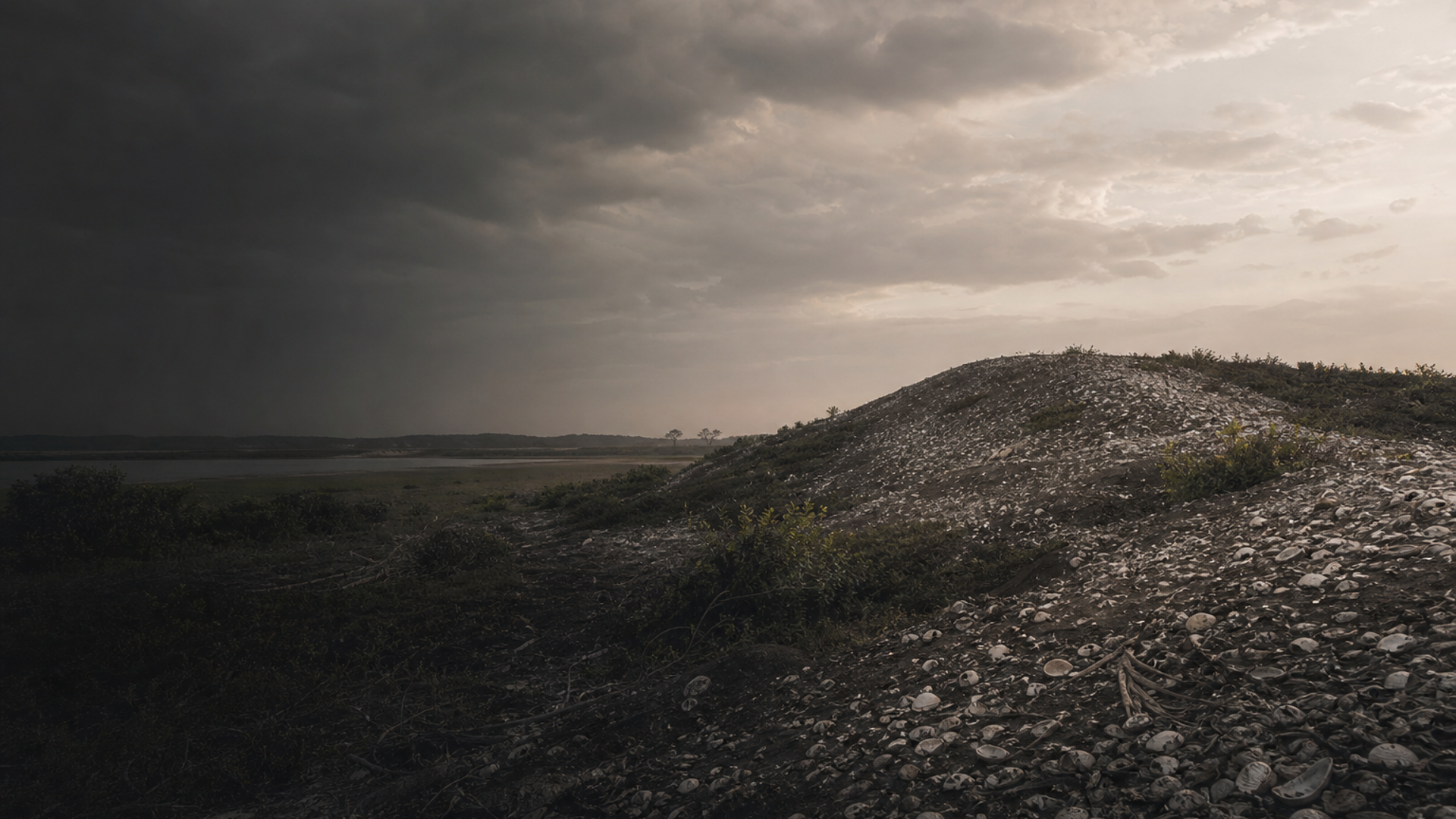
Cinematic though the picture can be—mounds rising like petrified tides—the archaeological record is uneven. Preservation biases, later disturbance, and limited excavation at many sites mean our reconstructions of daily life are built on fragmentary evidence. Integrating ancient DNA with stratigraphic and isotopic data promises to enrich interpretations of diet, mobility, and social ties, but at Vau‑Una such integrative studies are at an early stage.

  • Diet centered on shellfish, fish, and coastal birds; middens preserve seasonal use
  • Mounds served as living floors, craft loci, and burial spaces—places of memory
Chapitre V

Genetic Profile

The Vau‑Una assemblage currently includes one reported ancient genome dated to 1318–1409 CE. That individual carries Y‑chromosome haplogroup Q and mitochondrial haplogroup B—lineages widely reported among Indigenous peoples of the Americas. Y‑haplogroup Q represents a major founding paternal lineage across North and South America; mtDNA haplogroup B is one of the principal maternal branches found from Mesoamerica to southern South America.

These assignments align the Vau‑Una individual with continental patterns of Indigenous ancestry, suggesting biological continuity with broader Native American lineages rather than recent transoceanic input. However, sample count here is n=1, so any population‑level inference is highly preliminary. Archaeological context indicates local coastal adaptation, but genetic diversity within sambaqui communities could be substantial; a single genome cannot capture structure, sex‑biased mobility, or admixture dynamics.

Future work should pair increased sampling with isotopic analysis (for diet and mobility) and comparison to contemporaneous and earlier coastal genomes. Such integrated datasets could test hypotheses about long‑term continuity, gene flow along the Brazilian coast, and relationships between sambaqui builders and inland groups. For now, the genetic signal from Vau‑Una is a crucial but solitary thread in a much larger tapestry.

  • Individual shows Y‑DNA Q and mtDNA B—lineages common in Indigenous Americas
  • Single sample (n=1): conclusions about populations are tentative and preliminary
Chapitre VI

Legacy & Modern Connections

Sambaqui mounds remain visible reminders of sustained coastal lifeways and are part of regional cultural heritage in Brazil. The Vau‑Una genome offers a bridge between archaeological landscapes and living descendant communities, but ethical engagement and collaboration are essential when interpreting and publishing ancient DNA results. Genetic data can corroborate oral histories and archaeological narratives, yet must be communicated with humility and attention to cultural perspectives.

Conservation of sambaquis and community‑led research can protect archaeological context while opening avenues for multidisciplinary study: archaeobotany, zooarchaeology, isotopes, and expanded ancient genomics. As more data accumulate, it will become possible to map patterns of continuity and change between pre‑contact communities and present‑day populations in Northeast Brazil. For now, the Vau‑Una individual is a poignant, provisional window into a human life shaped by tide and estuary—an invitation for deeper, collaborative inquiry.

  • Sambaquis are living heritage sites that require protection and community partnership
  • Ancient DNA offers connections to modern descendants but must be treated ethically
Propulsé par l'IA

Assistant IA

Posez des questions sur la culture Vau‑Una Sambaqui (~600 BP)

Assistant IA par DNAGENICS

Débloquer cette fonction
Posez des questions sur la culture Vau‑Una Sambaqui (~600 BP). L'assistant IA peut expliquer les résultats génétiques, le contexte historique, les preuves archéologiques et les liens génétiques avec les populations actuelles, dans les limites de l'interprétation.
Exemple d'analyse IA

La culture Vau‑Una Sambaqui (~600 BP) représente un chapitre fascinant de l'histoire humaine…

L'analyse génétique met en évidence des similarités avec des populations antérieures et des signes d'adaptations propres. Les échantillons d'ADN ancien éclairent les schémas migratoires et les liens entre populations, avec des limites qui dépendent de l'étude et du contexte archéologique.

Il s'agit d'un aperçu de l'analyse IA. Accédez à l'assistant complet pour explorer :

  • Composition et similarité génétique
  • Schémas migratoires et origines
  • Vie quotidienne et pratiques culturelles
  • Contexte génétique actuel

Explorez d'autres cultures antiques

Découvrez les récits de civilisations issues du monde antique