Préparation du rapport

Chargement des informations et références disponibles

Connexion au corpus archéologique…

Collecte des archives antiques

Aller au contenu principal
Viminacium: Roman Serbia on the Danube
Profil culturel

Viminacium: Roman Serbia on the Danube

Archaeology and DNA illuminate life at Viminacium and Timacum Minus, 1–538 CE

1 CE - 538 CE
Serbia (Viminacium, Timacum Minus)
Faites défiler pour commencer
Chapitre I

Le récit

Comprendre la culture Viminacium: Roman Serbia on the Danube

Archaeological remains and 64 ancient genomes from Roman-era Serbia (1–538 CE) reveal a multiethnic frontier landscape at Viminacium and Timacum Minus. Material culture and Y/mtDNA patterns point to local Balkan continuity with Mediterranean and eastern influences, consistent with Imperial-era mobility.

Time Period

1–538 CE

Region

Serbia (Viminacium, Timacum Minus)

Common Y-DNA

E (14), R (7), G (6), J (5), I (3)

Common mtDNA

H (17), U (6), T (4), J (3), K (3)

Chapitre II

Chronologie

Moments clés de l'histoire de cette culture

100 CE

Viminacium prospers as a Roman urban and military center

By the 2nd century CE Viminacium had grown from a legionary base into a major urban, commercial, and funerary hub along the middle Danube, evidenced by baths, forts, and extensive cemeteries.

Chapitre III

Origins & Emergence

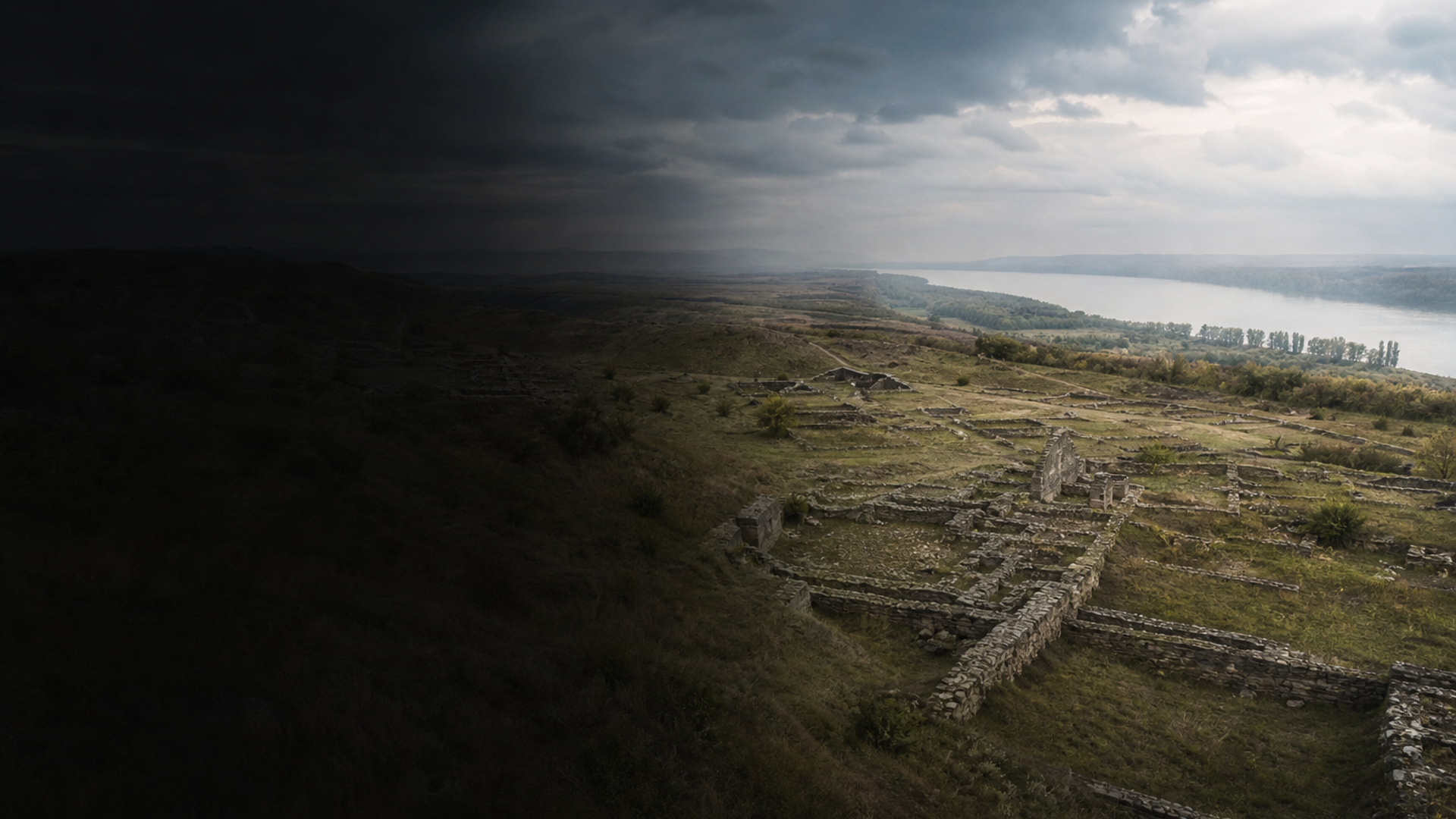
The sites sampled — Viminacium (Rit, Pirivoj, Više Grobalja, Pećine, Stari Kostolac) and Timacum Minus (Slog) — lay along the middle Danube in the province historically known as Moesia Superior. Archaeological data indicates Viminacium grew from a 1st-century CE legionary base into a bustling urban and funerary landscape; Timacum Minus functioned as a smaller military and civic node to the east.

Material remains—fortifications, bath complexes, tombstones, and imported ceramics—bear witness to long-distance connections across the Roman Empire. The 64 ancient genomes analyzed come from cemetery contexts and settlement deposits spanning 1–538 CE, providing a regionally concentrated window into population composition during the Imperial and Late Antique periods.

Limited evidence suggests that much of the population shows continuity with local Balkan Iron Age lineages, overlaid by gene-flow signals consistent with Mediterranean and eastern Mediterranean connections typical of Roman frontier towns. Archaeological stratigraphy and grave goods corroborate episodes of immigration and mobility: soldier burial types, non-local pottery, and osteological markers of diverse diets and activities. While the dataset is substantial for a single region, caution is warranted when interpreting rarer genetic lineages present at low counts.

  • Viminacium developed from a 1st-century CE legionary camp into a major urban center.
  • Material culture shows strong imperial trade links and mobility.
  • Genetic data indicate local continuity with added Mediterranean/eastern inputs.
Chapitre IV

Daily Life & Society

Strolling through the necropoleis and ruined streets of Viminacium, one imagines a city of soldiers, merchants, artisans, and families drawing breath on the Danube frontier. Archaeological excavations reveal bathhouses, workshops, brick-built houses, and richly furnished graves that reflect social differentiation and cultural plurality. Tombstones name legions and units, while grave assemblages include locally made ceramics alongside imported amphorae, pointing to trade in wine, oil, and spices.

Bioarchaeological evidence—dental wear, isotopes where available, and pathological markers—paints an occupationally diverse populace: heavy limb enthesopathies in some individuals suggest manual labor, while indicators of childhood diet and mobility vary across cemeteries. The presence of foreign-style weapon burials and distinct funerary rites in some graves suggests the presence of soldiers and migrants who brought cultural practices from across the Empire.

Archaeological data indicates households were anchored to local landscapes even as they participated in imperial networks. The cemeteries sampled capture both native Balkan traditions and imported lifeways, mirroring the genetic mixture detected in the ancient DNA.

  • Urban amenities (baths, workshops) and imported goods signal economic integration with the Empire.
  • Osteological indicators reflect varied occupations and life histories in a multiethnic community.
Chapitre V

Genetic Profile

The genetic snapshot from 64 individuals reveals a complex tapestry consistent with an Imperial frontier city. Y-chromosome haplogroup E is the most frequent (14 individuals), a lineage commonly observed in the Balkans and Mediterranean; R (7) and G (6) are also present, while J (5) and I (3) appear at lower frequencies. On the maternal side, haplogroup H predominates (17 individuals), with U (6), T (4), J (3), and K (3) represented among mtDNA lineages.

These distributions suggest a population rooted in local Balkan ancestry (H and U maternal lineages; R and I paternal signatures) but enriched by Mediterranean and eastern contributions (higher E, G, J frequencies) that could reflect recruitment of soldiers, merchants, and settlers from across the Empire. Archaeological contexts such as legionary graves and imported artifacts align with this interpretation.

Statistical caution: while 64 samples constitute a robust regional assemblage, counts for several haplogroups are small (for example I: 3 Y-chromosomes; mtDNA J and K: 3 each). Limited evidence suggests these low-frequency lineages may represent either persistent local pockets or recent arrivals; further sampling and autosomal analyses are needed to resolve their origins and the degree of admixture. Overall, the genetic signal complements archaeological evidence for a dynamic, multiethnic urban frontier during 1–538 CE.

  • Y-DNA dominated by E (14), with R, G, J, I also present — indicating mixed Balkan and Mediterranean inputs.
  • mtDNA dominated by H (17), supporting maternal continuity with regional populations; low counts for some haplogroups warrant caution.
Chapitre VI

Legacy & Modern Connections

The human story at Viminacium and Timacum Minus is not locked in the past; echoes of these populations endure in the genetic landscape of the modern Balkans. Archaeological layers and ancient genomes together suggest continuity of local ancestry blended with centuries of mobility tied to Roman imperial networks. Modern inhabitants of Serbia commonly carry mtDNA and Y-DNA lineages seen in the ancient samples, although centuries of later migrations (Slavic movements, medieval, Ottoman-era changes) have further reshaped ancestry profiles.

Archaeogenetics thus provides a cinematic yet evidence-based bridge: skeletons in riverine cemeteries become testimonies of migration, service in imperial armies, and everyday trade. While direct one-to-one links between individual ancient genomes and present-day people require dense comparative sampling and careful modeling, the regional pattern underscores long-term connections between past and present populations along the Danube.

  • Ancient genomes from Viminacium reflect admixture patterns that contribute to the genetic fabric of the modern Balkans.
  • Long-term continuity is visible, but later historical migrations also modified regional ancestry profiles.
Propulsé par l'IA

Assistant IA

Posez des questions sur la culture Viminacium: Roman Serbia on the Danube

Assistant IA par DNAGENICS

Débloquer cette fonction
Posez des questions sur la culture Viminacium: Roman Serbia on the Danube. L'assistant IA peut expliquer les résultats génétiques, le contexte historique, les preuves archéologiques et les liens génétiques avec les populations actuelles, dans les limites de l'interprétation.
Exemple d'analyse IA

La culture Viminacium: Roman Serbia on the Danube représente un chapitre fascinant de l'histoire humaine…

L'analyse génétique met en évidence des similarités avec des populations antérieures et des signes d'adaptations propres. Les échantillons d'ADN ancien éclairent les schémas migratoires et les liens entre populations, avec des limites qui dépendent de l'étude et du contexte archéologique.

Il s'agit d'un aperçu de l'analyse IA. Accédez à l'assistant complet pour explorer :

  • Composition et similarité génétique
  • Schémas migratoires et origines
  • Vie quotidienne et pratiques culturelles
  • Contexte génétique actuel

Explorez d'autres cultures antiques

Découvrez les récits de civilisations issues du monde antique