Menu
Store
Blog
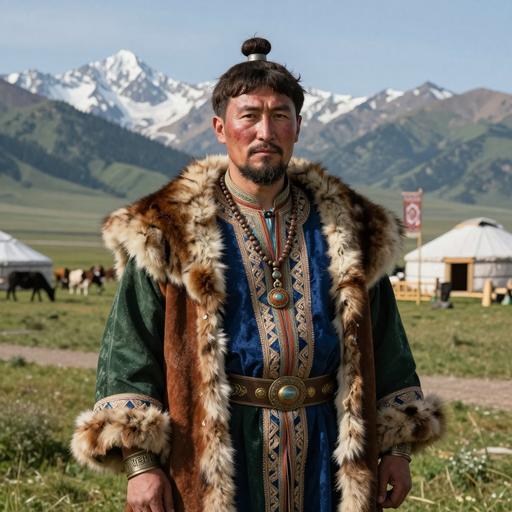
Portrait reconstruction of DA207
Ancient Individual

A man buried in Kazakhstan in the Modern era

DA207
1650 CE - 1850 CE
Male
Historical Kazakhstan
Kazakhstan
Scroll to begin
Chapter I

Identity

The biological and cultural markers that define this ancient individual

Sample ID

DA207

Date Range

1650 CE - 1850 CE

Biological Sex

Male

mtDNA Haplogroup

H2a

Y-DNA Haplogroup

R-M417

Cultural Period

Historical Kazakhstan

Chapter II

Place

Where this individual was discovered

Country Kazakhstan
Locality Tian Shan. Central Steppe
Coordinates 43.0686, 68.2489
Chapter III

Time

When this individual lived in the broader context of human history

DA207 1650 CE - 1850 CE
Chapter IV

Story

The narrative of this ancient life

The historical era of Kazakhstan, particularly during the time of the Turkic peoples, is a fascinating epoch that spans several centuries, featuring a complex tapestry of cultures, empires, and significant socio-economic developments. Here’s an extensive and detailed exploration of this era:

Early Turkic Influence

Turkic Migration and Early Settlement

The Turkic peoples began migrating to the region that would become Kazakhstan around the 6th century AD. This migration was part of a larger movement of Turkic tribes across Central Asia. Initially, the region was inhabited by various Indo-Iranian peoples, such as the Saka and the Scythians, but the Turkic influx marked a significant cultural and demographic shift.

Formation of the Göktürk Khaganate

The Göktürk Khaganate (552–744 AD) was one of the earliest and most influential Turkic states, covering vast areas of Central Asia, including parts of modern-day Kazakhstan. It was established by the Ashina clan and quickly grew in power due to its control over the Silk Road trade routes and its military prowess. The khaganate played a crucial role in defining the early Turkic cultural and political landscape.

The Rise of the Oghuz and Kipchak

Oghuz Turks

The Oghuz Turks were another significant Turkic group that emerged around the 8th century. They settled in the western parts of Kazakhstan, extending their influence into what is now southern Russia and the Caspian Sea area. The Oghuz are particularly important, as they laid the cultural groundwork for future Turkic states in the region, such as the Seljuks and later the Ottoman Empire.

Kipchak Confederation

From the 9th century onwards, the Kipchak confederation became a dominant force in the steppes of Kazakhstan. Known for their nomadic lifestyle, the Kipchaks were skilled horsemen and warriors. They eventually expanded their territory to encompass much of the Eurasian Steppe, impacting trade and warfare across Central Asia, the Middle East, and Eastern Europe.

Cultural and Economic Developments

Nomadic Lifestyle and Societal Structure

The Turkic cultures of historical Kazakhstan were predominantly nomadic, relying heavily on the pastoral economy. The societal structure was clan-based, with a hierarchical organization that often saw powerful clan leaders or khans exerting influence over groups of tribes. This nomadic lifestyle facilitated adaptability and resilience, traits that were essential for survival in the harsh Central Asian environment.

The Silk Road

Kazakhstan’s geographical position made it a crucial part of the Silk Road, facilitating cultural and economic exchanges between East and West. This brought not only wealth but also a blend of cultural influences, including Islamic, Persian, and Chinese elements. Trade goods such as silk, textiles, and spices passed through Kazakh territories, promoting urban development in cities like Taraz and Otrar.

Islamization and Cultural Syncretism

Introduction of Islam

Islam began spreading into Kazakhstan around the 8th and 9th centuries, introduced by missionaries and traders from the Abbasid Caliphate. By the 10th century, it had become a significant religious and cultural force, leading to the Islamization of the Turkic peoples. This religious shift brought about significant changes in the social structure, legal systems, and cultural life, influencing everything from art and architecture to governance.

Syncretic Cultural Developments

The interaction between indigenous Turkic traditions and Islamic culture led to a unique syncretic civilization. Traditional music, folklore, and art forms were blended with Islamic artistic and architectural styles, leading to the creation of distinct cultural expressions seen in the architecture of mosques and madrassas, and the literary works of poets and scholars.

The Mongol Invasion and Later Turkic Empires

Mongol Conquests

The 13th century saw the arrival of the Mongols, who, under Genghis Khan, conquered most of Central Asia, including Kazakhstan. The Mongol Empire facilitated even greater cultural exchanges and increased trade along the Silk Road. However, the invasion also brought destruction, reshaping the political and demographic landscape of the region.

The Golden Horde and Kazakh Khanate

Following the fragmentation of the Mongol Empire, the Golden Horde emerged as a powerful successor state in the 13th and 14th centuries, covering much of Eastern Europe to Central Asia. In the 15th century, the Kazakh Khanate was formed, marking the rise of a distinct Kazakh ethnic identity. The Kazakh Khanate maintained the nomadic Turkic traditions while also embracing elements of the sedentary cultures surrounding them.

Conclusion

The historical era of Kazakhstan during the time of the Turkic peoples is characterized by a dynamic interplay of migration, conquest, and cultural fusion. The Turkic tribes not only shaped the demographic and cultural landscape of Kazakhstan but also contributed to the broader historical currents of Central Asia and beyond. This period laid down the foundations for modern Kazakh culture, characterized by a rich blend of nomadic traditions, Turkic roots, and Islamic influences.

Chapter V

Genetics

The genetic ancestry of this ancient individual

Ancient Genetic Admixture

This analysis compares the DNA profile of DA207 with ancient reference populations, showing the genetic composition in terms of prehistoric ancestral groups.

Neolithic Farmers 37.8%
European Hunter-Gatherers 24.5%
Western Steppe Pastoralists 21.6%
Ancient Asians 12.5%
Ancient Native Americans 3.7%

Modern Genetic Admixture

This analysis compares the DNA profile with present-day reference populations, showing what percentage of genetic makeup resembles modern populations from different regions.

Europe 50.3%
Eastern European 27.6%
Northwestern European 16.1%
Northwestern European 7.0%
English 6.2%
Scandinavian 2.9%
Southern European 6.5%
Iberian 6.5%
Asia 37.3%
Northern West Asian 28.0%
Mesopotamian 18.1%
Anatolian 6.9%
Cypriot 2.2%
Caucasian 0.9%
Central Asian, Northern Indian & Pakistani 9.3%
Indian 9.3%
Africa 8.4%
Northern East African 8.4%
Ethiopian 8.4%
Oceania 2.5%
Melanesian 2.5%
Papuan 2.5%
America 1.5%
America 1.5%
Native American 1.5%

Closest Modern Populations

These are the modern populations showing the closest statistical alignment to A man buried in Kazakhstan in the Modern era, ranked by genetic distance. Lower distance values indicate closer statistical similarity.

1
Turkish Rumeli
4.0865
2
Turkish Deliorman
4.5739
3
Turkish Balikesir
5.3878
4
Roma Barcelona
5.4349
5
Turkish Denizli
5.7944
6
Turkish Aydin
5.8612
7
Kabardin
5.9746
8
Turkish Konya
5.9863
9
Turkish Nevsehir
6.0092
10
Kumyk
6.0160
Chapter VI

Context

Other ancient individuals connected to this sample

Sources

References

Scientific publications and genetic data

Scientific Publication

137 ancient human genomes from across the Eurasian steppes

Authors Damgaard PB, Marchi N, Rasmussen S
Abstract

For thousands of years the Eurasian steppes have been a centre of human migrations and cultural change. Here we sequence the genomes of 137 ancient humans (about 1× average coverage), covering a period of 4,000 years, to understand the population history of the Eurasian steppes after the Bronze Age migrations. We find that the genetics of the Scythian groups that dominated the Eurasian steppes throughout the Iron Age were highly structured, with diverse origins comprising Late Bronze Age herders, European farmers and southern Siberian hunter-gatherers. Later, Scythians admixed with the eastern steppe nomads who formed the Xiongnu confederations, and moved westward in about the second or third century BC, forming the Hun traditions in the fourth-fifth century AD, and carrying with them plague that was basal to the Justinian plague. These nomads were further admixed with East Asian groups during several short-term khanates in the Medieval period. These historical events transformed the Eurasian steppes from being inhabited by Indo-European speakers of largely West Eurasian ancestry to the mostly Turkic-speaking groups of the present day, who are primarily of East Asian ancestry.

G25 Coordinates

The G25 coordinates for sample DA207 can be used for detailed admixture analysis in our G25 Studio tool.

DA207,0.10700004,0.08858652,-0.00037034,0.00336902,-0.00782298,-0.00482152,-0.00063054,-0.0059453,-0.01301202,-0.00147724,1.17E-05,0.00382872,-0.00809524,-0.00636194,0.00211198,-0.0032873,-0.00490336,-0.00137802,-0.00789138,-0.00318512,0.00526238,0.00194034,-0.00509792,-0.0049025,0.00297855
Analyze in G25 Studio
Use code for 40% off Expires Feb 27