Menu
Store
Blog
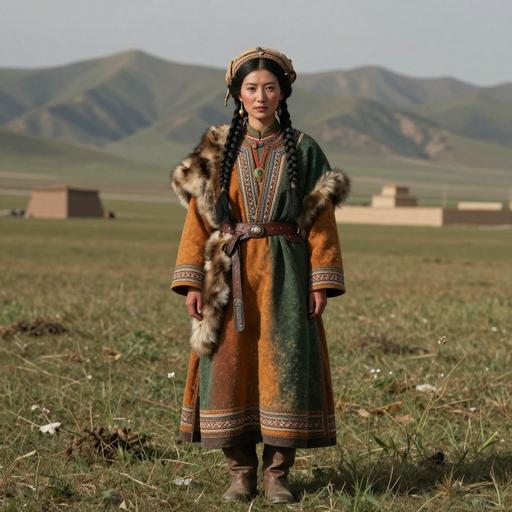
Portrait reconstruction of DA226
Ancient Individual

A woman buried in Kazakhstan in the Medieval era

DA226
50 CE - 450 CE
Female
Kangju Culture in Kazakhstan
Kazakhstan
Scroll to begin
Chapter I

Identity

The biological and cultural markers that define this ancient individual

Sample ID

DA226

Date Range

50 CE - 450 CE

Biological Sex

Female

mtDNA Haplogroup

U2e1h1a

Cultural Period

Kangju Culture in Kazakhstan

Chapter II

Place

Where this individual was discovered

Country Kazakhstan
Locality Tian Shan. Central Steppe
Coordinates 43.0686, 68.2489
Chapter III

Time

When this individual lived in the broader context of human history

DA226 50 CE - 450 CE
Chapter IV

Story

The narrative of this ancient life

The Kangju were a significant nomadic group that flourished in the Central Asian steppes, particularly in the territory corresponding to present-day southern Kazakhstan, from around the 2nd century BCE to the 4th century CE. The Kangju culture, as an influential part of the nomadic steppe cultures, provides a fascinating insight into the ways of life, social structures, and interactions of pastoral nomadic societies during this period.

Geographical Context

The Kangju people inhabited the vast steppes and river valleys of what is now southern Kazakhstan. This region provided a complex mix of landscapes, including arid deserts, rich pastures, and resource-rich river valleys such as those created by the Syr Darya and Chu rivers. This geography facilitated their pastoral lifestyle and allowed them to engage in limited agriculture, supporting their semi-nomadic existence.

Origins and Ethnogenesis

The origins of the Kangju are somewhat hazy, with historical records suggesting they may have been related to, or ancestral to, other Central Asian groups such as the Saka or early Turkic tribes. Ancient Chinese sources, notably the Han dynasty's historical texts, describe the Kangju as one of the steppe's formidable powers, highlighting their interactions with both sedentary and nomadic neighbors.

Social and Political Organization

The Kangju society was structured around clan-based nomadic networks. They did not build permanent settlements, but rather lived in yurts and followed a seasonal migratory pattern in search of grazing land for their livestock. This mobility was central to their social organization, as it allowed for the efficient use of the sparse resources available in the steppe environment.

Politically, the Kangju were organized into a loose confederation of tribes, led by chieftains who wielded authority based on both hereditary status and personal charisma. Their political power often extended to neighboring regions, and they were known to extract tributes and influence from nearby oases and city-states.

Economy and Trade

The Kangju economy was predominantly based on pastoralism, with herds of sheep, goats, horses, and camels providing not only subsistence but also trade goods like wool, leather, and dairy products. They were skilled horsemen, and their mobility allowed them to engage in trade across vast distances.

The Kangju also played a crucial role in the Silk Road trade networks. Their strategic location connected the vast markets of the East with those of the West, facilitating the exchange of goods such as silk, spices, precious metals, and other luxury items. Their involvement in trade brought wealth and new cultural influences into their society.

Cultural Attributes

Culturally, the Kangju were characterized by their nomadic lifestyle, which influenced their art, religious practices, and social customs. They practiced a form of animism or shamanism, with a strong reverence for natural elements and sky deities. Archaeological evidence suggests they also engaged in elaborate burial practices, with kurgans (burial mounds) providing rich insights into their beliefs about the afterlife and the status of individuals within their society.

The Kangju were adept in metalwork, as evidenced by archaeological finds of weapons, tools, and decorative items crafted from bronze and iron. These artifacts showcase a blend of influences, indicative of their interactions with both eastern and western cultures.

Legacy and Impact

The legacy of the Kangju culture is observed in the enduring traditions of nomadic pastoralism in Central Asia. Their historical presence contributed to the cultural and genetic mosaic of the region, influencing subsequent nomadic empires such as the Huns and Turkic khanates. The Kangju are also a testament to the dynamic and connective nature of the ancient Silk Road, highlighting the impact of nomadic cultures on regional stability and cross-cultural exchanges.

In summary, the Kangju culture in Kazakhstan represents a vibrant and integral component of the nomadic steppe cultures, marked by their adaptability, economic acumen, and significant role in the historical tapestry of Central Asia. Their influence is still felt in the cultural and historical identity of the region today.

Chapter V

Genetics

The genetic ancestry of this ancient individual

Ancient Genetic Admixture

This analysis compares the DNA profile of DA226 with ancient reference populations, showing the genetic composition in terms of prehistoric ancestral groups.

Western Steppe Pastoralists 36.1%
European Hunter-Gatherers 27.8%
Neolithic Farmers 19.7%
Ancient Asians 9.0%
Ancient Native Americans 7.5%

Modern Genetic Admixture

This analysis compares the DNA profile with present-day reference populations, showing what percentage of genetic makeup resembles modern populations from different regions.

Asia 53.2%
Northern West Asian 39.5%
Caucasian 39.5%
Central Asian, Northern Indian & Pakistani 8.8%
Pakistan 7.0%
Indian 1.4%
Northern Asian 4.9%
Siberian 4.9%
Europe 43.6%
Northwestern European 25.6%
Scandinavian 10.6%
English 10.6%
Northwestern European 4.4%
Eastern European 18.0%
America 3.1%
America 3.1%
Native American 3.1%

Closest Modern Populations

These are the modern populations showing the closest statistical alignment to A woman buried in Kazakhstan in the Medieval era, ranked by genetic distance. Lower distance values indicate closer statistical similarity.

1
Pamiri Rushan
7.0420
2
Tajik Yaghnobi
7.0901
3
Turkish Deliorman
7.1383
4
Tatar Mishar
7.2506
5
Turkish Rumeli
7.3031
6
Pamiri Shugnan
7.8299
7
Tatar Kazan
8.0182
8
Lezgin
8.2053
9
Turkish Balikesir
8.2331
10
Kumyk
8.3777
Chapter VI

Context

Other ancient individuals connected to this sample

Sources

References

Scientific publications and genetic data

Scientific Publication

137 ancient human genomes from across the Eurasian steppes

Authors Damgaard PB, Marchi N, Rasmussen S
Abstract

For thousands of years the Eurasian steppes have been a centre of human migrations and cultural change. Here we sequence the genomes of 137 ancient humans (about 1× average coverage), covering a period of 4,000 years, to understand the population history of the Eurasian steppes after the Bronze Age migrations. We find that the genetics of the Scythian groups that dominated the Eurasian steppes throughout the Iron Age were highly structured, with diverse origins comprising Late Bronze Age herders, European farmers and southern Siberian hunter-gatherers. Later, Scythians admixed with the eastern steppe nomads who formed the Xiongnu confederations, and moved westward in about the second or third century BC, forming the Hun traditions in the fourth-fifth century AD, and carrying with them plague that was basal to the Justinian plague. These nomads were further admixed with East Asian groups during several short-term khanates in the Medieval period. These historical events transformed the Eurasian steppes from being inhabited by Indo-European speakers of largely West Eurasian ancestry to the mostly Turkic-speaking groups of the present day, who are primarily of East Asian ancestry.

G25 Coordinates

The G25 coordinates for sample DA226 can be used for detailed admixture analysis in our G25 Studio tool.

DA226,0.10904134,0.06441832,0.02202848,0.03325014,-0.01085696,0.01402174,-0.00072636,-0.00421044,-0.01924132,-0.01870242,-0.00203584,0.00161836,-0.00584502,-0.00774654,0.01305066,0.00103044,-0.01181272,0.0020565,-0.00151278,-0.00458896,-0.00219764,0.00326894,0.0007489,0.01158478,0.00062951
Analyze in G25 Studio
Use code for 40% off Expires Feb 27