Menu
Store
Blog
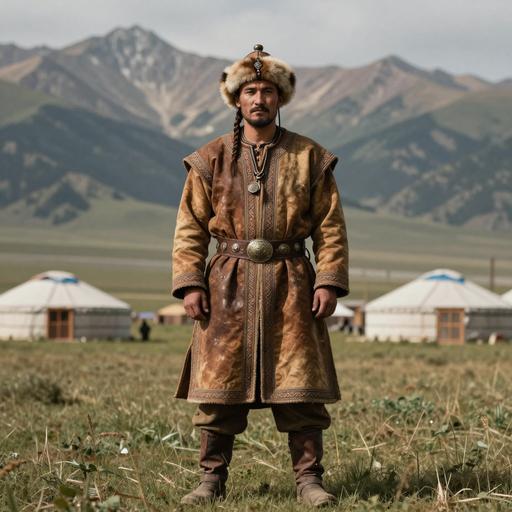
Portrait reconstruction of DA94
Ancient Individual

A man buried in Kazakhstan in the Middle Ages era

DA94
600 CE - 1300 CE
Male
Medieval Nomad, Kazakhstan
Kazakhstan
Scroll to begin
Chapter I

Identity

The biological and cultural markers that define this ancient individual

Sample ID

DA94

Date Range

600 CE - 1300 CE

Biological Sex

Male

mtDNA Haplogroup

Z1a1

Y-DNA Haplogroup

R-M198

Cultural Period

Medieval Nomad, Kazakhstan

Chapter II

Place

Where this individual was discovered

Country Kazakhstan
Locality Tian Shan. Central Steppe
Coordinates 43.0686, 68.2489
Chapter III

Time

When this individual lived in the broader context of human history

DA94 600 CE - 1300 CE
Chapter IV

Story

The narrative of this ancient life

The medieval era of the Turkic nomadic cultures in what is today Kazakhstan is a fascinating period marked by dynamic social structures, rich traditions, and significant historical impacts. This era, often spanning from the 6th to the 12th centuries, was characterized by the dominance of various Turkic khanates, confederations, and empires, such as the Göktürks, the Western Turkic Khaganate, and later, the Kimek and Kipchak Confederations. Here’s an extensive and detailed description of this intriguing era and culture:

Social and Political Structure

  1. Tribal Society: The Turkic nomads organized themselves into tribes, each consisting of several clans typically led by a chief or a khan. These tribes formed confederations for mutual defense and cooperation.

  2. Leadership and Governance: The khan, who was often seen as possessing divine favor or mandate, led with the assistance of tribal councils known as 'kurultai'. These councils were composed of clan leaders and were crucial for decision-making processes such as warfare and alliances.

  3. Military Organization: Turkic nomadic groups were renowned for their formidable cavalry. Every male member was expected to be a skilled horseman and warrior, which contributed to the mobility and military prowess of these tribes.

Economy and Lifestyle

  1. Nomadic Pastoralism: The economy was primarily based on nomadic pastoralism. The vast steppes of Kazakhstan provided ample grazing lands for horses, sheep, camels, and goats. The movement of nomads was typically seasonal, following patterns that maximized the use of available resources.

  2. Trade: Despite their nomadic lifestyle, the Turkic tribes were actively involved in trade, particularly along the Silk Road. They traded livestock, horses, fur, and leather goods for silk, spices, and other luxuries brought by caravans.

  3. Craftsmanship: There was a notable tradition of craftsmanship, particularly in metalworking and textiles. The nomads produced exquisite jewelry, weapons, and practical items like saddles and tents, which were often adorned with intricate designs.

Culture and Beliefs

  1. Tengriism: The primary religion was Tengriism, a shamanistic and animistic belief system centered around the sky god Tengri. Nature and ancestor worship were integral parts of their spiritual life, with shamans playing essential roles as mediators between the physical and spiritual worlds.

  2. Oral Traditions: Storytelling, epic poetry, and music were vital cultural elements. Bards, known as 'ashiks' or 'ozans', played stringed instruments like the dombra and were key to passing down histories and legends orally.

  3. Art and Symbolism: Art was both decorative and symbolic, often featuring motifs of animals, particularly those revered in Tengriism, such as horses, wolves, and eagles. These motifs were prominent in personal adornment, weaponry, and household items.

Historical Impact

  1. Cultural Influences: The Turkic nomads played a significant role in the cultural exchange that defined the medieval Silk Road. They not only facilitated trade but also influenced and integrated various cultural elements from China, Persia, and Byzantium into their own.

  2. Military Influence: Their military techniques, especially horseback archery and mobile warfare, had far-reaching impacts, influencing neighboring cultures and later empires across Eurasia.

  3. Formation of Khanates and Empires: The confederations and khanates formed during this era set the stage for the rise of significant historical figures like Genghis Khan. The Mongol Empire, for instance, was deeply influenced by Turkic military strategies and governance models.

In conclusion, the medieval nomadic societies of Kazakhstan were central players in the historical developments of Central Asia. Their cultural legacy, marked by adaptability, artistic expression, and martial prowess, had lasting influences on the regions they interacted with and the subsequent empires that arose from these nomadic traditions.

Chapter V

Genetics

The genetic ancestry of this ancient individual

Ancient Genetic Admixture

This analysis compares the DNA profile of DA94 with ancient reference populations, showing the genetic composition in terms of prehistoric ancestral groups.

Ancient Asians 48.6%
European Hunter-Gatherers 22.6%
Western Steppe Pastoralists 17.1%
Neolithic Farmers 8.3%
Ancient Native Americans 3.4%

Modern Genetic Admixture

This analysis compares the DNA profile with present-day reference populations, showing what percentage of genetic makeup resembles modern populations from different regions.

Asia 64.8%
Central Asian, Northern Indian & Pakistani 35.2%
Central Asian 24.7%
Pakistan 10.5%
Northern Asian 22.6%
Siberian 22.6%
Chinese & Southeast Asian 5.1%
Chinese 3.4%
Indonesian Khmer Thai Myanma 1.6%
Japanese & Korean 2.0%
Japanese 2.0%
Europe 29.7%
Eastern European 18.9%
Northwestern European 10.6%
English 8.7%
Scandinavian 1.8%
America 4.9%
America 4.9%
Native American 4.9%
Africa 0.6%
North African 0.6%
Egyptian 0.6%

Closest Modern Populations

These are the modern populations showing the closest statistical alignment to A man buried in Kazakhstan in the Middle Ages era, ranked by genetic distance. Lower distance values indicate closer statistical similarity.

1
Tatar Siberian
3.3511
Chapter VI

Context

Other ancient individuals connected to this sample

Sources

References

Scientific publications and genetic data

Scientific Publication

137 ancient human genomes from across the Eurasian steppes

Authors Damgaard PB, Marchi N, Rasmussen S
Abstract

For thousands of years the Eurasian steppes have been a centre of human migrations and cultural change. Here we sequence the genomes of 137 ancient humans (about 1× average coverage), covering a period of 4,000 years, to understand the population history of the Eurasian steppes after the Bronze Age migrations. We find that the genetics of the Scythian groups that dominated the Eurasian steppes throughout the Iron Age were highly structured, with diverse origins comprising Late Bronze Age herders, European farmers and southern Siberian hunter-gatherers. Later, Scythians admixed with the eastern steppe nomads who formed the Xiongnu confederations, and moved westward in about the second or third century BC, forming the Hun traditions in the fourth-fifth century AD, and carrying with them plague that was basal to the Justinian plague. These nomads were further admixed with East Asian groups during several short-term khanates in the Medieval period. These historical events transformed the Eurasian steppes from being inhabited by Indo-European speakers of largely West Eurasian ancestry to the mostly Turkic-speaking groups of the present day, who are primarily of East Asian ancestry.

G25 Coordinates

The G25 coordinates for sample DA94 can be used for detailed admixture analysis in our G25 Studio tool.

DA94,0.0816169,-0.1322895,0.05869,0.0310121,-0.05375356,-0.00646874,0.00242252,0.00580404,-0.00217168,-0.0137179,0.00017468,0.00081474,-0.00116948,-0.0174024,0.0122438,0.00119296,-0.0129543,-0.00058146,0.00514196,0.00599546,-0.01643638,0.00090154,-0.00092016,0.00393288,-0.0018827
Analyze in G25 Studio
Use code for 40% off Expires Feb 27