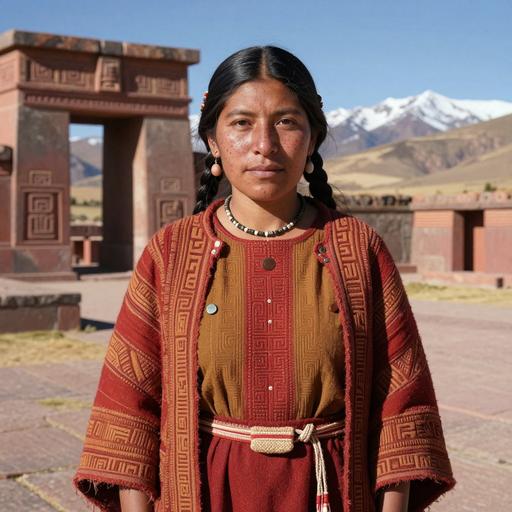
The Tiwanaku culture, which thrived between approximately 300 and 1100 CE, was one of the significant pre-Columbian civilizations of the Andes. While the Tiwanaku culture is primarily associated with its heartland around Lake Titicaca in present-day Bolivia, its influence extended into various regions, including what is modern-day southern Peru. Understanding the Tiwanaku's impact on the Cullcunche region, among others in Peru, reveals a fascinating layer of Andean history marked by complex social, religious, and architectural developments.
Geographic Context
The Tiwanaku civilization's reach into southern Peru, including areas like Cullcunche, reflects the wide sphere of cultural and economic influence that this civilization had across the Andes. The Andes provided a unique environment with its high-altitude plains, where the Tiwanaku could develop sophisticated agricultural practices, such as raised field agriculture, to support large populations. These practices not only facilitated food production but also served as a foundation for Tiwanaku’s expansion.
Social and Political Structure
Tiwanaku society was highly stratified, with a powerful elite class that controlled religious and administrative functions. Theocracy was central to its governance; the rulers often held dual roles as both political leaders and divine figures. The societal structure allowed for a cohesive control over expansive territories through a combination of direct rule and the establishment of colonies or client states.
Religion and Ideology
Religion was a cornerstone of Tiwanaku culture, with a pantheon that often integrated natural elements. They revered deities associated with the sun, moon, and other natural phenomena, which were celebrated through elaborate rituals. The Tiwanaku's religious practices and iconography, such as the staff-bearing deity and motifs like the Andean cross, resonate across the Andean world and manifest in various archaeological sites. Religious centers were not only centers of worship but also of astronomical observation, playing critical roles in agricultural planning and social organization.
Architecture and Art
Tiwanaku is renowned for its monumental stone architecture and intricate stone-carved artworks. Cities like Tiwanaku itself featured impressive structures such as the Kalasasaya temple and the Akapana pyramid. These served not only as architectural feats but as embodiments of celestial and ritual functions. The stonework often employed a sophisticated technique of interlocking blocks, which is visible throughout various Tiwanaku-influenced sites.
In peripheral regions like Cullcunche, local architecture may have integrated or adapted these styles, using regional materials and building techniques but drawing directly from Tiwanaku’s iconography and practical design. Additionally, sculptural arts and pottery from this era exhibit a high degree of detail, depicting cosmological themes, anthropomorphic figures, and mythical creatures.
Economy and Trade
Tiwanaku's economic system was bolstered by agriculture, particularly the cultivation of potatoes, quinoa, and maize, enabled by their innovative raised-field systems. The civilization also engaged in extensive trade networks that facilitated the exchange of goods such as textiles, metals, and ceramics across the Andes and beyond. These networks were crucial in disseminating cultural attributes, as seen in Tiwanaku-influenced pottery and artifacts found in areas like Cullcunche.
Cultural Legacy
The Tiwanaku culture left an indelible mark on the regions it influenced, including Peru. Following the decline of the Tiwanaku around 1100 CE, its cultural and technological legacies continued to impact successor societies, including the Inca. Many aspects of Tiwanaku's social and religious systems, agricultural techniques, and architectural styles were adopted or adapted by subsequent civilizations. The Cusco region and ultimately the Inca Empire would draw from these preceding cultural traditions, further developing them into the expansive Andean social and political structures known later in pre-Columbian history.
Conclusion
In exploring the Tiwanaku culture's impact in regions like Cullcunche, southern Peru, one sees a complex interplay of culture, religion, and technology that shaped the Andes’ historical trajectory. The expansion and influence of Tiwanaku reflect the intricate nature of Andean civilizations well before European contact, highlighting the sophisticated systems and diverse cultural practices that characterized this period. The vestiges of their presence continue to be a subject of archaeological and historical inquiry, shedding light on the vibrant and dynamic pre-Columbian history of the Andes.