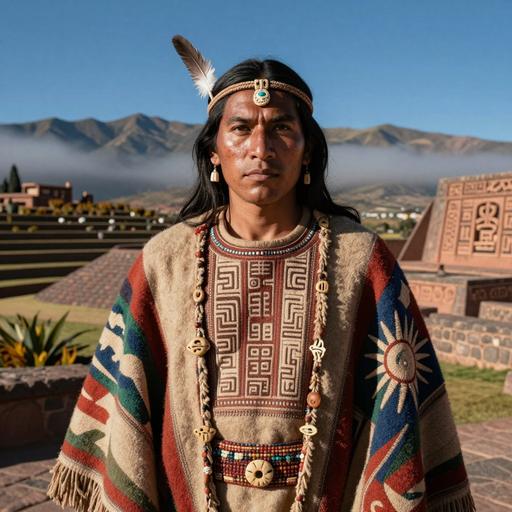
The Tiwanaku culture, often associated with one of the most influential early civilizations in the Andes, thrived around Lake Titicaca in what is now Bolivia from approximately 300 to 1000 AD. Its influence extended over large parts of the southern Andes, including sites such as Maucallacta in present-day Peru. This culture is renowned for its architectural achievements, complex societal structure, and far-reaching influence on later Andean cultures, most notably the Inca.
Geographical Setting
Maucallacta is situated in the high-altitude Andean region, characterized by rugged mountainous terrain and a harsh environment. Despite the challenging conditions, the Tiwanaku efficiently managed agriculture through advanced irrigation systems, creating raised fields known as \suka kollus" that significantly increased their agricultural output.
Architecture and Urban Planning
Tiwanaku is celebrated for its monumental architecture, characterized by massive stone constructions, finely cut masonry, and fertile understanding of cosmic alignment. This is reflected in structures like the Akapana Pyramid, the Kalasasaya Temple, and the Gateway of the Sun at the Tiwanaku site. Maucallacta, while not as visually imposing as the central Tiwanaku site, displays influences through its own ceremonial centers that follow similar planning principles.
The architecture of Tiwanaku, including its satellite sites like Maucallacta, was not just for functional purposes but contained cosmic and spiritual significance, often aligning with celestial events. This reflects a deep integration of religion and astronomy in the societal structure.
Society and Culture
Tiwanaku society was hierarchically organized, with a powerful elite class that controlled religious and state affairs. This class system facilitated the sophisticated organization required for monumental construction projects and elaborate trade networks. Tiwanaku culture is marked by its extensive trade routes, which spread across the Andes, connecting distant regions. This enabled the exchange not only of goods such as pottery, textiles, and metals but also of ideas and cultural practices.
In terms of religion, Tiwanaku society was deeply spiritual, worshiping deities often represented in their art and architecture. The most significant deity is believed to have been Viracocha, a creator god. Artifacts and iconography frequently depict religious figures, suggesting a rich tradition of mythology and oral history.
Art and Iconography
The art of Tiwanaku, including that found at Maucallacta, is characterized by intricate stone carvings, textile designs, and ceramics. These often feature abstract and symbolic motifs, such as the Andean cross (chakana) and representations of mythological beings. The iconography frequently included representations of pumas, condors, and human figures, often interpreted as symbolic of power and divinity.
Tiwanaku ceramics are distinguished by their polychrome designs and sophisticated iconographic themes, often reflecting religious or cosmological significance. These ceramics have been found throughout the Tiwanaku influence zones, indicating a standardized style shared across their territory.
Agriculture and Economy
The Tiwanaku civilization was highly adept in agriculture, employing advanced techniques suited to the high-altitude environment. The "suka kollus" raised fields enabled them to create a productive agricultural system capable of sustaining large populations. This agricultural innovation was crucial for supporting the urban centers and enabling the trade networks that facilitated the cultural expansion of Tiwanaku.
Decline and Legacy
The decline of the Tiwanaku civilization around 1000 AD is believed to have been caused by a combination of climatic changes, such as prolonged drought, and perhaps social upheaval or conflict. However, their cultural legacy persisted, heavily influencing subsequent civilizations, including the Inca. The organizational, architectural, and cultural practices developed by Tiwanaku were mirrored and expanded upon by the Inca, who revered Tiwanaku as a sacred site and a foundational element of their own civilization.
Conclusion
Understanding the Tiwanaku culture, particularly through sites like Maucallacta, provides significant insights into early Andean civilizations. Their advancements in architecture, society, and agriculture are testament to their complexity and far-reaching influence. Additionally, the cultural and religious practices laid foundational elements that would shape the Andean world for centuries to come."