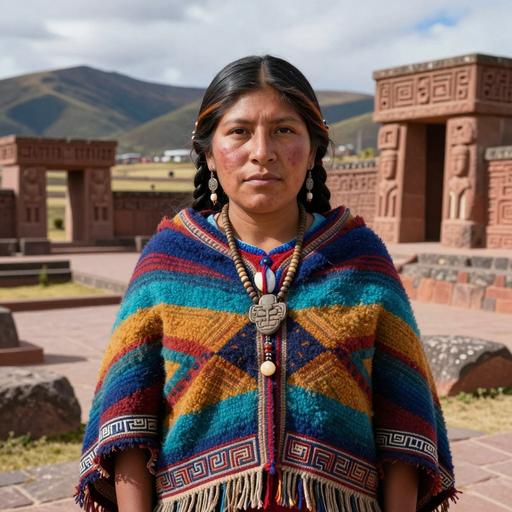
The Tiwanaku culture, thriving from approximately 300 to 1000 CE near the southern shores of Lake Titicaca in present-day Bolivia, is one of the most significant pre-Columbian civilizations in the Andes. The city of Tiwanaku served as the cultural and political hub of this ancient society, and although it reached its pinnacle around 500 to 900 CE, its influence extended throughout a substantial part of the Andean region.
Geographical Context and Architecture:
The Tiwanaku civilization was strategically located near Lake Titicaca, the world's highest navigable lake, which played a crucial role in the region's agricultural prosperity. Tiwanaku's monumental architecture is a testament to its advanced engineering and architectural prowess. The site of Putuni, which is part of the larger Tiwanaku complex, is often associated with elite or ceremonial functions.
Putuni Sector:
Putuni, sometimes referred to as the \Palace of the Sarcophagi," was a focal point for the elite within Tiwanaku. It is characterized by a series of finely-worked stone structures, reflecting intricate stone masonry and elaborate carvings. This area may have served both a residential and ceremonial purpose for the ruling class. The precise alignment and construction techniques indicate a high level of sophistication and an understanding of both architectural form and aesthetic design.
Social and Political Organization:
The Tiwanaku culture at Putuni reflects a highly organized society with a complex social hierarchy. The elite's residences, possibly located at Putuni, suggest a societal structure where social status was closely tied to religious authority and political power. The rulers likely held both secular and sacred roles, which were central to maintaining control over the surrounding regions and fostering the cultural and religious cohesion that defined Tiwanaku.
Economy and Subsistence:
Economically, Tiwanaku was able to sustain its large population through innovative agricultural techniques, including raised field farming (known as suka kollus), which maximized the local environment's productivity. The proximity of Lake Titicaca was advantageous for fishing, trade, and transportation. Trade networks extended as far as northern Chile and Peru, bringing in resources such as tropical fruits and seashells, and exporting pottery, textiles, and crafted stonework. The exchange of goods facilitated not only economic stability but also cultural exchange.
Religion and Iconography:
Religion was a central pillar of the Tiwanaku society, with the gateway at Kalasasaya Temple and the monolithic Ponce and Bennett stelae symbolizing spiritual and cosmological beliefs. The iconography often depicted in Tiwanaku art features complex imagery, including deities, shamans, and mythical beings, signifying an elaborate cosmology. The motifs found in Putuni often reflect this spiritual richness, possibly serving to reinforce the divine nature of the leaders who resided there.
Cultural and Artistic Achievements:
Tiwanaku's artistic achievements are reflected in their pottery, textiles, and stone carvings. The pottery often featured geometric shapes and depicted both natural and supernatural themes, symbolizing cultural narratives and religious myths. Stone artworks from Putuni and other parts of Tiwanaku showcase exquisite craftsmanship, with precision detailing that symbolizes the syncretic nature of Tiwanaku's interconnectedness with its environment and the divine.
Legacy and Influence:
The legacy of Tiwanaku, particularly visible in the archaeological remnants of sites like Putuni, is influential in understanding pre-Columbian Andean civilizations. Tiwanaku's architectural and artistic styles spread northwards, influencing subsequent cultures such as the Wari and Inca. As a center of cultural convergence, Tiwanaku at Putuni represents a pivotal moment in Andean prehistory, acting as a keystone in the complex mosaic of ancient South American history.
Overall, the Tiwanaku culture at Putuni highlights a sophisticated society marked by architectural brilliance, societal complexity, and a deep connection with its ecological and spiritual surroundings. The remnants of this civilization continue to captivate archaeologists and historians, offering profound insights into the dynamics of pre-Columbian South America."