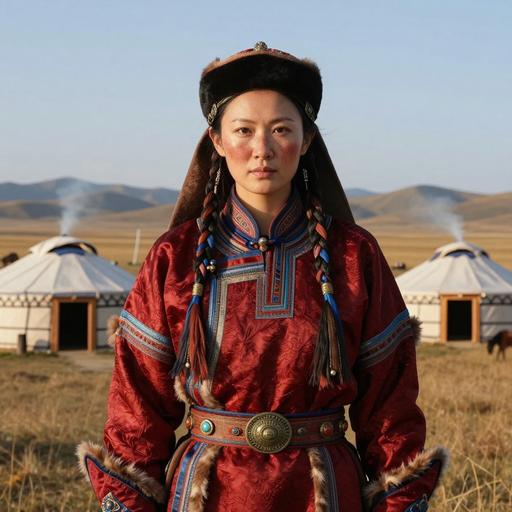
GD2-2 - A woman buried in Mongolia in the Tribal era

Download PDF creates a visual, rasterized copy. Use Print for selectable text and better assistive-technology support.

Menu
Currency
Main
Store
Blog

Loading Report

Preparing your ancestry journey

Connecting to ancient matches...

Preparing your report

Skip to main content
Portrait reconstruction of A woman buried in Mongolia in the Tribal era
Ancient Individual

A woman buried in Mongolia in the Tribal era

A woman buried in Mongolia during the Zubu Mongols

A fragment of the ancient world, preserved across millennia in strands of DNA.

GD2-2
880 CE - 985 CE
Female
Mongolia
Scroll to begin
Chapter I

Identity

The biological and cultural markers that define this ancient individual

Sample ID

GD2-2

Date Range

880 CE - 985 CE

Cultural Period

Zubu Mongols

Biological Sex

Female

mtDNA Haplogroup

A25

Y-DNA Haplogroup

N/A (Female)

Social Role

Pastoralist (AI estimate, era-typical)

Chapter II

Place

Where this individual was discovered

Country Mongolia
Locality Gurvan Dov
Chapter III

Time

When this individual lived in the broader context of human history

GD2-2 880 CE - 985 CE
Chapter IV

Story

The narrative of this ancient life

Region & Environment

The Zubu Mongols are placed in Mongolia, within the steppe ecologies that supported seasonal herding and riding-based travel. Grasslands and water access structured routes between pastures, while the open terrain favored rapid movement and flexible settlement strategies.

Historical Context

This timeframe falls within the Mongol period, after the major consolidation of Mongol leadership in the early 13th century. Rather than a single unified imperial system in day-to-day life for all groups, tribal and regional identities remained important, interacting with larger imperial authority and regional political arrangements.

Populations & Lifeways

Zubu groups would have lived primarily as mobile or semi-mobile pastoralists, with lifeways organized around herding and seasonal movement. Clan affiliations mattered for forming alliances, maintaining obligations, and mobilizing riders for regional political needs, whether for defense, escort, or campaigning.

Archaeology & Material Culture

Material culture for Mongol-period Mongolia typically combines steppe traditions with broader patterns visible across the Mongol sphere. Archaeological evidence may include burial features and associated goods, alongside portable domestic equipment consistent with mobility, though local variation is expected across the region.

Culture & Society

Tribal society emphasized lineage ties, shared ritual and social norms, and practical cooperation among mobile households. Within the larger Mongol political environment, tribal leaders would have negotiated the balance between autonomy and obligations to higher-level authorities.

Legacy & Transition

By the 13th to 14th centuries, Mongol political structures continued to evolve, with authority becoming increasingly regional. The Zubu Mongols thus represent one strand in the broader transformation of steppe governance, where tribal networks remained essential even as overarching systems shifted.

Chapter V

Genetics

These comparisons show genetic similarity, not identity or origin. The populations listed are those whose genomes show statistical alignment to this ancient individual.

Similarity reflects shared history, not shared identity. These are analytical comparisons, not claims about who this person was.

Modern Genetic Admixture

This analysis compares the DNA profile with present-day reference populations, showing statistical similarity to modern reference populations from different regions. The excavation site records where this individual was found, not a fixed modern genetic identity.

Asia 99.5%
Northern Asian 66.9%
Siberian 37.1%
Mongolian 29.8%
Central Asian, Northern Indian & Pakistani 12.4%
Central Asian 12.4%
Chinese & Southeast Asian 10.1%
Chinese 9.6%
Tibetan 0.6%
Japanese & Korean 10.0%
Japanese 10.0%
Oceania 0.6%
Melanesian 0.6%
Papuan 0.6%
Context

Related Samples

This individual exists within a broader network of ancient samples. No ancient genome stands alone.

Sample ID Culture/Period Date Location Action
GD1-1 First Turkic Khaganate of Mongolia 541 CE Gurvan Dov, Mongolia View
GD1-3 Zubu Mongols 776 CE Gurvan Dov, Mongolia View
GD1-4 Xiongnu-Xianbei Cultures of Mongolia 59 CE Gurvan Dov, Mongolia View
GD2-2 Zubu Mongols 880 CE Gurvan Dov, Mongolia View
GD2-4 First Turkic Khaganate of Mongolia 550 CE Gurvan Dov, Mongolia View
TK4-2 Mongol Empire 1283 CE Tavan Khailaast, Mongolia View
TK4-5 Mongol Empire 1300 CE Tavan Khailaast, Mongolia View
TK5-2 Mongol Empire 1330 CE Tavan Khailaast, Mongolia View
TK5-8 Mongol Empire 1299 CE Tavan Khailaast, Mongolia View
Sample ID Culture/Period Date Location Action
GD1-3 Zubu Mongols 776 CE Gurvan Dov, Mongolia View
GD2-2 Zubu Mongols 880 CE Gurvan Dov, Mongolia View
Sources

References

Scientific publications and genetic data that inform this profile.

G25 Coordinates

These coordinates represent a position in genetic space, a tool for comparison, not a conclusion. You can use these to perform custom admixture analysis in G25 Studio.

GD2-2,0.0373588,-0.3738131,0.06684524,-0.03696616,-0.04913348,-0.03006902,0.01626846,0.02094962,0.0025284,0.00931958,-0.01960242,0.00271678,-0.00077994,0.00127584,-0.005238,-0.00891846,-0.00410364,0.0036303,0.0059104,0.00639722,0.0040171,-0.01446868,-0.0069137,0.00048258,0.00209509
Continue in G25 Studio
Use code for 30% off Expires Aug 05