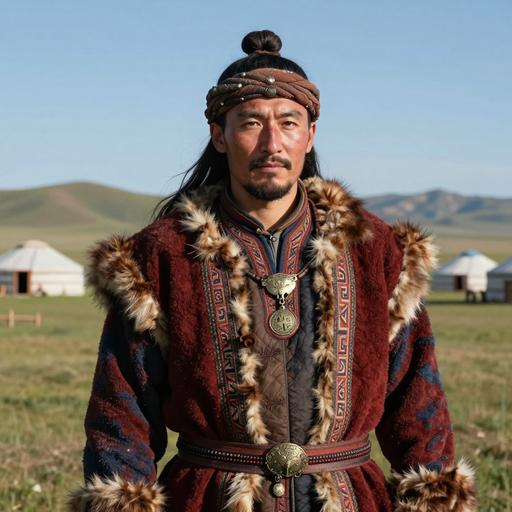
GD2-4 - A man buried in Mongolia in the Imperial era

Download PDF creates a visual, rasterized copy. Use Print for selectable text and better assistive-technology support.

Menu
Currency
Main
Store
Blog

Loading Report

Preparing your ancestry journey

Connecting to ancient matches...

Preparing your report

Skip to main content
Portrait reconstruction of A man buried in Mongolia in the Imperial era
Ancient Individual

A man buried in Mongolia in the Imperial era

A man buried in Mongolia during the First Turkic Khaganate of Mongolia

A fragment of the ancient world, preserved across millennia in strands of DNA.

GD2-4
550 CE - 635 CE
Male
Mongolia
Scroll to begin
Chapter I

Identity

The biological and cultural markers that define this ancient individual

Sample ID

GD2-4

Date Range

550 CE - 635 CE

Cultural Period

First Turkic Khaganate of Mongolia

Biological Sex

Male

mtDNA Haplogroup

F1b1e

Y-DNA Haplogroup

D-M174

Social Role

Pastoralist (AI estimate, era-typical)

Chapter II

Place

Where this individual was discovered

Country Mongolia
Locality Gurvan Dov
Chapter III

Time

When this individual lived in the broader context of human history

GD2-4 550 CE - 635 CE
Chapter IV

Story

The narrative of this ancient life

Region & Environment

The First Turkic Khaganate occupied much of the Inner Asian steppe, with major landscapes in and around Mongolia. Seasonal grasslands supported mobile herding and hunting, while mountain ranges and river valleys helped structure movement, pasture access, and communication routes.

Historical Context

In the centuries after the Xiongnu era and amid shifting Central Asian powers, Turkic-speaking groups expanded and reorganized political authority on the steppe. By 552 CE a Turkic khaganate (commonly associated with the early Göktürk polity) emerged with enough cohesion to project power across large distances, later facing fragmentation and changing alliances through the 7th and early 8th centuries.

Populations & Lifeways

Most people were mobile pastoralists engaged in herding (including livestock suited to steppe environments) and seasonal rounds. Households and clans maintained networks for pasture, marriage alliances, and political support, while elites coordinated tribute collection and military campaigns.

Archaeology & Material Culture

Archaeological signatures across Mongolia’s steppe include burial practices with grave goods, metalwork, and evidence for riding and transport technologies consistent with steppe mobility. Material culture commonly reflects a mobile economy and long-distance contacts, seen in categories of crafted objects and regional variations in funerary and prestige items.

Culture & Society

Steppe polities relied on kin-based leadership, hierarchy within ruling lineages, and the mobilization of mounted forces. Political legitimacy was tied to the khagan’s ability to manage resources, arbitrate alliances, and maintain control of tribute relationships that linked communities across the steppe.

Legacy & Transition

The First Turkic Khaganate was followed by shifting Turkic and steppe political formations, as authority fragmented and reassembled in response to internal dynamics and external pressures. Its emergence and later transformations helped shape the political landscape of Inner Asia in the centuries leading toward later Turkic khanates.

Chapter V

Genetics

These comparisons show genetic similarity, not identity or origin. The populations listed are those whose genomes show statistical alignment to this ancient individual.

Similarity reflects shared history, not shared identity. These are analytical comparisons, not claims about who this person was.

Modern Genetic Admixture

This analysis compares the DNA profile with present-day reference populations, showing statistical similarity to modern reference populations from different regions. The excavation site records where this individual was found, not a fixed modern genetic identity.

Asia 99.4%
Chinese & Southeast Asian 48.7%
Chinese 28.7%
Tibetan 20.0%
Northern Asian 40.3%
Mongolian 25.8%
Siberian 14.5%
Japanese & Korean 10.4%
Japanese 10.4%
Africa 0.7%
Context

Related Samples

This individual exists within a broader network of ancient samples. No ancient genome stands alone.

Sample ID Culture/Period Date Location Action
GD1-1 First Turkic Khaganate of Mongolia 541 CE Gurvan Dov, Mongolia View
GD1-3 Zubu Mongols 776 CE Gurvan Dov, Mongolia View
GD1-4 Xiongnu-Xianbei Cultures of Mongolia 59 CE Gurvan Dov, Mongolia View
GD2-2 Zubu Mongols 880 CE Gurvan Dov, Mongolia View
GD2-4 First Turkic Khaganate of Mongolia 550 CE Gurvan Dov, Mongolia View
TK4-2 Mongol Empire 1283 CE Tavan Khailaast, Mongolia View
TK4-5 Mongol Empire 1300 CE Tavan Khailaast, Mongolia View
TK5-2 Mongol Empire 1330 CE Tavan Khailaast, Mongolia View
TK5-8 Mongol Empire 1299 CE Tavan Khailaast, Mongolia View
Sample ID Culture/Period Date Location Action
GD1-1 First Turkic Khaganate of Mongolia 541 CE Gurvan Dov, Mongolia View
GD2-4 First Turkic Khaganate of Mongolia 550 CE Gurvan Dov, Mongolia View
Sources

References

Scientific publications and genetic data that inform this profile.

G25 Coordinates

These coordinates represent a position in genetic space, a tool for comparison, not a conclusion. You can use these to perform custom admixture analysis in G25 Studio.

GD2-4,0.02905616,-0.4167858,0.0314296,-0.04595312,0.00199108,-0.00305736,0.01148656,0.01328984,-0.00171496,0.01096556,-0.05857912,-0.00328304,0.00588248,0.00382056,-0.00520768,-0.00139072,-0.00254836,0.00059552,-0.0025148,0.0011068,0.00096836,-0.00087452,-0.00142604,0.0013838,0.00893068
Continue in G25 Studio
Use code for 30% off Expires Aug 05