Préparation du rapport

Chargement des informations et références disponibles

Connexion au corpus archéologique…

Collecte des archives antiques

Aller au contenu principal
Juan Dolio Ceramic Coast
Profil culturel

Juan Dolio Ceramic Coast

Coastal Ceramic-period communities in the Dominican Republic, revealed by archaeology and ancient DNA

1200 CE - 1650 CE
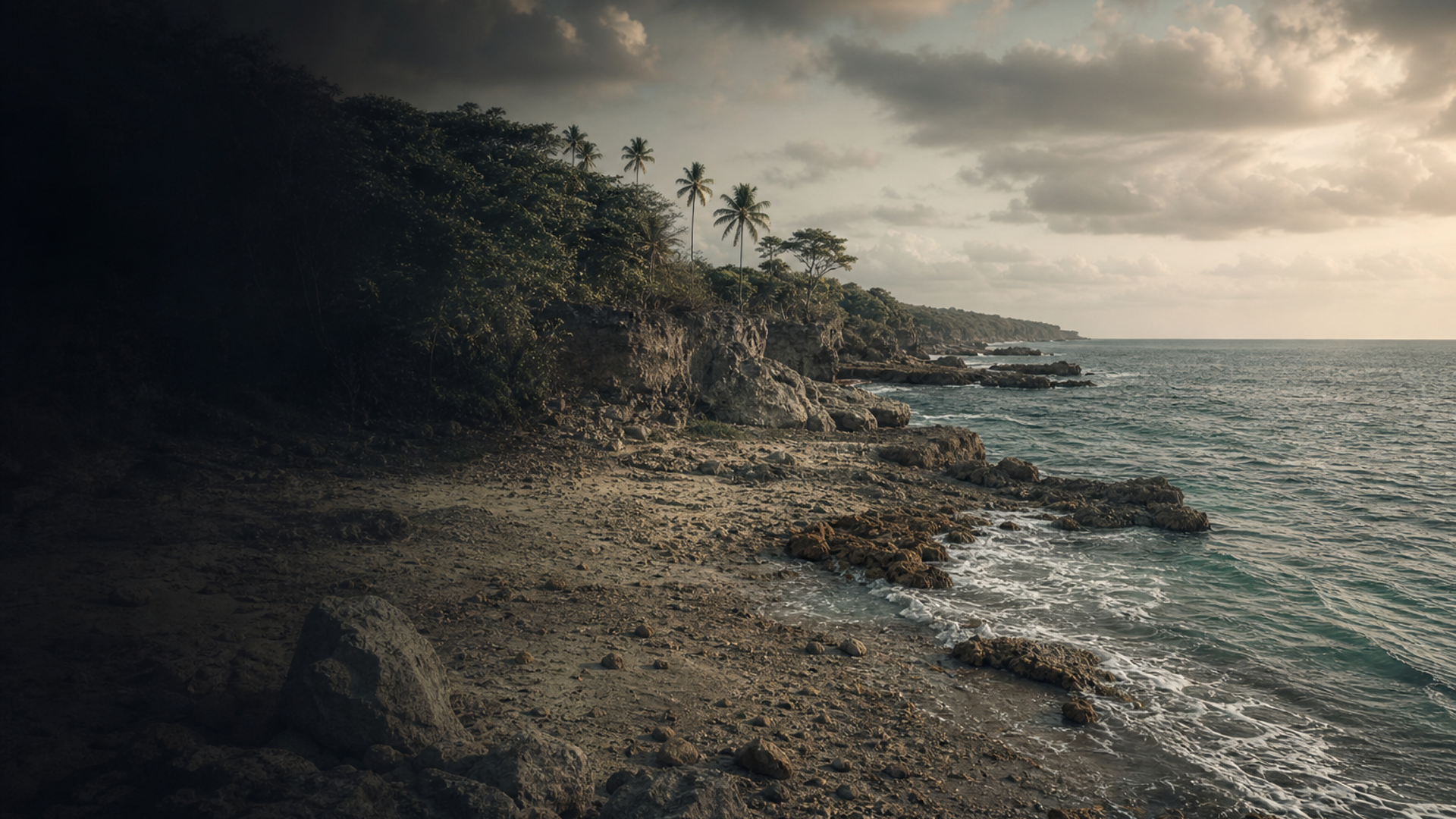
Juan Dolio, Dominican Republic
Faites défiler pour commencer
Chapitre I

Le récit

Comprendre la culture Juan Dolio Ceramic Coast

Archaeological and genetic evidence from Juan Dolio (1200–1650 CE) paints a vivid picture of Ceramic-period coastal life in Hispaniola. Limited but telling ancient DNA shows predominantly Indigenous maternal and paternal lineages, offering preliminary links to broader Caribbean and South American population movements.

Time Period

1200–1650 CE

Region

Juan Dolio, Dominican Republic

Common Y-DNA

Q (4/8 samples)

Common mtDNA

A (5), A2 (1), C1b (1), A2z (1)

Chapitre II

Chronologie

Moments clés de l'histoire de cette culture

1200 CE

Onset of local Ceramic occupation

Radiocarbon and stratigraphic evidence situate Juan Dolio's coastal occupation within the Ceramic period beginning around 1200 CE.

1492 CE

First sustained European contact in the region

European arrival initiates dramatic social and demographic transformations that reshape Caribbean societies and archaeological contexts.

1650 CE

End of sampled date range

The latest dates for the analyzed samples fall near 1650 CE, marking the end of the current temporal window.

Chapitre III

Origins & Emergence

Set along the sun-washed coast of Hispaniola, the Ceramic-period communities at Juan Dolio arose within a broader wave of pottery-using societies that spread across the Caribbean after the first millennium CE. Archaeological data indicates decorated ceramics, coastal shell middens, fish-hooks, and domestic debris consistent with settled shore-based lifeways dating from about 1200 CE onward. The material culture links Juan Dolio to the greater Ceramic Period network that archaeologists associate with migrations and cultural transmission from northern South America.

The story of emergence is reconstructed from ceramics, architecture traces, and occasional burials recovered in beach-edge deposits and low dunes. These finds suggest a community oriented to marine resources and regional exchange. Limited evidence suggests influences from Arawak-speaking groups moving through the Lesser Antilles, but exact pathways remain debated. Radiocarbon dates from charcoal and marine shell align sites in Juan Dolio to the 13th–17th centuries CE, a period of dynamic island connectivity and increasing interaction.

Because preservation varies and samples remain few, the archaeological picture is impressionistic rather than definitive. Ongoing excavations and interdisciplinary study—combining stratigraphy, radiocarbon calibration, and ancient DNA—are refining when and how these coastal settlements emerged and connected to wider Caribbean and South American networks.

  • Ceramic-period coastal settlement active c. 1200–1650 CE
  • Material culture suggests marine subsistence and regional exchange
  • Links to Arawak-associated Ceramic expansions are plausible but debated
Chapitre IV

Daily Life & Society

Archaeological traces at Juan Dolio evoke a life tuned to the sea: middens rich in shell and fish bone, stone and shell tools, and ceramics for cooking and storage. Structures are inferred from posthole stains and concentrations of domestic debris; they likely sheltered extended-family groups whose subsistence blended fishing, shellfish gathering, horticulture, and exchange.

Ceramics—often decorated with incision or punctation—served as both utilitarian ware and social expression. Small personal items and ornament fragments hint at identity markers, while the presence of non-local raw materials points to trade or mobility along coastal corridors. Burials, when present, are usually scarce and fragmentary, making social hierarchy difficult to assess. Nevertheless, the material record suggests communities resilient to coastal change, skilled in marine technologies, and engaged in a web of island-to-mainland connections.

Archaeological data indicates that social life at Juan Dolio was embedded in seasonal rhythms of fishing and cultivation, punctuated by visits from neighboring groups. The cinematic image—people repairing nets at dawn, shaping pottery by hand, and exchanging goods beneath palms—is rooted in tangible finds, even as many details remain provisional given the fragmentary record.

  • Subsistence focused on fishing, shellfish, and horticulture
  • Decorated ceramics and trade items indicate regional connections
Chapitre V

Genetic Profile

Ancient DNA from Juan Dolio provides a remarkable, if preliminary, molecular window into the people who occupied the coastal Ceramic sites. The dataset comprises eight samples dated within the archaeological range 1200–1650 CE. Four of eight male-line (Y-chromosome) samples belong to haplogroup Q, a lineage widely associated with Indigenous populations across the Americas. On the maternal side, mitochondrial DNA is dominated by haplogroup A (five samples), with specific sublineages recorded as A2 (1), C1b (1), and a rare A2z (1) variant. These maternal haplogroups are canonical Native American lineages, consistent with long-standing maternal continuity in the region.

Taken together, the genetic profile aligns closely with expectations for Indigenous Caribbean populations deriving from mainland migrations, most plausibly connected to northern South American source populations associated with Arawak-speaking expansions. However, important caveats apply: the sample count is small (n=8), limiting statistical power and the ability to resolve finer-scale population structure or detect low-frequency ancestries. Preservation biases, differential burial practices, and sampling location within Juan Dolio can also skew the genetic picture.

In short, the aDNA evidence supports strong Indigenous continuity in Juan Dolio during the Ceramic period and complements archaeological signals of mainland–island connections, but conclusions must remain cautious until larger, spatially diverse datasets are available.

  • Y-DNA dominated by haplogroup Q, consistent with Indigenous paternal ancestry
  • mtDNA dominated by haplogroups A and C1b; small sample size (n=8) makes results preliminary
Chapitre VI

Legacy & Modern Connections

The genetic signatures and material remains from Juan Dolio echo into the present. The predominance of Indigenous mtDNA and Y-DNA lineages underscores ancestral continuity that survives despite profound disruptions after European contact. These data help reconstruct ancestral threads that contribute to the genetic heritage of modern Caribbean populations and offer community-relevant narratives about identity and persistence.

Archaeological and genetic findings from Juan Dolio also inform broader debates about Caribbean prehistory: the tempo of colonization, the roles of South American source populations, and how maritime networks shaped cultural change. Because the current genetic sample set is small, these links are suggestive rather than definitive; nonetheless, they provide crucial anchors for future genomic and archaeological work that will deepen understanding of how past lives in places like Juan Dolio connect to people today.

  • Genetic continuity highlights Indigenous ancestry persisting into the historical era
  • Findings are an important but preliminary contribution to Caribbean ancestral reconstructions
Propulsé par l'IA

Assistant IA

Posez des questions sur la culture Juan Dolio Ceramic Coast

Assistant IA par DNAGENICS

Débloquer cette fonction
Posez des questions sur la culture Juan Dolio Ceramic Coast. L'assistant IA peut expliquer les résultats génétiques, le contexte historique, les preuves archéologiques et les liens génétiques avec les populations actuelles, dans les limites de l'interprétation.
Exemple d'analyse IA

La culture Juan Dolio Ceramic Coast représente un chapitre fascinant de l'histoire humaine…

L'analyse génétique met en évidence des similarités avec des populations antérieures et des signes d'adaptations propres. Les échantillons d'ADN ancien éclairent les schémas migratoires et les liens entre populations, avec des limites qui dépendent de l'étude et du contexte archéologique.

Il s'agit d'un aperçu de l'analyse IA. Accédez à l'assistant complet pour explorer :

  • Composition et similarité génétique
  • Schémas migratoires et origines
  • Vie quotidienne et pratiques culturelles
  • Contexte génétique actuel

Explorez d'autres cultures antiques

Découvrez les récits de civilisations issues du monde antique