Aller au contenu principal
Profil culturel

Merichleri Bronze Age Echo

A single burial at Kairyaka links Middle–Late Bronze Age Bulgaria to deep European ancestries

1866 CE - 1615 BCE
Merichleri (Kairyaka necropolis), Bulgaria

Le récit

Archaeological and genetic data from a single Middle–Late Bronze Age burial (c.1866–1615 BCE) at Merichleri's Kairyaka necropolis, Bulgaria, reveal a haplogroup R Y-line and mtDNA U lineage. Limited evidence suggests connections to broader Bronze Age population dynamics in the Balkans.

Time Period

c.1866–1615 BCE (Middle–Late Bronze Age)

Region

Merichleri (Kairyaka necropolis), Bulgaria

Common Y-DNA

R (observed: 1)

Common mtDNA

U (observed: 1)

Chronologie

1866 BCE

Burial at Kairyaka (Merichleri)

A Middle–Late Bronze Age interment dated c.1866–1615 BCE, providing the sole genomic sample from the necropolis.

Origins & Emergence

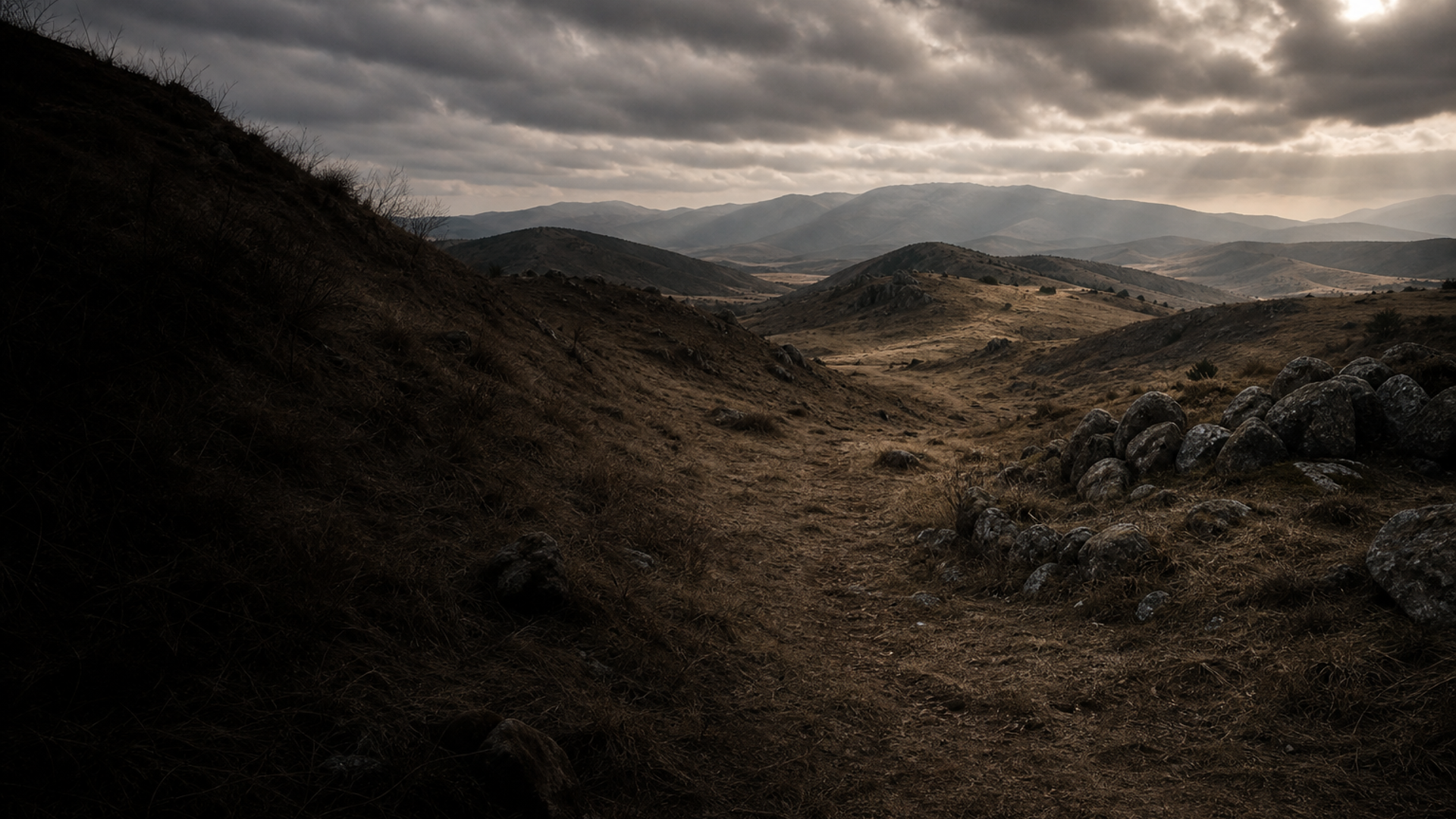
The burial from the Kairyaka necropolis at Merichleri sits in the cinematic haze between the Middle and Late Bronze Age, dated to c.1866–1615 BCE. Archaeological data indicates this period in Bulgaria was one of increasing interaction: trade networks extended across the Balkans, and mobile pastoral and metallurgical practices reshaped local lifeways. Limited evidence from Merichleri itself—one genomic sample and associated funerary context—can only hint at larger population dynamics.

Environmental and material traces from contemporary regional sites suggest communities practiced mixed farming, engaged with metallurgical centers, and participated in long-distance exchange. In broader Bronze Age narratives, the Balkans functioned as both a corridor and a crucible: influences arrived from the Eurasian steppe, Anatolia, and central Europe, producing complex cultural mosaics rather than simple, uniform migrations.

Because our genetic window into Merichleri is currently a single individual, claims about origins remain provisional. Archaeological evidence indicates local continuity in settlement patterns alongside episodic influxes of new ideas and people. Future genomic sampling from surrounding sites and stratified contexts will be essential to distinguish episodic contacts from sustained demographic change.

  • Site: Merichleri, Kairyaka necropolis (Bulgaria)
  • Date: c.1866–1615 BCE, Middle–Late Bronze Age
  • Interpretation limited by single-sample evidence

Daily Life & Society

Archaeological traces across Bronze Age Bulgaria paint a picture of lived experience shaped by the land and by networks of exchange. Contemporary sites show houses clustered near arable fields and pastures, where mixed agriculture—cereals, legumes—and animal herding coexisted. Craft specialization, particularly in bronze-working and pottery, became more visible in settlement debris and workshop contexts elsewhere in the region.

At necropoleis like Kairyaka, funerary practices provide a particularly evocative window into social identity. Burials capture choices of deposition, use of grave goods, and spatial organization of the dead—signals of status, kinship, and belief. Archaeological data indicates variation in burial rites during the Middle–Late Bronze Age, suggesting communities negotiated identity through both continuity and innovation.

Material culture and landscape use together suggest communities were adaptable: seasonal movement for pasture, reliance on local resources supplemented by imported goods, and social ties that reached beyond the immediate valley. However, because the Merichleri genetic dataset currently consists of a single individual, any reconstruction of household or community structure must remain cautious and provisional.

  • Mixed farming and herding economy inferred regionally
  • Funerary practices at necropoleis provide social clues

Genetic Profile

The genomic data from the Merichleri (Kairyaka) burial is intriguing but preliminary: one male-associated sample carries a Y-DNA lineage assigned broadly to haplogroup R, and the mitochondrial lineage is in haplogroup U. These assignments are consistent with patterns seen across much of Bronze Age Europe—where R-lineages (in diverse subclades) often increase in frequency concurrent with steppe-related ancestries, while mtDNA U lineages often reflect continuity with earlier European forager and mixed farmer populations.

Archaeogenetic studies emphasize that haplogroup labels alone do not equate to specific cultural labels; R encompasses multiple subbranches with distinct histories. With only one sample (n = 1), statistical inference about population-level ancestry, admixture proportions, or sex-biased migration at Merichleri is not robust. Nevertheless, combining the genetic signal with archaeological context allows cautious hypotheses: the presence of R may indicate some degree of gene flow from steppe-associated sources into the Balkans by the Middle–Late Bronze Age, while mtDNA U could point to maternal continuity from earlier European lineages.

To move from hypothesis to evidence, additional samples from Merichleri and neighboring cemeteries are necessary. Even a small increase in sample count can dramatically shift interpretations—so current conclusions remain tentative.

  • Y-DNA: R (broad assignment; subclade unspecified)
  • mtDNA: U, suggesting maternal links to earlier European lineages

Legacy & Modern Connections

The Merichleri burial offers a cinematic fragment of a long human story: one genome, a moment of burial, a signature in the earth. Archaeogenetics increasingly shows that modern populations are palimpsests—layers of ancient ancestries accumulated over millennia. The R and U lineages observed at Kairyaka resonate with broader European patterns, hinting at threads that may contribute to later genetic landscapes in the Balkans.

But with only a single sampled individual, any link to modern populations must be framed with caution. Archaeological continuity in settlement and material culture across the region suggests cultural persistence, while genetic snapshots like this one invite targeted sampling strategies. As more ancient genomes from Bulgaria and neighboring regions are analyzed, the tentative connections suggested here can be tested and refined, transforming evocative possibility into robust historical narrative.

  • Signals of continuity and contact may underlie modern Balkan genetic diversity
  • Conclusions are provisional until expanded sampling increases statistical power

Assistant IA

Assistant IA par DNAGENICS

Débloquer cette fonction
Posez des questions sur la culture Merichleri Bronze Age Echo. L'assistant IA peut expliquer les résultats génétiques, le contexte historique, les preuves archéologiques et les liens génétiques avec les populations actuelles, dans les limites de l'interprétation.
Exemple d'analyse IA

La culture Merichleri Bronze Age Echo représente un chapitre fascinant de l'histoire humaine…

L'analyse génétique met en évidence des similarités avec des populations antérieures et des signes d'adaptations propres. Les échantillons d'ADN ancien éclairent les schémas migratoires et les liens entre populations, avec des limites qui dépendent de l'étude et du contexte archéologique.

Il s'agit d'un aperçu de l'analyse IA. Accédez à l'assistant complet pour explorer :

  • Composition et similarité génétique
  • Schémas migratoires et origines
  • Vie quotidienne et pratiques culturelles
  • Contexte génétique actuel