Préparation du rapport

Chargement des informations et références disponibles

Connexion au corpus archéologique…

Collecte des archives antiques

Aller au contenu principal
Urartian Echoes at Karmir Blur
Profil culturel

Urartian Echoes at Karmir Blur

Fortress tombs in Armenia reveal Iron Age lives at the edge of empires

902 CE - 417 BCE
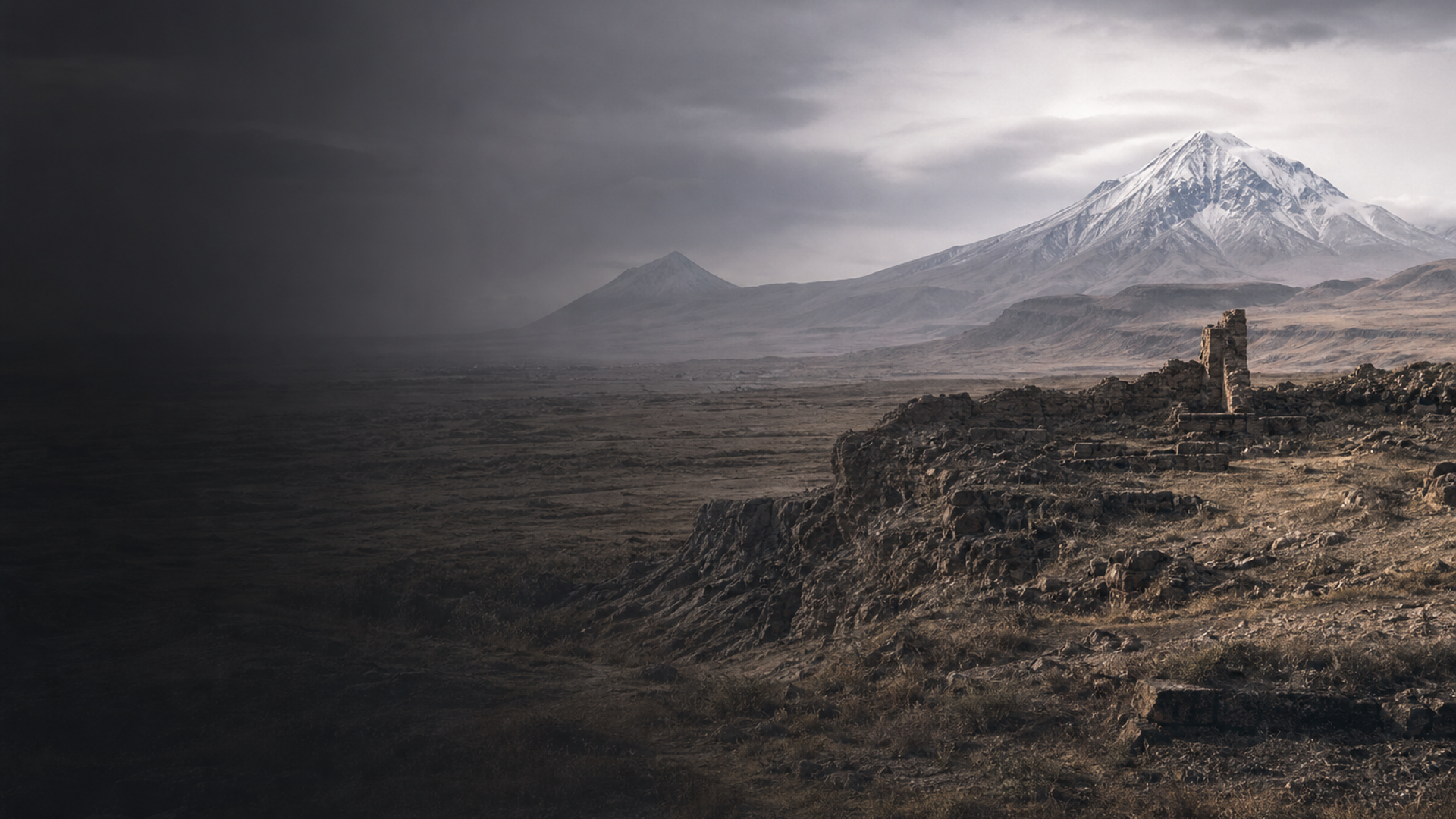
Karmir Blur, Teishebaini — Ararat plain, Armenia
Faites défiler pour commencer
Chapitre I

Le récit

Comprendre la culture Urartian Echoes at Karmir Blur

Archaeological remains from Karmir Blur (Teishebaini), Armenia, illuminate the Urartian Empire (c. 9th–5th centuries BCE). Limited genetic data from nine samples offer preliminary maternal-line glimpses that complement material culture and raise questions about regional continuity and contacts.

Time Period

902–417 BCE (Iron Age)

Region

Karmir Blur, Teishebaini — Ararat plain, Armenia

Common Y-DNA

Not reported / limited data

Common mtDNA

J1b (2), T (1), I (1), U (1), K (1)

Chapitre II

Chronologie

Moments clés de l'histoire de cette culture

860 BCE

Consolidation of Urartian Polities

Regional chiefs and fortress centers such as Teishebaini consolidate power across the Armenian highlands, forming the core of Urartian state structures.

590 BCE

Destruction and Rebuilding Phases

Archaeological layers at Karmir Blur record burning and reconstruction, reflecting cycles of conflict and recovery in the late Iron Age.

Chapitre III

Origins & Emergence

On a windswept spur above the Ararat plain, Karmir Blur (the fortress of Teishebaini) was built into stone and story. Archaeological data indicates the site rose to prominence during the formative centuries of the Urartian state (traditionally dated to the early 1st millennium BCE). Excavations have revealed monumental fortifications, administrative buildings, storerooms and temples dedicated to storm and warrior deities — evidence of a polity organizing resources, craft production and irrigation on a regional scale. Material culture from Teishebaini shows local traditions blended with influences from neighboring Anatolia, the Zagros, and the Assyrian world: finely worked bronze, standardized storage vessels, and inscriptions in cuneiform that document political ties and tribute.

Limited evidence suggests that the Urartian territorial network coalesced through a mix of local development and external contacts, rather than a single sweeping migration. The archaeological sequence at Karmir Blur — destruction layers, rebuilding phases and rich necropoleis — preserves a portrait of an emergent state asserting control across the Armenian highland from roughly the 9th to 6th centuries BCE. As with many Iron Age polities, the material remains speak to centralized authority, economic integration, and ritual life, yet they leave open the questions of language shift and population continuity that genetic studies are beginning to address.

  • Karmir Blur = ancient Teishebaini, a major Urartian fortress
  • Construction and material culture date primarily to 9th–6th centuries BCE
  • Evidence for regional contacts with Anatolia, Assyria, and the Zagros
Chapitre IV

Daily Life & Society

Life inside the walls of Teishebaini combined the practical rhythms of provisioning with the dramatic rituals of state religion. Archaeological excavations of houses and storerooms reveal carefully managed grain reserves, pottery types used for cooking and storage, and workshops where bronze tools, weapons and ornaments were produced. Irrigation channels and terraces in the surrounding landscape speak to engineered agriculture sustaining urban populations. Funerary contexts in the necropolis at Karmir Blur uncovered richly furnished tombs: pottery, weaponry, and personal adornments that underscore social differentiation and craft specialization.

Religious practice was woven into civic identity. Temples and cult spaces dedicated to deities such as Teisheba (a storm god) were centers for offerings and public ritual, and inscriptions emphasize royal patronage of cult and infrastructure. Trade and diplomacy left their marks — imported objects and stylistic influences point to exchange networks reaching across the Near East. Yet archaeological remains also record violence: destruction layers and weapons suggest periods of conflict and rebuilding, a reminder of the precarious balance of power in the Iron Age Caucasus.

This material world, painstakingly reconstructed from stone, metal and pottery, provides the cultural stage on which genetic data can be read — showing who lived, worked and died in these fortified cities.

  • Storage, metallurgy and irrigation sustained urban life
  • Temples and inscriptions show centralized religious and political authority
Chapitre V

Genetic Profile

Ancient DNA from nine individuals recovered in the necropolis of Teishebaini (Karmir Blur) provides a preliminary maternal-line snapshot of Urartian-era inhabitants dated between 902 and 417 BCE. The mitochondrial haplogroups observed include J1b (two individuals), T, I, U and K. These lineages are broadly West Eurasian in distribution: haplogroup J and T are often associated with Near Eastern and Neolithic farming populations; U and I are common among European hunter‑gatherer and later populations; K is linked to Neolithic expansions from Anatolia.

Because the dataset is small (n = 9) and represents only maternal lineages, conclusions must be cautious. Limited evidence suggests a mixture of ancestries consistent with a highland population shaped by both local Caucasian substrates and sustained contacts with neighboring regions (Anatolia, the Near East and the Zagros). The absence of consistent Y-DNA reporting in these samples prevents firm statements about paternal lineages or sex-biased mobility.

Genetic patterns from Teishebaini add a vital dimension to archaeological narratives: they support a picture of population complexity rather than wholesale replacement during the Iron Age. However, given the small sample size, these findings are preliminary and should be tested against larger datasets from the Armenian highlands and adjacent regions before inferring broader demographic processes.

  • MtDNA diversity (J1b, T, I, U, K) suggests mixed West Eurasian maternal ancestry
  • Small sample size (n=9) and lack of Y-DNA limit strong demographic conclusions
Chapitre VI

Legacy & Modern Connections

The ruins of Karmir Blur echo into modern Armenian cultural memory, but the relationship between the ancient Urartian population and later Armenian-speaking communities remains complex. Linguistically, the Urartian language was non‑Indo‑European, while Armenian emerged as an Indo‑European language in the highlands; archaeological data indicates cultural continuity in settlement and irrigation technologies, yet language shift and population admixture are plausible.

Genetic data from Teishebaini offers tentative evidence of long-standing West Eurasian maternal lineages in the region, but cannot by itself prove direct ancestry to modern Armenians. Limited evidence suggests regional continuity in place and certain maternal lineages, combined with later demographic inputs. Future, larger genetic studies combined with archaeology will be needed to clarify how Urartian communities contributed to the genetic and cultural tapestry of the Armenian highlands.

  • Archaeology shows cultural continuity in settlement and infrastructure
  • Genetic signals are preliminary; more data needed to assess continuity with modern populations
Propulsé par l'IA

Assistant IA

Posez des questions sur la culture Urartian Echoes at Karmir Blur

Assistant IA par DNAGENICS

Débloquer cette fonction
Posez des questions sur la culture Urartian Echoes at Karmir Blur. L'assistant IA peut expliquer les résultats génétiques, le contexte historique, les preuves archéologiques et les liens génétiques avec les populations actuelles, dans les limites de l'interprétation.
Exemple d'analyse IA

La culture Urartian Echoes at Karmir Blur représente un chapitre fascinant de l'histoire humaine…

L'analyse génétique met en évidence des similarités avec des populations antérieures et des signes d'adaptations propres. Les échantillons d'ADN ancien éclairent les schémas migratoires et les liens entre populations, avec des limites qui dépendent de l'étude et du contexte archéologique.

Il s'agit d'un aperçu de l'analyse IA. Accédez à l'assistant complet pour explorer :

  • Composition et similarité génétique
  • Schémas migratoires et origines
  • Vie quotidienne et pratiques culturelles
  • Contexte génétique actuel

Explorez d'autres cultures antiques

Découvrez les récits de civilisations issues du monde antique