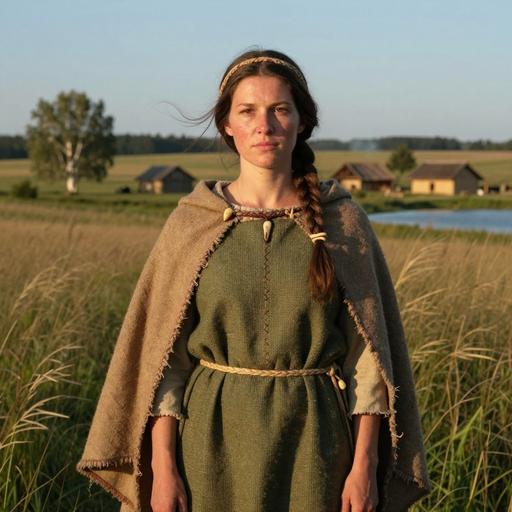
The Early Linear Pottery Culture, notably represented by the Ludwinowo site, is an era that played a foundational role in the Neolithic transition within Central Europe. Emerging around 5500 BCE, this culture marks the early stages of agricultural societies in Europe, where innovative farming techniques and sedentary lifestyles began replacing the previously dominant hunter-gatherer communities.
Geographic and Chronological Context
The Linear Pottery Culture (Linearbandkeramik, or LBK) spread across the Central European plains, encompassing areas that today are part of Hungary, Germany, Austria, Czech Republic, Slovakia, and Poland, where the Ludwinowo site is located. This region provided fertile loess soils, ideal for the early agricultural practices. The Ludwinowo site, in particular, offers a snapshot of the cultural and technological adaptations characteristic of this transition.
Social and Settlement Patterns
The Ludwinowo community, like other LBK settlements, was primarily sedentary, characterized by small hamlets or clusters of longhouses made of timber, wattle, and daub. These structures were built to suit extended family units, highlighting a shift towards more complex kinship and social structures. The establishment of permanent villages allowed for the development of communal facilities and a more organized social hierarchy.
Economy and Subsistence
The economy in the Ludwinowo site was predominantly based on agriculture, with an emphasis on the cultivation of emmer wheat, einkorn wheat, and barley. The introduction of domesticated animals, such as cattle, pigs, and sheep, played a critical role, indicating advancements in husbandry. This transition reflects significant ecological knowledge and adaptation, as early European farmers had to manage soils, crops, and livestock in a region previously dominated by wild flora and fauna.
Material Culture and Technology
One of the defining features of the Linear Pottery Culture is its, eponymous, pottery. The ceramics from Ludwinowo are characterized by simple yet elegant linear decorations, typically incised or impressed onto the surface. These decorative motifs not only served functional purposes but also held symbolic meanings, possibly related to identity or ritual practices.
In terms of tools, the community made extensive use of polished stone axes, which were essential for both farming and construction purposes. Flint tools, often sourced from local quarries, were expertly crafted for a variety of cutting and scraping tasks. The technological expertise seen in these tools reflects a deep understanding of material properties and craftsmanship.
Rituals and Beliefs
The spiritual and ritual life of the Early Linear Pottery Culture is not entirely understood, but burial practices provide some insights. The Ludwinowo site, like others in the LBK, exhibits burial grounds that suggest a belief in an afterlife or the importance of ancestor veneration. Graves often contained grave goods, such as pottery and tools, indicating the symbolic importance of these items.
Moreover, the spatial organization of Ludwinowo, with dedicated areas for specific activities and burials, implies a structured cosmology and social order. The presence of animal remains in ritual contexts also suggests shamanistic practices or sacrificial rites.
Interaction and Exchange
The people of Ludwinowo and their contemporaries were not isolated. Evidence points to a network of trade and exchange that spread innovations, raw materials, and cultural practices across vast distances. The movement of obsidian and marine shells, for example, alludes to long-distance trade routes and cultural contact with distant groups.
Impact and Legacy
The Early Linear Pottery Culture, including the Ludwinowo site, represents a pivotal moment in European prehistory. It laid the groundwork for successive agricultural societies and set the stage for the development of more complex socio-political structures in the region. This era signifies not only a technological revolution but also a profound transformation in human society, where community organization, economic management, and cultural expressions evolved in unprecedented ways.
Overall, the Early Linear Pottery Culture of Ludwinowo provides crucial insights into the life of Europe's first farmers and the cultural innovations that shaped the continent's prehistoric landscape.