Menu
Currency
Main
Store
Blog

Loading Report

Preparing your ancestry journey

Connecting to ancient matches...

Preparing your report

Skip to main content
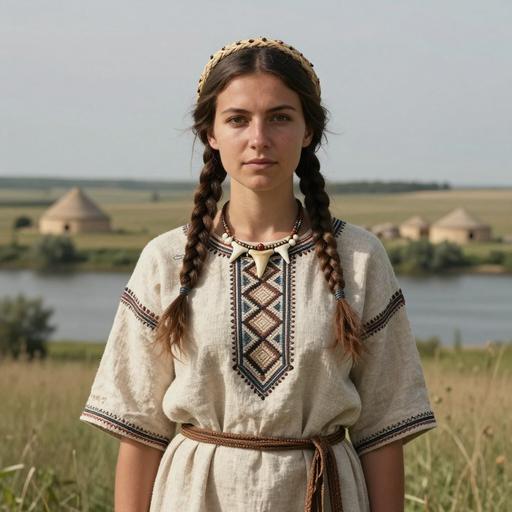
Portrait reconstruction of A woman buried in Ukraine in the Copper Age era
Ancient Individual

A woman buried in Ukraine in the Copper Age era

A woman buried in Ukraine during the Serednii Stih culture

A fragment of the ancient world, preserved across millennia in strands of DNA.

ukr123
4342 BCE - 4171 BCE
Female
Ukraine
Scroll to begin
Chapter I

Identity

The biological and cultural markers that define this ancient individual

Sample ID

ukr123

Date Range

4342 BCE - 4171 BCE

Cultural Period

Serednii Stih culture

Biological Sex

Female

mtDNA Haplogroup

U5a2d

Y-DNA Haplogroup

N/A (Female)

Chapter II

Place

Where this individual was discovered

Country Ukraine
Locality Deriivka (Kirovohrad Oblast, Oleksandriia District)
Coordinates 48.9142, 33.7649
Chapter III

Time

When this individual lived in the broader context of human history

ukr123 4342 BCE - 4171 BCE
Chapter IV

Story

The narrative of this ancient life

The Serednii Stih culture, associated with the Proto-Indo-European (PIE) people, is an intriguing subject that captures a crucial period in prehistoric Europe. Originating in the Pontic-Caspian steppe region, encompassing parts of modern-day Ukraine, Russia, and Kazakhstan, this culture played a significant role in shaping the development and dissemination of Indo-European languages and practices.

Geographic and Temporal Context

The Serednii Stih culture, flourishing between approximately 4500 and 3500 BCE, is situated in the vast Eurasian steppe, characterized by its expansive grasslands, moderate climate, and a network of rivers. This geography facilitated both nomadic pastoralism and the early establishment of agricultural practices, providing a rich environment for cultural and technological innovations.

Economy and Subsistence

The economy of the Serednii Stih culture was based on a mixed system of animal husbandry and agriculture, with sheep, cattle, and goats playing crucial roles. The domestication and use of horses, pivotal for transportation and possibly early chariotry, marked a significant advancement in their mobile pastoral lifestyle. Agriculture, while not as predominant as animal husbandry, included the cultivation of barley and wheat, supporting semi-sedentary settlements during different seasons.

Social Structure and Organization

Socially, the Serednii Stih culture might have been organized into tribes or extended kin groups, each led by chieftains or charismatic leaders. Evidence suggests a hierarchical structure, with leaders distinguished by burial rites involving kurgans or tumuli. These burial mounds often contained grave goods, such as pottery, weapons, and ornaments, pointing to a society that valued status and wealth.

Material Culture and Technology

Artifacts from the Serednii Stih culture reveal a community skilled in metallurgy, crafting tools, weapons, and decorative items from copper and later bronze. The pottery style was generally utilitarian, with simplistic designs that prioritized function over form, although some decorative patterns did appear over time, suggesting a gradual evolution in aesthetic preferences.

Religion and Beliefs

The religious beliefs of the Serednii Stih culture, like many early Indo-European groups, likely centered around natural elements and life cycles, possibly featuring a pantheon of deities associated with the sun, sky, and earth. Evidence from burial sites suggests ritual practices and a belief in an afterlife, as seen in the inclusion of grave goods meant to accompany the deceased in their journey beyond.

Linguistic Contributions

Linguistically, the Proto-Indo-European language, thought to be spoken by the Serednii Stih people, forms the ancestral root of many modern Indo-European languages. This language likely contained numerous terms for familial relationships, agriculture, warfare, and day-to-day activities, reflecting the culture's environment and structure.

Legacy and Influence

The Serednii Stih culture's influence is profound, as it represents a critical point in the diffusion of Indo-European languages and cultural practices across Europe and parts of Asia. The migratory patterns and expansions associated with this culture contributed significantly to the spread of technological innovations, linguistic frameworks, and possibly social conventions, laying a foundation for the future civilizations of Europe and beyond.

In conclusion, the Serednii Stih culture, while not as well-documented as some later prehistoric societies, remains a key chapter in understanding the early development of Indo-European culture. Through its innovations in subsistence strategies, social organization, and linguistic contribution, it set the stage for vast cultural transformations that would echo throughout history.

Context

Related Samples

This individual exists within a broader network of ancient samples. No ancient genome stands alone.

Sample ID Culture/Period Date Location Action
buk002 Starčevo-Criș Culture of Negrileşti 5612 BCE Negrilești (Galati, Negrilești), Romania View
buk003 Starčevo-Criș Culture of Grădinile 5801 BCE Grădinile, Romania View
buk004 Gumelnița Culture 4045 BCE Gumelnița (Călărași, Oltenita), Romania View
buk010 Sălcuța Culture 5548 BCE Gârlești (Dolj County, Craiova), Romania View
buk012 Sălcuța Culture 5624 BCE Gârlești (Dolj County, Craiova), Romania View
buk013 Sălcuța Culture 5557 BCE Gârlești (Dolj County, Craiova), Romania View
buk018 Boian Culture 4931 BCE Curătești, Romania View
buk019 Boian Culture 4984 BCE Curătești, Romania View
buk022 Boian Culture 4984 BCE Curătești, Romania View
buk023 Boian Culture 4938 BCE Curătești, Romania View
buk029 Boian Culture 4715 BCE Căscioarele, Romania View
buk033 Boian Culture 4721 BCE Căscioarele, Romania View
buk040 Boian Culture 5204 BCE Sultana Valea (Călărași, Manasteria), Romania View
lbk101 Early Linear Pottery Culture of Ludwinowo 4350 BCE Ludwinowo-6 (Kuyavian-Pomeranian Province, Włocławek), Poland View
lbk102 Eastern Linear Pottery Culture of Kruszyn 4350 BCE Kruszyn-13 (Kuyavian-Pomeranian Province, Włocławek), Poland View
lbk104 Eastern Linear Pottery Culture of Kruszyn 4350 BCE Kruszyn-13 (Kuyavian-Pomeranian Province, Włocławek), Poland View
lbk138 Late Lengyel Culture from Krusza Zamkowa 4330 BCE Krusza Zamkowa-3 (Kuyavian-Pomeranian Province, Inowrocław), Poland View
poz120 Late Lengyel Culture from Krusza Zamkowa 4333 BCE Krusza Zamkowa-3 (Kuyavian-Pomeranian Province, Inowrocław), Poland View
poz121 Late Lengyel Culture from Krusza Zamkowa 4333 BCE Krusza Zamkowa-3 (Kuyavian-Pomeranian Province, Inowrocław), Poland View
poz177 Lublin-Volhynian Culture 4152 BCE Książnice (Świętokrzyskie Province, Busko County, Pacanów), Poland View
poz236 Late Neolithic Lengyel Culture of Racot 4311 BCE Racot (Greater Poland Province, Kościan), Poland View
poz252 Late Lengyel Culture from Siniarzewo 4531 BCE Siniarzewo-1 (Kuyavian-Pomeranian Province, Aleksandrów County, Zakrzewo), Poland View
poz264 Lublin-Volhynian Culture 3956 BCE Książnice (Świętokrzyskie Province, Busko County, Pacanów), Poland View
poz275 Lublin-Volhynian Culture 3954 BCE Książnice (Świętokrzyskie Province, Busko County, Pacanów), Poland View
poz297 Komornica Culture 5621 BCE Łojewo (Kuyavian-Pomeranian Province, Inowrocław), Poland View
poz375 Lublin-Volhynian Culture 3951 BCE Bronocice (Świętokrzyskie Province, Pińczów County, Działoszyce), Poland View
poz503 Kamienskie Culture Mesolithic 6814 BCE Kamienskie (Warmian-Masurian Province, Pisz County, Orzysz), Poland View
rom011 Iclod Culture 4836 BCE Iclod (Cluj, Iclod), Romania View
rom046 Iclod Culture 4711 BCE village Iclod, Cluj county, Romania View
rom047 Decea Mureșului Culture 4343 BCE village Decea Mureșului, Alba county, Romania View
rom057_rom058 Starčevo-Criș Culture 5623 BCE village Baciu, Cluj county, Romania View
rom061 Mesolithic Iron Gates, Romania 7584 BCE Ostrovul-Corbului (Mehedinți County, Hinova), Romania View
rom066 Mesolithic Iron Gates, Romania 6641 BCE Ostrovul-Corbului (Mehedinți County, Hinova), Romania View
ukr005 Neolithic Ukraine 5471 BCE Deriivka (Kirovohrad Oblast, Oleksandriia District), Ukraine View
ukr033 Neolithic Nikolske Culture 4681 BCE Nikol’ske, Ukraine View
ukr040 Neolithic Nikolske Culture 4442 BCE Nikol’ske, Ukraine View
ukr087 Neolithic Ukraine 5356 BCE Vasylivka (Zaporizhia Oblast, Vasylivka District, Vasylivska municipality), Ukraine View
ukr102 Mesolithic Ukraine 6471 BCE Deriivka (Kirovohrad Oblast, Oleksandriia District), Ukraine View
ukr104 Serednii Stih culture 3701 BCE Deriivka (Kirovohrad Oblast, Oleksandriia District), Ukraine View
ukr108 Mesolithic Ukraine 6066 BCE Deriivka (Kirovohrad Oblast, Oleksandriia District), Ukraine View
ukr111 Neolithic Ukraine 4834 BCE Deriivka (Kirovohrad Oblast, Oleksandriia District), Ukraine View
ukr112 Serednii Stih culture 4446 BCE Deriivka (Kirovohrad Oblast, Oleksandriia District), Ukraine View
ukr113 Neolithic Ukraine 4836 BCE Deriivka (Kirovohrad Oblast, Oleksandriia District), Ukraine View
ukr116 Serednii Stih culture 4446 BCE Deriivka (Kirovohrad Oblast, Oleksandriia District), Ukraine View
ukr117 Neolithic Ukraine 5304 BCE Deriivka (Kirovohrad Oblast, Oleksandriia District), Ukraine View
ukr123 Serednii Stih culture 4342 BCE Deriivka (Kirovohrad Oblast, Oleksandriia District), Ukraine View
ukr125 Ukrainian Epipaleolithic-Mesolithic Culture 8708 BCE Deriivka (Kirovohrad Oblast, Oleksandriia District), Ukraine View
ukr144 Neolithic Nikolske Culture 5209 BCE Nikol’ske, Ukraine View
ukr147 Neolithic Nikolske Culture 4784 BCE Nikol’ske, Ukraine View
ukr149 Neolithic Nikolske Culture 4602 BCE Nikol’ske, Ukraine View
ukr158 Neolithic Yasinovatka Culture 5314 BCE Yasynuvatka (Zaporizhia Oblast, Zaporizhia District, Petro-Mykhailivka municipality), Ukraine View
ukr159 Neolithic Yasinovatka Culture 5210 BCE Yasynuvatka (Zaporizhia Oblast, Zaporizhia District, Petro-Mykhailivka municipality), Ukraine View
ukr160 Yasinovatka Culture 5357 BCE Yasynuvatka (Zaporizhia Oblast, Zaporizhia District, Petro-Mykhailivka municipality), Ukraine View
ukr161 Neolithic Yasinovatka Culture 5209 BCE Yasynuvatka (Zaporizhia Oblast, Zaporizhia District, Petro-Mykhailivka municipality), Ukraine View
ukr162 Yasinovatka Culture 4784 BCE Yasynuvatka (Zaporizhia Oblast, Zaporizhia District, Petro-Mykhailivka municipality), Ukraine View
Sample ID Culture/Period Date Location Action
I7585 Serednii Stih culture 4049 BCE Kopachіv (Kyiv Oblast, Obukhiv District, Obukhiv municipality), Ukraine View
ukr104 Serednii Stih culture 3701 BCE Deriivka (Kirovohrad Oblast, Oleksandriia District), Ukraine View
ukr112 Serednii Stih culture 4446 BCE Deriivka (Kirovohrad Oblast, Oleksandriia District), Ukraine View
ukr116 Serednii Stih culture 4446 BCE Deriivka (Kirovohrad Oblast, Oleksandriia District), Ukraine View
ukr123 Serednii Stih culture 4342 BCE Deriivka (Kirovohrad Oblast, Oleksandriia District), Ukraine View
Sources

References

Scientific publications and genetic data that inform this profile.

Scientific Publication

Genetic continuity, isolation, and gene flow in Stone Age Central and Eastern Europe

Authors Mattila TM, Svensson EM, Juras A, Günther T, Kashuba N et al.
Abstract

The genomic landscape of Stone Age Europe was shaped by multiple migratory waves and population replacements, but different regions do not all show similar patterns. To refine our understanding of the population dynamics before and after the dawn of the Neolithic, we generated and analyzed genomic sequence data from human remains of 56 individuals from the Mesolithic, Neolithic, and Eneolithic across Central and Eastern Europe. We found that Mesolithic European populations formed a geographically widespread isolation-by-distance zone ranging from Central Europe to Siberia, which was already established 10,000 years ago. We found contrasting patterns of population continuity during the Neolithic transition: people around the lower Dnipro Valley region, Ukraine, showed continuity over 4000 years, from the Mesolithic to the end of the Neolithic, in contrast to almost all other parts of Europe where population turnover drove this cultural change, including vast areas of Central Europe and around the Danube River.

Use code for 25% off Expires Jul 12