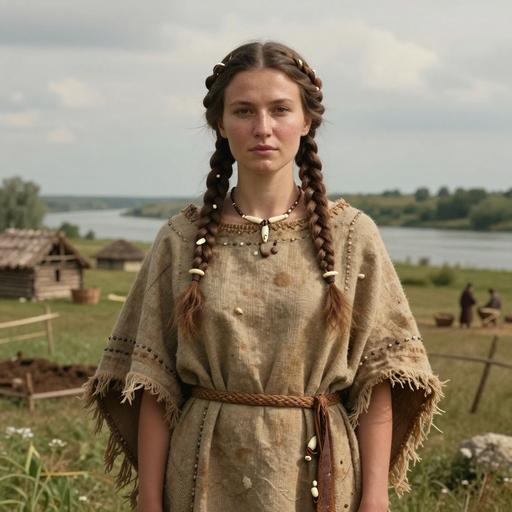
The Serednii Stih culture, associated with the Proto-Indo-European (PIE) people, is an intriguing subject that captures a crucial period in prehistoric Europe. Originating in the Pontic-Caspian steppe region, encompassing parts of modern-day Ukraine, Russia, and Kazakhstan, this culture played a significant role in shaping the development and dissemination of Indo-European languages and practices.
Geographic and Temporal Context
The Serednii Stih culture, flourishing between approximately 4500 and 3500 BCE, is situated in the vast Eurasian steppe, characterized by its expansive grasslands, moderate climate, and a network of rivers. This geography facilitated both nomadic pastoralism and the early establishment of agricultural practices, providing a rich environment for cultural and technological innovations.
Economy and Subsistence
The economy of the Serednii Stih culture was based on a mixed system of animal husbandry and agriculture, with sheep, cattle, and goats playing crucial roles. The domestication and use of horses, pivotal for transportation and possibly early chariotry, marked a significant advancement in their mobile pastoral lifestyle. Agriculture, while not as predominant as animal husbandry, included the cultivation of barley and wheat, supporting semi-sedentary settlements during different seasons.
Social Structure and Organization
Socially, the Serednii Stih culture might have been organized into tribes or extended kin groups, each led by chieftains or charismatic leaders. Evidence suggests a hierarchical structure, with leaders distinguished by burial rites involving kurgans or tumuli. These burial mounds often contained grave goods, such as pottery, weapons, and ornaments, pointing to a society that valued status and wealth.
Material Culture and Technology
Artifacts from the Serednii Stih culture reveal a community skilled in metallurgy, crafting tools, weapons, and decorative items from copper and later bronze. The pottery style was generally utilitarian, with simplistic designs that prioritized function over form, although some decorative patterns did appear over time, suggesting a gradual evolution in aesthetic preferences.
Religion and Beliefs
The religious beliefs of the Serednii Stih culture, like many early Indo-European groups, likely centered around natural elements and life cycles, possibly featuring a pantheon of deities associated with the sun, sky, and earth. Evidence from burial sites suggests ritual practices and a belief in an afterlife, as seen in the inclusion of grave goods meant to accompany the deceased in their journey beyond.
Linguistic Contributions
Linguistically, the Proto-Indo-European language, thought to be spoken by the Serednii Stih people, forms the ancestral root of many modern Indo-European languages. This language likely contained numerous terms for familial relationships, agriculture, warfare, and day-to-day activities, reflecting the culture's environment and structure.
Legacy and Influence
The Serednii Stih culture's influence is profound, as it represents a critical point in the diffusion of Indo-European languages and cultural practices across Europe and parts of Asia. The migratory patterns and expansions associated with this culture contributed significantly to the spread of technological innovations, linguistic frameworks, and possibly social conventions, laying a foundation for the future civilizations of Europe and beyond.
In conclusion, the Serednii Stih culture, while not as well-documented as some later prehistoric societies, remains a key chapter in understanding the early development of Indo-European culture. Through its innovations in subsistence strategies, social organization, and linguistic contribution, it set the stage for vast cultural transformations that would echo throughout history.