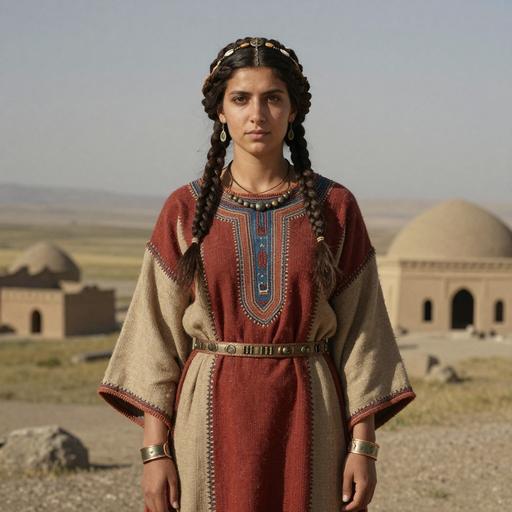
The Story
The journey of mtDNA haplogroup W3A1A1
Origins and Evolution
mtDNA haplogroup W3A1A1 is a downstream subclade of W3A1A within the broader W3 / W maternal lineage, a West Eurasian group that diversified in the Holocene. Given the known age and geographic placement of its parent clade (W3A1A; ~4 kya in the Near East / South Asia), W3A1A1 most plausibly formed during the late Bronze Age / early Iron Age (approximately 3 kya) in or adjacent to the Near East and South Asia. Its emergence likely reflects continued localized mutation and lineage sorting after the initial dispersal of W3-derived maternal lineages out of a Near Eastern / southern Asian source.
Because W3A1A and related W3 subclades are generally low frequency and show limited internal diversity, W3A1A1 is best understood as a relatively young, geographically restricted lineage whose present-day pattern reflects a mixture of short-distance dispersals, rare long-distance movements, and localized founder events rather than continent-wide replacement.
Subclades (if applicable)
W3A1A1 itself is a fine-resolution terminal or near-terminal branch in current phylogenies with limited reported internal substructure. Where small sub-lineages exist, they are observed at very low frequency and currently lack robust geographic clustering in published datasets. Ongoing mtDNA sequencing and dense sampling in South Asia and the Caucasus could reveal further downstream diversity, but at present W3A1A1 appears to be a narrowly distributed subclade with few confirmed downstream branches.
Geographical Distribution
The distribution of W3A1A1 is patchy and low-frequency across a broad swath of Eurasia. Confirmed and reported occurrences cluster in:
- South Asia (India, Pakistan) among diverse caste and tribal groups, reflecting either local differentiation or incoming maternal lineages from the west.
- The Caucasus and adjacent West Asia (Armenia, Georgia, Iran, Anatolia), consistent with the parent clade's Near Eastern ties.
- Central Asia (Turkic and Iranian-speaking populations) where historical mobility and admixture have produced mixed maternal profiles.
- Eastern and Northern Europe in small numbers (e.g., populations of Eastern Europe and Scandinavia), likely reflecting later long‑distance gene flow, historic mobility, or more recent admixture.
- Western China / southern Siberia (e.g., Uyghur, Altaian individuals) only at very low frequency, consistent with long-distance dispersal or complex frontier admixture.
Only a very small number of ancient DNA occurrences are currently reported for this lineage, indicating that while it is present in archaeological contexts, it has not been a major continent‑scale maternal lineage in prehistoric times.
Historical and Cultural Significance
Because W3A1A1 is low-frequency and geographically scattered, it does not define a single archaeological culture. Instead, its presence in multiple regions makes it a useful marker for tracing localized maternal continuity and small-scale migrations across the Near East, South Asia and Central Eurasia during the post‑Neolithic period. Possible historical processes that could explain its distribution include: continued gene flow along trade and migration routes connecting the Near East, South Asia and the Eurasian steppe in the Bronze–Iron Ages; assimilation into diverse communities during later historic movements (e.g., Iron Age expansions, Silk Road interactions); and stochastic founder effects in small, endogamous populations.
While broad-brush links to major steppe movements (e.g., Bronze Age mobility) or to West Asian agricultural expansions can be proposed in specific regional cases, the current data require caution: W3A1A1 is best treated as a marker of patchy maternal admixture and localized demographic events rather than as a signature of any single large-scale cultural horizon.
Conclusion
W3A1A1 is a fine-scale, late Holocene mtDNA subclade of the W3 family that likely formed in the Near East / South Asia about 3 kya. Its low frequency and scattered occurrences across South Asia, the Caucasus, Central Asia and parts of Europe reflect post‑Neolithic dispersal dynamics, regional founder events, and later historic admixture rather than a broad prehistoric expansion. Increased sampling, full mitogenome sequencing and additional ancient DNA finds will improve resolution of its phylogeny, age estimates, and the specific migratory episodes that shaped its modern distribution.
Key Points
- Origins and Evolution
- Subclades (if applicable)
- Geographical Distribution
- Historical and Cultural Significance
- Conclusion