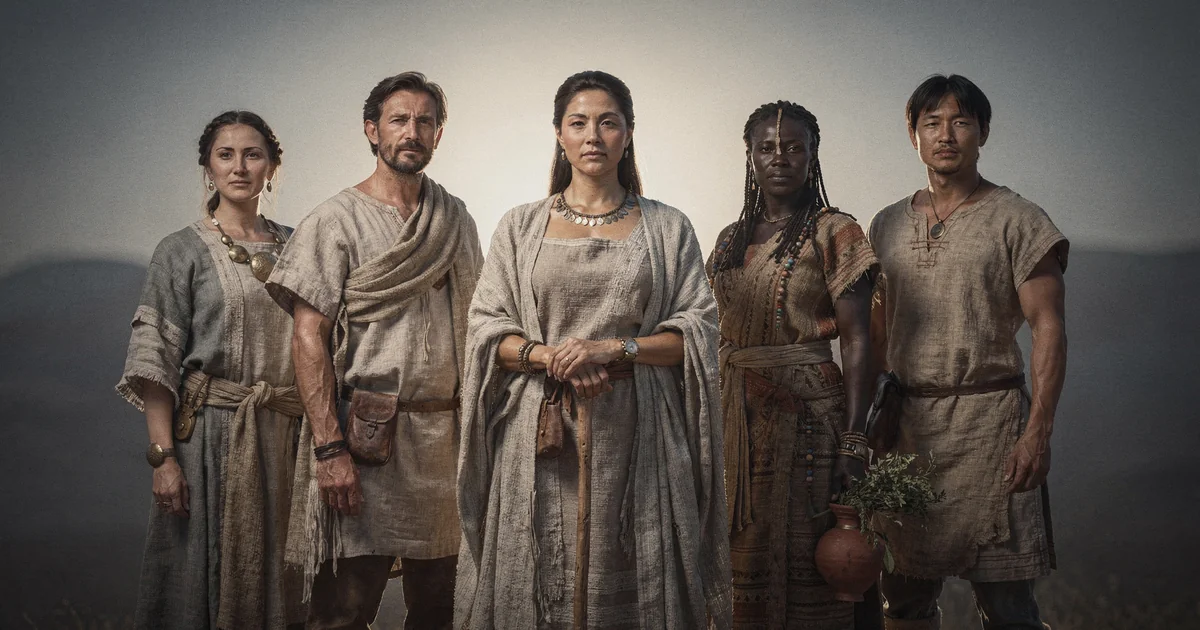
"Across centuries of movement, one story was carried forward."
A Story Carried, Not Lost
Some histories are written in books. Others are carried in the blood, in the law, in the voices of those who remember. Discover the genetic threads that connect you to one of history's most enduring ancestries.
A People Defined by Continuity
Jewish ancestry represents one of the longest continuous ancestral identities documented in human history. Maintained through lineage, culture, and tradition, it is a story not of fragmentation but of remarkable cohesion across vast stretches of time and geography.
For over three thousand years, Jewish communities have preserved not only their traditions and texts but also distinctive genetic signatures that trace back to ancient populations. This is not merely an origin—it is an unbroken chain of identity, passed from generation to generation through scholarship, law, and the simple act of remembering.
Your DNA carries echoes of this continuity. The patterns written in your chromosomes connect you to communities that thrived in ancient Judea, weathered centuries of diaspora, and emerged—transformed but unbroken—across the modern world.
"Identity maintained through learning, law, and community. Survival through remembrance."
Origins and Early Communities
The genetic roots of Jewish ancestry trace to the ancient Near East—to the early Israelite and Judean populations who lived in the lands between the Mediterranean and the Jordan River.
Archaeological and genetic evidence converge on a picture of communities that emerged in the Bronze and Iron Ages, developing distinctive practices that would shape their descendants for millennia. These were not isolated tribes but participants in the rich cultural exchange of the ancient Levant.
The genetic signatures that persist today reflect both this ancient foundation and the subsequent journeys of Jewish communities across the world. Modern population genetics reveals that despite centuries of dispersal, Jewish populations share genetic markers that tie them to this common origin.
This is heritage measured not in decades but in millennia—a genetic memory of communities that built temples, wrote laws, and planted the seeds of traditions that continue to flourish today.
Diaspora Without Disappearance
The scattering of Jewish communities across the globe was not an ending but a transformation. Each branch adapted while preserving its connection to a common root. This report currently detects Ashkenazi ancestry; Sephardic and Mizrahi detection are in active development.
Ashkenazi
Central & Eastern Europe
Communities that flourished in the Rhineland, Poland, Lithuania, and Russia, developing rich traditions of scholarship and cultural practice while maintaining genetic continuity through centuries of European life.
Sephardi
Iberia & Mediterranean
Descendants of the vibrant Jewish communities of medieval Spain and Portugal, who carried their heritage across the Mediterranean, North Africa, and the Ottoman Empire after the expulsions of the 1490s.
Mizrahi
Middle East & North Africa
Communities that maintained continuous presence in the ancient Near East—from Babylon to Yemen, from Persia to Egypt—preserving the oldest unbroken lines of Jewish settlement outside the Land of Israel.
Despite geographic separation spanning continents and centuries, genetic studies consistently reveal that these communities share more genetic ancestry with each other than with their non-Jewish neighbors. This is the genetic signature of a people who moved without disappearing, who adapted without forgetting.
What This Report Reveals
Not just where your ancient matches lived—but how they remained connected.
Your Jewish Ancestry Report examines the genetic patterns that connect you to Jewish populations. Through advanced analysis of chromosomal segments, we identify the traces of ancestry that have been passed down through generations of your family.
Sample Ancestry Analysis
IBD Segments Detected
| Chromosome | Start Position | End Position | Length (cM) |
|---|---|---|---|
| Chr 3 | 45,234,567 | 52,145,890 | 12.45 |
| Chr 7 | 23,456,789 | 28,901,234 | 9.87 |
| Chr 11 | 67,890,123 | 73,456,789 | 8.23 |
Currently detecting Ashkenazi ancestry. Sephardi and Mizrahi detection coming soon.
The Experience of the Report
Carefully written, historically informed, designed for understanding.
Ancestry Percentage
Precise calculation of your Ashkenazi Jewish ancestry based on genetic similarity to well-characterized Ashkenazi reference populations.
Chromosome Browser
Visual map showing exactly which segments of your chromosomes carry Jewish ancestry signatures.
IBD Analysis
Identity-by-descent segments indicating recent Jewish ancestry, with detailed chromosome positions.
Historical Context
Learn about the historical events and migrations that shaped the genetic patterns in your results.
AI-Powered Insights
Ask questions about your results and receive personalized interpretations from our AI assistant.
Lifetime Updates
As we expand detection to additional communities, your report updates automatically at no extra cost.
Compatible With
Scientific Foundation
Science as a tool for understanding, not definition.
Our analysis draws on decades of research in population genetics, including landmark studies of Jewish population structure published in peer-reviewed journals. We apply rigorous methods while maintaining humility about what genetics can and cannot tell us about identity.
Population Genetics
Analysis grounded in published research on Jewish population structure and genetic history.
Founder Effects
Understanding of the genetic bottlenecks and founder events that shaped Jewish population genetics.
IBD Detection
Advanced algorithms for detecting identity-by-descent segments shared with reference populations.
Responsible Framing
Genetics illuminates ancestry but does not define identity. We present results with appropriate context and nuance.
Questions & Answers
Endogamy—marriage within a community—was historically common in Jewish populations. Over centuries, this practice created distinctive genetic patterns that make Jewish ancestry particularly detectable through DNA analysis, including elevated IBD sharing and characteristic population-specific variants.
Your percentage represents genetic similarity to reference populations, not an exact genealogical fraction. Higher percentages generally indicate more recent or more extensive Jewish ancestry, but genetic inheritance involves randomness—you don't inherit exactly 50% from each parent at every chromosome position.
Yes. We are actively developing detection for Sephardi and Mizrahi Jewish populations. When you purchase this report, you receive lifetime access—new community detections will be added to your report automatically at no additional cost.
Your report is generated instantly after purchase. You can access it immediately from your ancestry dashboard—no waiting, no processing delays.
Yes. We use industry-standard encryption for all data in transit and at rest. You maintain full control over your data, including the ability to delete it at any time. We never share your data with third parties without explicit consent.
Genetic analysis reveals biological ancestry but does not define identity. Very low percentages may not be statistically significant. Jewish identity can also be acquired through conversion, which leaves no genetic trace. We present results as one lens on heritage, not the complete picture.

Written in Your DNA, Carried Through Generations
Thousands of years of genetic history, reflected in every cell.
This report is included in the following packs:
From ancient Judea to your living room, explore the genetic connections carried in your DNA.
Secure payment · GDPR compliant · Your data stays yours
"Some histories are written in books.
Others are carried forward."