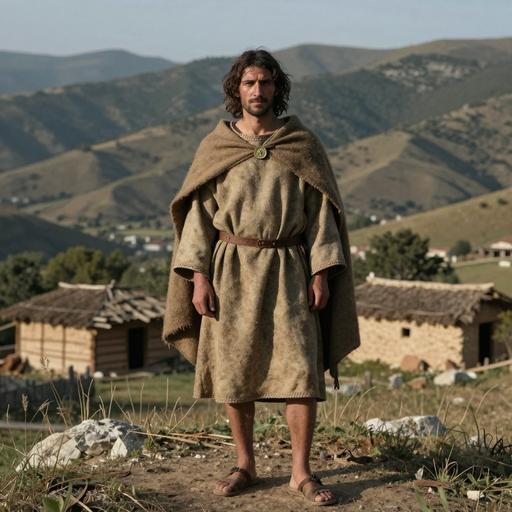
The Story
The journey of mtDNA haplogroup H1U2
Origins and Evolution
H1U2 is a low-frequency mitochondrial subclade nested within the H1U branch of haplogroup H1, itself one of the dominant Western European maternal lineages. Its phylogenetic placement as a downstream branch of H1U implies an origin within the same broad demographic process: a post‑glacial re‑expansion from an Iberian/Atlantic refuge. Based on its parent clade's coalescence around the early Holocene and the rarity of H1U2 in modern and ancient samples, a plausible coalescence time for H1U2 is in the mid‑to‑late Holocene (several thousand years after the initial H1U expansion), with an estimated origin around ~7 kya. This timing is consistent with local differentiation within Iberia or adjacent Atlantic France as populations stabilized and regional sublineages formed.
Subclades
H1U2 itself is a relatively deep but small branch with few reported downstream lineages in the literature and public databases. Unlike major H1 subclades (e.g., H1b, H1c) which have broader internal structure, H1U2 has limited documented diversity and a small number of characteristic diagnostic mutations reported from modern and a couple of archaeological samples. Because sampling is sparse, additional minor sublineages may exist but remain unsampled or unpublished.
Geographical Distribution
The observed distribution of H1U2 mirrors that of its parent clade but at lower frequencies. It is most plausibly concentrated in the Iberian Peninsula and adjacent Atlantic France, with sporadic occurrences across Western Europe (France, Britain, Ireland), parts of southern Europe (Italy, Sardinia) and low but detectable presence in northwest Africa (particularly Berber populations of Morocco and Algeria). Occasional finds in Scandinavia, Central/Eastern Europe, and the Near East likely reflect later mobility — maritime contacts, Neolithic/Metal Age movement, and historic gene flow — rather than a primary center of origin.
Historical and Cultural Significance
Because H1U2 is rare, its broad-scale demographic impact appears limited compared with major Eurasian mtDNA lineages. However, its presence in Iberia and coastal regions ties it to the long‑term continuity of maternal lineages in the Atlantic façade since the post‑glacial period. H1U2 may show low‑level continuity in regions influenced by Mesolithic persistence, local Neolithic farmer–hunter‑gatherer admixture, and later Bronze Age cultural expansions. Where ancient DNA has captured H1U‑type lineages in archaeological contexts, they help document continuity between prehistoric Iberian populations and later groups across Western Europe and northwest Africa.
Conclusion
H1U2 is best understood as a rare, regionally rooted mtDNA subclade derived from the H1U lineage that emerged after the Last Glacial Maximum within the Iberian/Atlantic refugium and subsequently dispersed at low frequencies across adjacent parts of Western Europe and northwest Africa. Its scarcity in modern and ancient datasets limits fine‑scale conclusions, but its phylogenetic position and geographic pattern are consistent with post‑glacial survival in Iberia followed by limited spread during the Holocene.
Key Points
- Origins and Evolution
- Subclades
- Geographical Distribution
- Historical and Cultural Significance
- Conclusion