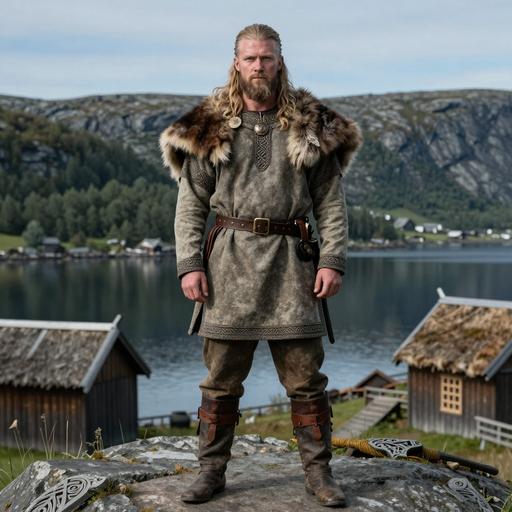
The Story
The journey of Y-DNA haplogroup I1A1B1A4A
Origins and Evolution
Y-DNA haplogroup I1A1B1A4A1 is a downstream branch of the broader I1 paternal lineage, one of the major Y-chromosome clades associated with northern Europe. Because this branch sits several levels below I1 and below the more localized I1A1B1A4 ancestor, it is best interpreted as a young, regional founder lineage that emerged after the initial post-glacial expansion of I1 in northern Europe.
The most plausible time frame for its formation is the Holocene, likely in the late Neolithic to Bronze Age or even later, when increasingly structured populations in Scandinavia, the Baltic, and adjacent parts of northwestern Europe produced many localized male-line clusters. Its ultimate roots lie in the deeper history of Mesolithic and early post-glacial northern European ancestry, but this subclade itself probably arose as a small branching event within a regional population.
Subclades
As a terminal or near-terminal branch in this context, I1A1B1A4A1 is notable primarily for its position as a fine-scale lineage marker rather than for a large internal diversity of well-established downstream branches. In practical population-genetic terms, such clades often represent single or few-founder lines that may be concentrated in particular families, districts, or historically connected communities.
If additional downstream branches are discovered, they would likely be interpreted as further evidence of localized paternal continuity in a specific northern European population cluster.
Geographical Distribution
This lineage is expected to be found mainly in northern and northwestern Europe, with the strongest likelihood in populations where I1 is common or historically documented. The highest frequencies would typically be expected in:
- Scandinavia, especially Sweden, Norway, Denmark, and Finland
- Germanic and North Sea populations, including northern Germany and the Netherlands
- British Isles, particularly regions with documented Scandinavian or Germanic ancestry
- Baltic and East European populations at lower frequencies, reflecting historical gene flow
- Diaspora populations in the Americas, Australia, and New Zealand due to relatively recent migration
Because this is a very specific downstream branch, it is likely to be rare even in regions where its parent haplogroup is moderately common.
Historical and Cultural Significance
The broader I1 lineage is strongly associated with northern European paternal history, including prehistoric hunter-gatherer ancestry in Europe and later population expansions during the Neolithic, Bronze Age, Iron Age, and Viking Age. Although I1A1B1A4A1 itself cannot be assigned with confidence to any single archaeological culture, it is reasonable to associate it with populations influenced by:
- Nordic Bronze Age demographic continuity
- Pre-Roman and Germanic Iron Age population structure
- Viking Age mobility and regional expansion
- Medieval northern European founder effects and local surname lineages
Its significance lies in showing how broad prehistoric lineages became subdivided into highly localized paternal branches during the last several thousand years.
Conclusion
Y-DNA haplogroup I1A1B1A4A1 is a rare, highly downstream branch of the northern European I1 haplogroup. Its distribution is expected to be concentrated in Scandinavia and adjacent northwest Europe, where long-term population continuity and founder effects created many fine-scale paternal lineages.
From a genealogical perspective, this clade is most useful for identifying deep paternal relatedness within northern European populations and for tracing very localized ancestral connections rather than broad continental migrations.
Key Points
- Origins and Evolution
- Subclades
- Geographical Distribution
- Historical and Cultural Significance
- Conclusion