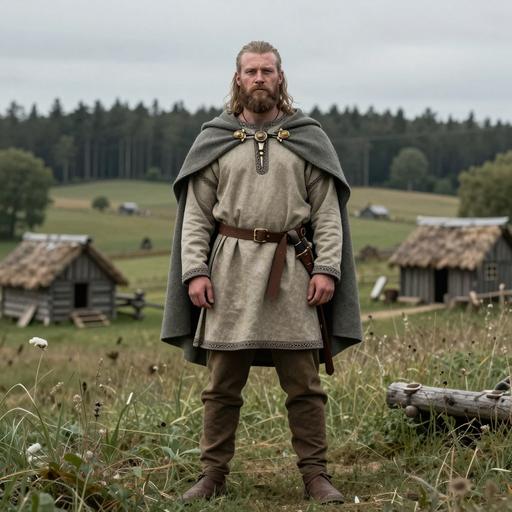
The Story
The journey of Y-DNA haplogroup I2A1B
Origins and Evolution
Y-DNA haplogroup I2a1b is a subclade within I2a1, itself part of the broader haplogroup I2 lineage that is widely interpreted as one of Europe’s oldest surviving paternal branches. Because it sits several steps downstream from the parent clade, I2a1b likely reflects a later diversification event within a postglacial European hunter-gatherer lineage rather than a very ancient, pan-European root lineage.
The most plausible origin for this subclade is Southeastern Europe, where the deeper I2 lineages appear to have persisted through the Late Glacial and Early Holocene. A time depth of roughly 14 kya is a reasonable estimate for the emergence of I2a1b, though the exact age depends on the current phylogenetic resolution and sampling of ancient and modern DNA.
Subclades
As an intermediate-to-downstream branch, I2a1b serves as a connector between broader I2a1 ancestry and more localized regional descendant lineages. In many Y-DNA phylogenies, clades at this level accumulate geographic signal quickly, so descendant branches may be strongly associated with particular Balkan, Carpathian, or Central European populations.
Because the tree is still being refined, the precise internal structure of I2a1b may vary by database and naming system. The important genetic pattern is that this lineage belongs to the European hunter-gatherer-associated I2 continuum, with later demographic growth likely shaped by Neolithic, Bronze Age, and historic-era population movements.
Geographical Distribution
I2a1b is found at low to moderate frequencies across a broad swath of Europe, with its strongest associations generally in Southeastern Europe and neighboring regions. It is especially consistent with populations in the Balkans, but it also appears in Central Europe, Eastern Europe, and in lower frequencies in Northern and Western Europe due to later dispersals.
In modern data, this haplogroup can appear in:
- Balkan populations with deep regional continuity
- East Slavic and neighboring Eastern European populations
- Central European groups, including German- and Austrian-speaking populations
- Scandinavian and Baltic populations at lower levels
- British and Irish populations at low levels, often reflecting historic migration
- Diaspora populations in the Americas and Australia
Historical and Cultural Significance
The broader I2 paternal lineage is often linked to European Mesolithic hunter-gatherers, making I2a1b part of a genetic legacy that predates the spread of agriculture in Europe. While direct one-to-one associations with specific archaeological cultures should be treated cautiously, this lineage is broadly compatible with populations that maintained continuity through the transition from foraging to mixed subsistence systems in Southeastern Europe.
Later expansions of I2-derived lineages may have been influenced by Neolithic demographic restructuring, Bronze Age mobility, and the formation of regional populations in the Balkans and Carpathian Basin. In more recent periods, the spread of I2a1b into northwestern and overseas populations likely reflects historical migrations, state formation, and modern diaspora movements rather than original deep-time origin outside Southeastern Europe.
Conclusion
I2a1b is a geographically informative subclade of haplogroup I2, representing a branch of Europe’s ancient paternal heritage that likely diversified in Southeastern Europe after the last Ice Age. Its modern distribution reflects both deep regional continuity in the Balkans and later dispersal into much of Europe, making it an important lineage for studies of European population history.
Key Points
- Origins and Evolution
- Subclades
- Geographical Distribution
- Historical and Cultural Significance
- Conclusion