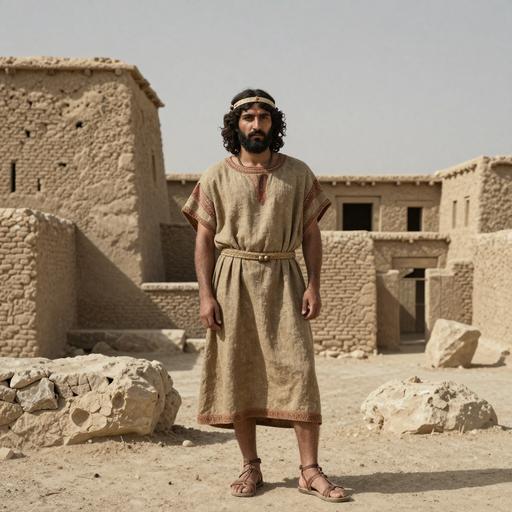
The Story
The journey of Y-DNA haplogroup J2A1A1
Origins and Evolution
Y-DNA haplogroup J2A1A1 is a downstream subclade of J2a1a, itself part of the broader J2 branch of haplogroup J. The deeper J2 lineage is widely interpreted as having diversified in the Near East during the post-glacial and early Holocene period, with later subclade formation tracking the spread of early farming communities, trade networks, and population movements across the eastern Mediterranean and adjacent West Asian regions.
As an intermediate-to-late subclade within J2a, J2A1A1 likely reflects a relatively localized paternal diversification compared with the older, more geographically widespread J2a branches. Its estimated age is consistent with a formation in the early Holocene to mid-Holocene, roughly around 8 kya, although the exact age depends on the phylogenetic resolution and the specific downstream SNPs used in different datasets.
Subclades
Because J2A1A1 is an intermediate branch, it serves as a connector between broader J2a diversity and more regionally concentrated descendant lineages. In population studies, its downstream branches may be especially important for distinguishing paternal lineages associated with particular Anatolian, Levantine, Caucasus, Balkan, and Aegean histories.
Typical phylogenetic context:
- J
- J2
- J2a
- J2a1
- J2a1a
- J2A1A1
- J2a1a
- J2a1
- J2a
- J2
Geographical Distribution
Haplogroup J2A1A1 is most often encountered in the Near East and eastern Mediterranean, but it also appears at lower frequencies in neighboring regions shaped by long-term migration and contact. Its distribution is consistent with a lineage that expanded through Anatolia, the Levant, Mesopotamia, the Caucasus, the Balkans, Greece, southern Italy, and parts of the Arabian Peninsula and North Africa.
It is also reported in some Jewish populations, reflecting the broader West Asian roots of J2 lineages and later diaspora histories. Occasional detections in South Asia may reflect ancient gene flow, Islamic-era mobility, or more recent regional admixture, depending on the population and dataset.
Historical and Cultural Significance
J2 lineages, including J2A1A1, are often discussed in relation to the spread of early agriculture, sedentary village life, and later Bronze Age connectivity across the eastern Mediterranean and West Asia. While no single archaeological culture can be assigned exclusively to this haplogroup, its regional pattern fits demographic processes that involved Neolithic farmers, Anatolian and Levantine populations, Aegean exchange systems, and later Classical-era and historic-period mobility.
In the Balkans and Greece, J2 subclades are frequently associated with the long-term genetic impact of Aegean and Near Eastern connections, including maritime interaction, urbanization, and population movement in antiquity. In the Caucasus and Mesopotamia, they fit equally well with deep regional continuity and repeated episodes of interregional contact.
Population Genetics Perspective
From a population-genetic standpoint, J2A1A1 should be understood as part of a broader paternal network rather than as a marker of a single ethnicity or culture. Its presence across multiple West Asian and Mediterranean populations indicates shared ancestry and repeated diffusion rather than one isolated origin event.
The lineage’s frequency is generally moderate to low in any single population, but it can become more visible in certain localities due to founder effects, endogamy, or historical demographic expansions. Its phylogenetic position suggests that it is more informative for reconstructing regional historical relationships than for identifying very ancient human dispersals.
Conclusion
J2A1A1 is a Near Eastern-derived Y-DNA subclade of J2a that reflects the long demographic history of the eastern Mediterranean, Anatolia, the Levant, and adjacent regions. Its distribution and age are consistent with a lineage shaped by Holocene population expansions, Neolithic ancestry, and later Bronze Age and historical-era mobility across West Eurasia.
Key Points
- Origins and Evolution
- Subclades
- Geographical Distribution
- Historical and Cultural Significance
- Population Genetics Perspective