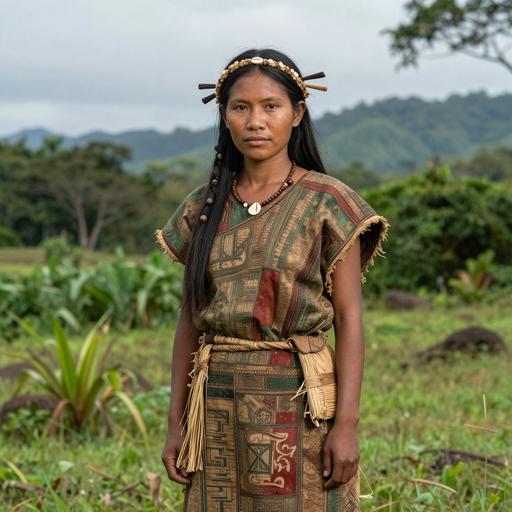
The Story
The journey of mtDNA haplogroup B5A2
Origins and Evolution
mtDNA haplogroup B5a2 is a downstream branch of B5a (itself a daughter of the broader haplogroup B) that likely formed in East to Southeast Asia during the early Holocene. Its estimated coalescence shortly after the Last Glacial Maximum places its origin within the time frame of expanding post-glacial hunter–gatherer populations and the earliest regional development of localized Holocene forager and early farming communities. Phylogenetic studies based on control-region and whole-mitogenome data indicate that B5a2 is an intermediate clade with a geographic signal concentrated in continental East Asia and Island Southeast Asia, consistent with localized differentiation after an initial B5a expansion.
Subclades
B5a2 is not a single uniform lineage but contains local sublineages identified by complete mitogenome sequencing in regional population studies. These downstream branches tend to show limited geographic scope (for example, subbranches restricted to parts of southern China, Taiwan, or specific island groups), which is typical for Holocene regional diversification. Many studies refer to named subclades when full mitogenomes are available; targeted phylogeographic work often reveals micro-endemic subbranches that help trace finer-scale maternal connections across coastal and island systems.
Geographical Distribution
The present-day distribution of B5a2 is focused on East and Southeast Asia, with detections across mainland China, Korea, and Japan, as well as in multiple populations of Island Southeast Asia and among some Austronesian-speaking groups. Frequencies are generally higher in southern Chinese and mainland Southeast Asian sampling locales and are lower but detectable in parts of Near Oceania and select Pacific islanders where Austronesian-mediated gene flow reached. Its pattern—concentrated in coastal and riverine populations and present in both mainland and island contexts—supports a role in Holocene coastal dispersals and later maritime expansions.
Historical and Cultural Significance
B5a2 contributes to the maternal genetic background of populations involved in several major demographic processes of the Holocene in East and Southeast Asia. It likely existed among early Holocene coastal hunter–gatherers and became integrated into emerging Neolithic/early agricultural communities in southern China and mainland Southeast Asia. Later, as Austronesian-speaking peoples expanded from Taiwan and coastal mainland regions into Island Southeast Asia and the Pacific during the mid-to-late Holocene, some B5a2 lineages were carried seaward, producing detectable presence in maritime and island populations. Its co-occurrence with other East/Southeast Asian maternal lineages (for example F1, M7, and N9a) is typical of mixed coastal forager–farmer ancestries in the region.
Conclusion
B5a2 is best understood as a regional early Holocene maternal lineage that illustrates local diversification within the broader B5a clade. It is useful in reconstructing maternal-level population structure and movements across East and Southeast Asia and provides genetic support for coastal and maritime dispersals that shaped island populations. Continued whole-mitogenome sampling and denser geographically targeted studies will refine its internal substructure and improve resolution on the timing and routes of its downstream spread.
Key Points
- Origins and Evolution
- Subclades
- Geographical Distribution
- Historical and Cultural Significance
- Conclusion