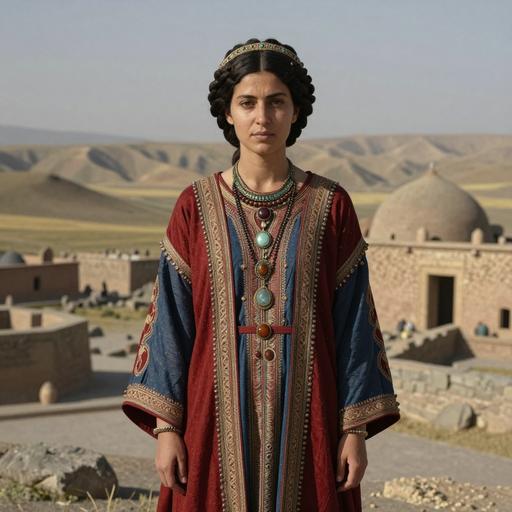
The Story
The journey of mtDNA haplogroup K1A4F1
Origins and Evolution
K1A4F1 is a downstream maternal lineage nested within K1a4 (itself a branch of haplogroup K), a clade with deep ties to Near Eastern and European Neolithic ancestries. The immediate ancestor, K1A4F, is inferred to have arisen on the Anatolian / Near Eastern frontier during the later stages of Neolithic-to-Chalcolithic population movements (user-provided estimate ~5.5 kya); K1A4F1 likely split from that upstream node shortly thereafter (~5.0 kya). As with other K subclades, K1A4F1 is defined by coding-region and control-region variants that place it as a low-frequency, geographically localized descendant of the Anatolian-derived Neolithic maternal gene pool.
Genetically, K lineages are characteristic of farmer-associated maternal ancestry in Europe and the Near East. The rarity of K1A4F1, relative to larger K subclades, suggests a history of localized founder events, genetic drift, and limited subsequent expansion compared with major European maternal lineages (for example H or U subclades).
Subclades (if applicable)
At present K1A4F1 is recognized as a terminal/near-terminal branch in available phylogenies (few or no well-differentiated downstream subclades are documented in public databases). The scarcity of observed variation within K1A4F1 reflects both its low modern frequency and limited sampling; discovery of additional complete mitogenomes from southern Europe, Anatolia, or ancient contexts could reveal further internal structure.
Geographical Distribution
Modern distribution: K1A4F1 is recorded primarily in southern European populations (Italy, Greece, Iberia, Balkans) with lower-frequency occurrences in western Europe (France, Britain) and the Near East (Anatolia, Levant). Small numbers appear in some Caucasus/anatolian-fringe groups and within certain Jewish communities and modern diasporas (Americas, Australia) as a result of historic and recent migrations.
Archaeogenetic evidence: K1A4F1 is currently rare in ancient DNA datasets; the presence of at least one securely-identified archaeological sample tied to this clade indicates the lineage persisted through historical periods in at least one local context and is not solely a modern phenomenon.
The pattern—concentration in the Mediterranean and southern Europe with low-frequency pockets elsewhere—fits a scenario in which the lineage arrived with or shortly after Anatolian-derived Neolithic farmers and remained most common in regions with substantial Neolithic farmer ancestry, later subject to drift and localized persistence.
Historical and Cultural Significance
Because K1A4F1 is a low-frequency maternal marker, it is not tied to a single large-scale, male-driven migration event; rather, its history is best read as part of the broader story of Neolithic farmer dispersal from Anatolia into the Mediterranean and subsequent population processes (local founder effects, isolation in mountainous or insular populations, and later historical mobility). Its modest presence in some Jewish and Levantine-derived communities likely reflects the shared Near Eastern maternal substratum and later geographic movements of those populations.
K1A4F1 is therefore most informative at regional and genealogical scales: finding the haplogroup in a person often points to maternal ancestry connected to southern Europe or the Near East, but its rarity limits strong macro-historical claims without corroborating autosomal or archaeological evidence.
Conclusion
K1A4F1 is a geographically focused, low-frequency mtDNA lineage derived from K1a4 that probably arose on the Anatolian/Near Eastern margin in the late Neolithic–Chalcolithic period and persisted mainly in southern Europe with secondary low-frequency occurrences in the Near East, parts of western Europe, and diasporas. Its scarcity in modern and ancient databases makes it a useful marker for fine-scale maternal ancestry when confidently called, but also means phylogeographic inferences should be made cautiously and in combination with broader genetic and historical data.
Key Points
- Origins and Evolution
- Subclades (if applicable)
- Geographical Distribution
- Historical and Cultural Significance
- Conclusion