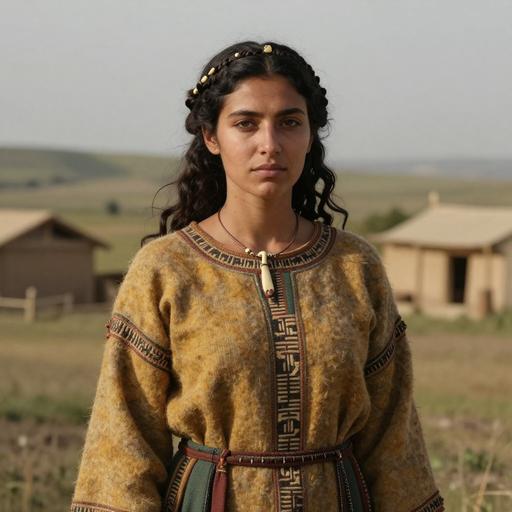
The Story
The journey of mtDNA haplogroup K1C1
Origins and Evolution
mtDNA haplogroup K1C1 is a downstream lineage of K1c (itself a branch of K) that most likely formed in the early Holocene in the Near East/Anatolia. Based on its phylogenetic position within K1 and the archaeological-genetic record for K1c, the most parsimonious estimate places K1C1's formation shortly after the Last Glacial Maximum as populations expanded and the Neolithic transition began (~8–9 kya). As with many K-derived lineages, K1C1 shows a pattern consistent with an origin in Near Eastern/Anatolian refugia followed by diffusion into Europe on Neolithic migration routes.
Dating of mtDNA lineages has uncertainties stemming from mutation-rate calibration and sampling, so the ~8 kya estimate should be understood as an approximate time to common maternal ancestry rather than a precise calendar date.
Subclades (if applicable)
K1C1 is a defined terminal clade beneath K1c. Compared with some other K sublineages, K1C1 does not yet have a large, deeply resolved set of widely reported downstream subbranches in the public literature; localized substructure has been reported in targeted population studies and ancient DNA samples, but many downstream branches remain rare or are only represented by a few modern or ancient individuals. Continued dense sampling and full mitogenome sequencing in regions of interest (Anatolia, the Levant, southern Europe, and Jewish communities) tends to reveal additional fine-scale subclades over time.
Geographical Distribution
The modern and ancient distribution of K1C1 mirrors the Neolithic dispersal routes from the Near East into Europe. It is observed at low-to-moderate frequencies in southern European populations (Iberia, Italy, Greece), in parts of Anatolia and the Levant, and at lower frequencies across central and western Europe, including the British Isles and Scandinavia in some studies. K1C1 has also been detected in Caucasus populations, coastal North African groups influenced by Near Eastern gene flow, and on Mediterranean islands (e.g., Sardinia and other insular contexts). Ancient DNA identifications (the user's database reports 42 ancient samples with K1C1) show its presence in archaeological contexts associated with early farmer communities as well as in later periods, supporting continuity and low-frequency persistence through multiple eras.
Historical and Cultural Significance
K1C1's primary historical signal is tied to the Neolithic transition: its pattern of occurrence in early farmer-associated contexts (for example, LBK and other early Neolithic groups) supports an association with the spread of agriculture from Anatolia into Europe. In later periods, K1C1 appears intermittently in Bronze Age, Iron Age, and historical-era samples, indicating persistence rather than a major secondary expansion. The haplogroup is also observed at low-to-moderate levels in some Jewish communities (including Ashkenazi groups in some studies), reflecting the complex regional history and founder events that affected maternal lineages in those populations.
Because mtDNA traces only maternal ancestry, K1C1 is best interpreted together with autosomal, Y-chromosome, and archaeological data to reconstruct demographic events. Its distribution highlights Near Eastern origins with Neolithic spread and subsequent low-frequency survival across Europe and parts of the Mediterranean.
Conclusion
K1C1 is a Near Eastern/Anatolian-derived mtDNA lineage that contributed to the maternal genetic makeup of early European farming communities and persists at low-to-moderate frequencies across southern and parts of central and western Europe, as well as in Near Eastern and some Mediterranean island populations. It provides a useful marker for studies of Neolithic dispersal and later regional demographic processes, but like many rare subclades, more complete mitogenome sampling — especially from under-sampled regions and ancient contexts — will refine its internal structure and historical trajectory.
Key Points
- Origins and Evolution
- Subclades (if applicable)
- Geographical Distribution
- Historical and Cultural Significance
- Conclusion