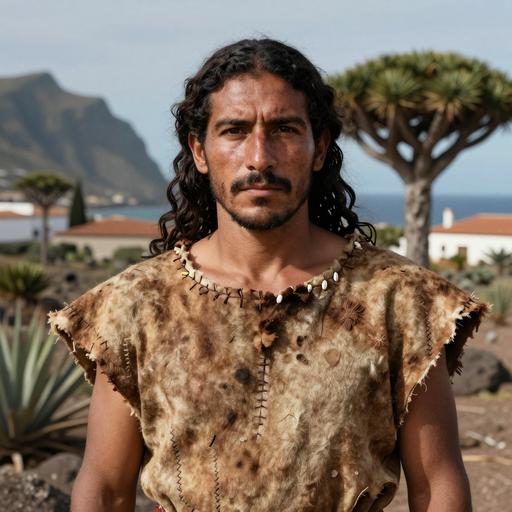
The Story
The journey of Y-DNA haplogroup E1B1B1B1
Origins and Evolution
E1B1B1B1 is a downstream lineage of the well-known North African Y-DNA lineage commonly referred to as E-M81 (E1b1b1b). Based on its position in the phylogenetic tree relative to E-M81 and the geographic clustering of detected samples, E1B1B1B1 most likely arose in the Maghreb after the initial E-M81 radiation. Molecular-clock and phylogeographic reasoning place its origin in the Late Bronze Age to Iron Age interval (on the order of ~~3.0 kya~~), younger than the parent E-M81 node which shows a Late Neolithic–Bronze Age origin in northwest Africa.
The lineage shows signals consistent with a regional founder effect and local diversification: many downstream branches are geographically concentrated in Amazigh-speaking areas, on oceanic islands, or in isolated mountainous enclaves. This distribution pattern is characteristic of a lineage that expanded locally and then produced several localized, star-like subclades.
Subclades (if applicable)
E1B1B1B1 contains multiple downstream branches that have been observed as locally restricted subclades in population surveys and targeted sequencing studies. While SNP nomenclature and exact terminal markers vary across published datasets, common patterns include:
- Island-specific or valley-specific lineages (e.g., private clusters in the Canary Islands and highland Amazigh communities).
- Shallow, star-like expansions consistent with a recent founder effect in particular communities.
Detailed naming and SNP resolution require targeted high-coverage Y-chromosome sequencing; population surveys using STRs and targeted SNP panels typically identify E1B1B1B1 as one of several regional sublineages of the broader E-M81 complex.
Geographical Distribution
E1B1B1B1 is concentrated in northwest Africa with the highest frequencies among Amazigh (Berber) groups of the Maghreb. Secondary, lower-frequency occurrences are found in the Iberian Peninsula (especially southwestern Iberia), the Canary Islands (ancient Guanche and modern island populations), parts of southern Italy and Sicily, and — at low levels — in Sahelian/West African populations and the Near East due to historical contacts.
The geographic pattern reflects both prehistoric expansions within North Africa and later historical movements (trans-Mediterranean contact, maritime colonization of islands, and historic trade or migration). The strongest signals of differentiation and high frequency are within Amazigh-speaking populations of Morocco, western Algeria and parts of Tunisia.
Historical and Cultural Significance
E1B1B1B1 is closely tied to the demographic history of northwest Africa. Its high frequency in many Amazigh populations makes it a useful marker for studies of Berber population structure, local founder events, and prehistoric/historic demographic processes in the Maghreb. Archaeological and historical contexts relevant to its spread and local prominence include:
- The Late Neolithic to Bronze Age demographic changes in North Africa that set the stage for later local differentiations.
- Island colonization events (notably the peopling of the Canary Islands) where E1B1B1B-derived lineages are well-documented among ancient Guanche remains and among modern islanders — indicative of early maritime contacts and subsequent isolation.
- Historical Mediterranean contacts (Phoenician, Roman, Islamic and later maritime movements) that account for scattered occurrences in Iberia, Sicily and elsewhere around the Mediterranean.
Because of its regional concentration, E1B1B1B1 is often invoked in genetic studies as part of the signature of North African ancestry in forensic, medical and population-genetic contexts.
Conclusion
As a subclade of the E-M81 complex, E1B1B1B1 represents a relatively recent Maghrebi paternal lineage that illustrates how regional founder effects and localized expansions shape Y-chromosome diversity. Its distribution — highest among Amazigh groups and present at lower frequencies in adjacent Mediterranean populations and island communities — reflects a combination of prehistoric demographic events in northwest Africa and later historical gene flow across the Mediterranean and into the Atlantic islands. High-resolution sequencing and improved SNP nomenclature will continue to refine the internal structure and exact age estimates of this and related subclades.
Key Points
- Origins and Evolution
- Subclades (if applicable)
- Geographical Distribution
- Historical and Cultural Significance
- Conclusion