The Story
The journey of Y-DNA haplogroup E1B1B1B1A
Origins and Evolution
Y-DNA haplogroup E1B1B1B1A sits as a downstream branch of the E-M81 (historically E1b1b1b1/E-V65 nomenclature in some older trees) family that predominates in the Maghreb. Based on the phylogenetic position relative to its parent clade and observed STR/SNP diversity patterns in modern samples, E1B1B1B1A most likely coalesced in Northwest Africa within the last ~1,500–2,500 years (we give an approximate age of ~2.0 kya). Its emergence reflects the dynamic demographic history of the region after the initial E-M81 expansion, including localized founder events and subsequent limited dispersals across the nearby Mediterranean and Atlantic coasts.
Subclades (if applicable)
E1B1B1B1A is itself an intermediate subclade within the broader E-M81 radiation. Where high-resolution SNP typing has been performed, researchers often find further internal structure indicating later, geographically restricted founder effects (for example island-specific or local Amazigh-enclave sublineages). In many published datasets the substructure is best seen in STR variance and in private SNPs found in isolated populations (e.g., Guanche-associated lineages). Ongoing sequencing efforts continue to resolve finer subclades; until broad sequencing is available, many downstream branches are described by private SNP clusters or local modal STR haplotypes.
Geographical Distribution
The modern geographic distribution of E1B1B1B1A is strongly concentrated in Northwest Africa (the Maghreb), with the highest frequencies among Amazigh (Berber) communities in parts of Morocco, Algeria and Tunisia. Island and coastal founder events are notable: the Canary Islands (ancient Guanche and modern islanders) retain elevated frequencies derived from Maghrebi sources, and pockets appear in southern Iberia (western Andalusia, Portugal) and parts of Sicily consistent with historical cross‑Mediterranean contacts. Background or low-frequency occurrences are reported in some Sahelian and West African groups (likely through regional admixture and historical movements), and small numbers appear in Near Eastern and eastern Mediterranean populations attributable to later historical gene flow. As expected, diaspora populations of North African origin (e.g., in the Americas and Europe) also carry the clade in the modern period.
Patterns of genetic diversity show reduced STR variation in island and isolated communities (a hallmark of founder effects), whereas continental Amazigh populations typically show greater internal diversity consistent with a longer regional persistence.
Historical and Cultural Significance
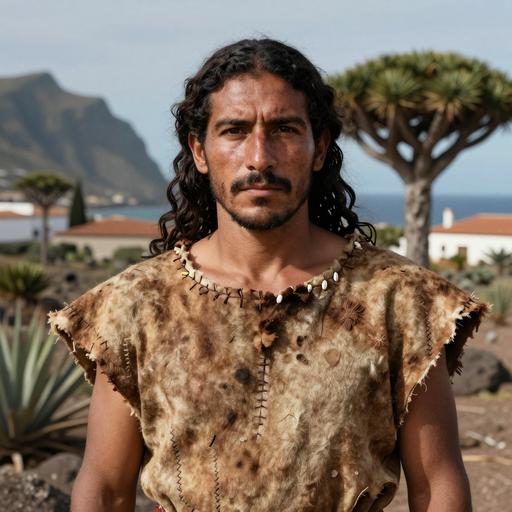
E1B1B1B1A is closely tied to Amazigh identity in population-genetic studies: it helps mark male-line continuity in many Berber-speaking groups and reflects demographic processes in the Maghreb during the late Bronze/Iron Age and historical periods. Its presence in the Canary Islands (Guanche) is consistent with a North African source for the pre-Hispanic island populations and contributes to models of maritime contact and settlement across the Strait of Gibraltar and nearby Atlantic routes. Low-frequency occurrences in southern Iberia and Sicily reflect multiple historical contacts — including Phoenician/Punic seafaring, Roman-era mobility, and later medieval and early modern Mediterranean interactions — rather than a single simple migration event.
From a cultural perspective, E1B1B1B1A is not tied to a single archaeological complex like Bell Beaker or Yamnaya; instead, its significance is greatest for regional North African demographic history, Amazigh ethnogenesis, and island founder effects (e.g., Guanche). Ancient DNA studies from North Africa and the nearby Mediterranean increasingly provide direct temporal context for E-M81-derived lineages, showing continuity and episodic gene flow over the last several thousand years.
Conclusion
E1B1B1B1A represents a geographically focused Maghrebi subclade of the broader E-M81 family, dating to the last few thousand years and shaped by local founder events and limited maritime dispersals. It is most informative for reconstructing recent male-line population structure in Northwest Africa, the Canary Islands, and adjacent coastal regions, and its further resolution through whole-Y sequencing will refine our understanding of Amazigh paternal lineage diversification and historical movements across the western Mediterranean.
Key Points
- Origins and Evolution
- Subclades (if applicable)
- Geographical Distribution
- Historical and Cultural Significance
- Conclusion