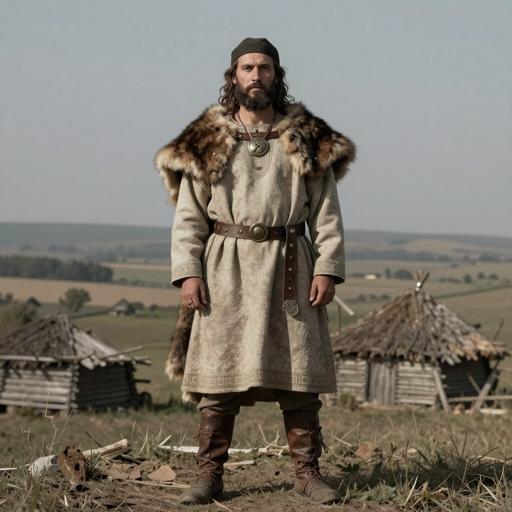
The Story
The journey of mtDNA haplogroup K1A4A1A
Origins and Evolution
mtDNA haplogroup K1A4A1A is a downstream subclade of K1A4A1, itself part of haplogroup K (a branch of U8/K clade). Given the established Near Eastern/Anatolian origin of K1A4A1 around the late Neolithic–Chalcolithic (~5.5 kya), K1A4A1A is best interpreted as a somewhat later offshoot that arose as populations derived from Anatolian and Levantine farmers dispersed locally and into adjacent regions during the later Neolithic, Chalcolithic and Early Bronze Age (roughly 4–3 kya). Its rarity and patchy distribution are consistent with a lineage that expanded only modestly and persisted at low frequencies through population turnovers and subsequent migrations.
Subclades
As a terminal or near-terminal branch reported as K1A4A1A, this lineage currently has few or no well-characterized downstream subclades in published phylogenies, and is usually treated as a fine-scale terminal designation used to tag identical-by-state or closely related full mitogenomes in databases. Continued mitogenome sequencing of ancient and modern samples may resolve further internal structure or identify closely related private mutations that define additional subbranches.
Geographical Distribution
The geographic pattern of K1A4A1A follows that of its parent clade: it is most often detected at low to moderate frequency in regions influenced by Neolithic farming expansions from Anatolia and the Levant. Confirmed and putative occurrences are concentrated in:
- Southern Europe (Italy, Greece, the Balkans, Iberia) where Near Eastern farmer maternal lineages integrated with local populations.
- Western Europe at low frequencies, usually as rare individual lineages likely reflecting later movements or low-level survival.
- The Near East and Anatolia, where the clade likely originated and persisted in low frequency.
- Caucasus and fringe Anatolian populations at very low frequencies.
- Modern diasporas (North and South America) as isolated occurrences resulting from recent migration.
Ancient DNA finds attributed to K1A4A1 and related K1A4 lineages in Chalcolithic and Bronze Age contexts support this broad, low-frequency distribution across the Mediterranean and Near East.
Historical and Cultural Significance
Because K1A4A1A descends from lineages associated with Anatolian/Levantine farmers, it is useful for tracking maternal gene flow associated with the spread of agriculture into Europe and later regional interactions. It occasionally appears in modern Jewish maternal lineages (rare), which is consistent with historical gene flow and population connections between the Levant, Anatolia and Mediterranean Jewish communities. The haplogroup is not linked to a single dominant demographic expansion (unlike some high-frequency mtDNA clades), but rather documents localized persistence and mixing over millennia — valuable for fine-scale population and forensic studies.
Conclusion
K1A4A1A exemplifies a low-frequency, regionally informative maternal lineage that likely formed in the Near East/Anatolia during the later Neolithic–Bronze Age and persisted in small numbers across Southern Europe and the Levant. It is primarily of research interest for reconstructing farmer-associated maternal ancestry and microevolutionary dynamics rather than representing a broad demographic replacement event.
Key Points
- Origins and Evolution
- Subclades
- Geographical Distribution
- Historical and Cultural Significance
- Conclusion